How long does it take to turn a mineral discovery into a producing mine. Also how long does permitting really take? These are questions that I see asked frequently in mining circles. The answer often thrown around is “18 years.” Is that really true or is it just a much-repeated industry myth?
Answering these questions is one reason we created a new online App called Timeline Viewer, hosted on the Drilling Down website (https://sites.google.com/view/drillingdown).
What Is the Timeline Viewer
The Timeline Viewer is a online application where anyone can take a look at the milestone history of selected mining projects. Key milestones are laid out chronologically from initial exploration, through studies, permitting, and sometimes even up to production.
The Viewer puts it all in one place: a visual, browsable record of what happened and when. This information is derived from corporate press releases, and weblinks are provided.
This App was vibe coded using the Zite platform (https://www.zite.com/). Just explain to the AI what you want to create, and it then writes all the code for you. Very simple to use and fast.
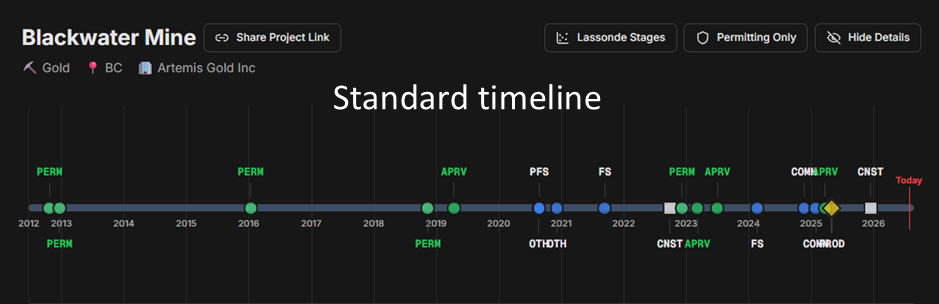
Let’s look at some Viewer output. The example below is the standard timeline view for the Brucejack Project in BC. One can see the sequence of activities that occurred over time as the mine moved into production. A details table (not shown) provides a brief description of each event. Hover over a point to see the details.
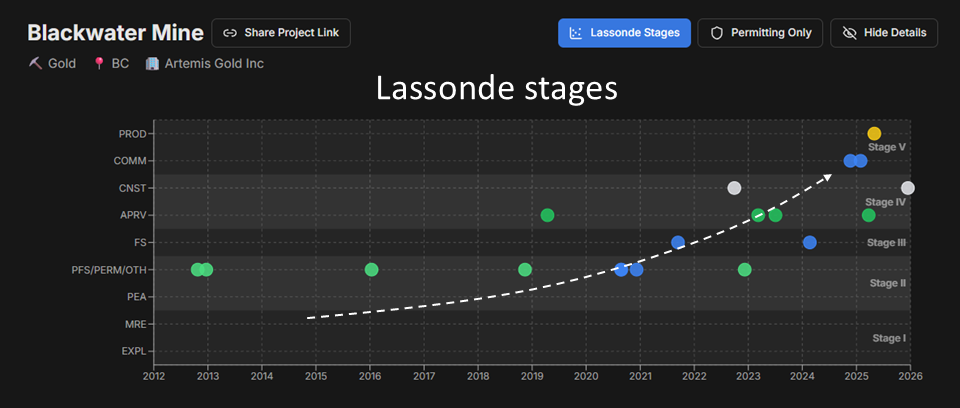
 An alternate way to examine the same timeline is to view the development progress in stages. In the Viewer app, we loosely use the term the “Lassonde Stages”, related to the Lassonde Curve (for more info). The Timeline Viewer lets you toggle on a view of the stages over time. Is it advancing towards production or flat lining at the same Stage.
For example, the image below shows the same Brucejack project with the Stages on the right side and milestones on the left axis. One can see the rapid rise as the project accelerates from exploration & studies (Stage II) to construction, commissioning, and production (Stage V). For comparison, the next image after Brucejack is the chart for the KSM Project. Do you notice any difference in the profile of the Stages?
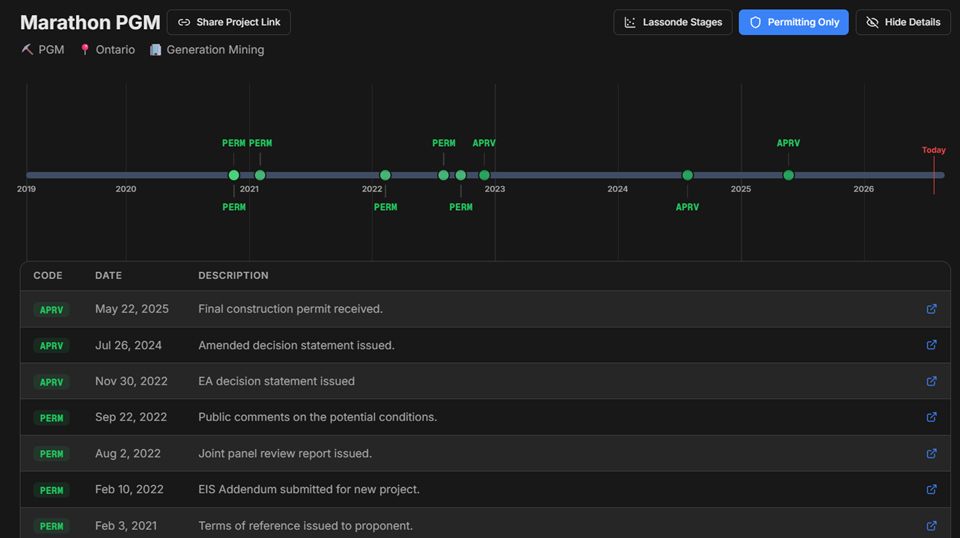
 The Viewer also allows one to see only the “permitting” events to focus on those. When was permitting initiated and when were approvals received? As an example, the timeline below is for the Generation Mining Marathon project, permitting activities only. They started the process in 2021 and received their federal final permit in 2025. The ball is in their court now.
Getting Started: The List of Projects
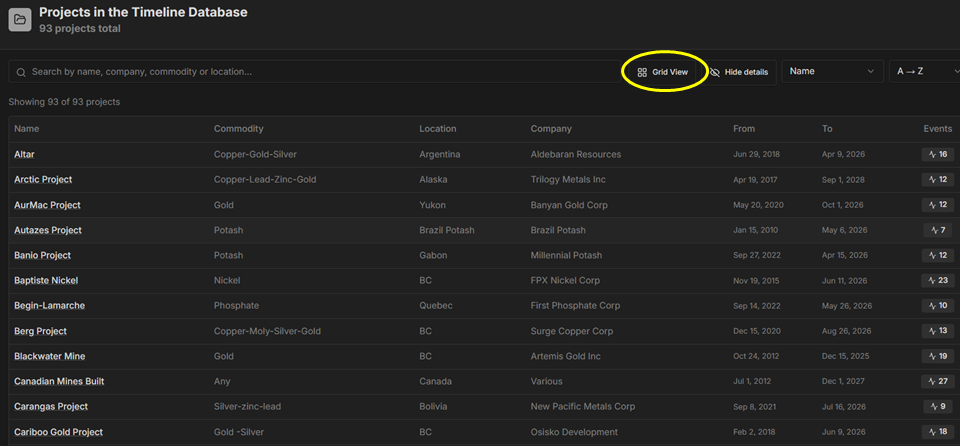
Before diving into an individual timelines, the obvious starting point is the List of Projects (https://jcrkyl7eju.zite.so/). This list gives you an overview of every project currently logged in the database (over 90 as of today).
You can browse the list in either Grid view or List view. Once you find a project of interest, clicking on it takes you to its timeline in the Viewer.
In the Viewer, (https://sites.google.com/view/drillingdown/timeline-viewer) you can trace the entire arc of a project’s development: when exploration drilling began, when a resource estimate was published, when studies (Preliminary Economic Assessment, Prefeasibility, Feasibility) were completed, when permits were approved, and when construction and commissioning eventually led to production. It’s a straightforward way to answer that “18 years” question for yourself, project by project.
Every milestone is categorized. The available categories cover the full lifecycle of a mining project: Exploration, Mineral Resource Estimate, Preliminary Economic Assessment, Prefeasibility Study, Feasibility Study, Permitting Activity, Permit Approval, Construction Start, Commissioning, Production, and a catch-all “Other” category for things like metallurgical testing, mergers, or partnerships that don’t fit neatly into the technical stages but are still significant to a project’s storyline.
All of the companies currently in the database (as of July 2026) are TSX listed. Many of their projects are in Canada, since government websites provide additional permitting timeline information as a backup. I noticed that some companies are much better at disclosing permitting steps than others. Its not often that I saw a company announce when public meetings were being held or when the public review period starts. I wonder why.
Why The Timeline Matters
For anyone following the mining sector, whether as an investor – analyst – geologist -engineer, the value of the Timeline Viewer is that it simplifies a series of press releases into a visual record.
You can look at different projects and start to notice patterns: which companies moved efficiently through permitting, which projects stalled for years at the exploration or pre-feasibility stage, and which ones sailed from discovery to production. Are there lifestyle companies out there in no hurry to get anywhere?
The Viewer is a tool for answering the “how long does it really take” question with actual information.
The Companion Piece: The Timeline Editor
The Timeline Viewer database is fed by a companion tool called the Timeline Editor, which is what allows the database to keep growing and stay current. The Editor is where the content gets compiled and maintained
If you’ve been following a specific project that isn’t in the database yet, you can add it yourself. Just send a message to KJKLTD@gmail.com to get access to the Editor. There is even a blank template available in Excel CSV format, so you can organize the project milestones on your own time and then upload them in the Editor.
One important thing to understand about this system is that it’s intended to be open source. Anyone who is given Editor access can modify a project’s timeline, which means there’s no absolute guarantee of accuracy on every entry. The information should be treated as crowdsourced rather than officially verified. Do not make investment decisions based on what you see here – this is for entertainment purposes only.
If you encounter a bug, issue or inaccuracy, please flag it by email (KJKLTD@gmail.com). We’re open to hearing comments, since nobody expects AI-written code to be 100% perfect.
Conclusion
 The Timeline Viewer is a simple tool for seeing how mining projects actually move (or don’t move) from discovery through to production. Over time as more projects get logged, the database becomes a richer resource for answering that original question honestly: does it really take 18 years to build a mine or how long does it take to permit? With enough timelines in the database, you can decide for yourself.
Note: You can sign up for the KJK mailing list to get notified when new blogs are posted. Follow me on Twitter at @KJKLtd for updates and other mining posts. The entire blog post library can be found at https://kuchling.com/library/
For some free mining calculator apps, including project timelines and a simplified cashflow modeller, check out this website https://sites.google.com/view/drillingdown
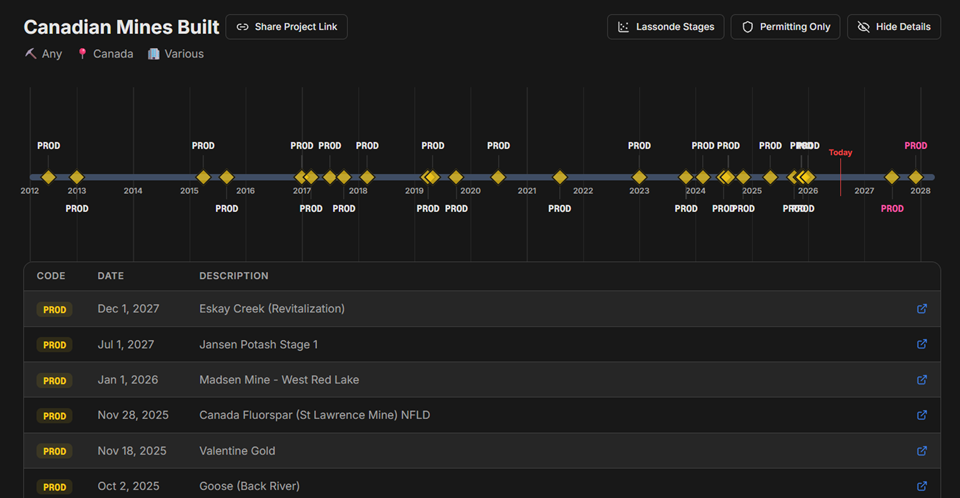
In closing, here is a summary timeline of all the mines coming into production in Canada over the last decade (from what I could find). The link to the timeline is https://neeovjtd7t.zite.so/project/3cd8bd8a-148f-4bc9-9bc3-fa56617f12d8