


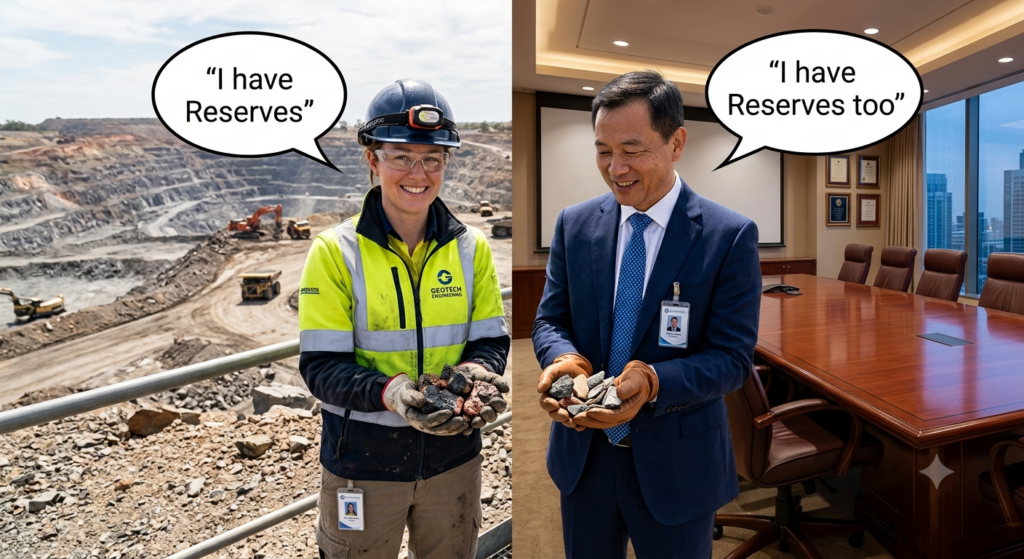
 (Posted 2022 Updated 2026) The mining industry reports their exploration results as either Mineral Resources or Mineral Reserves. Mineral Reserves are defined by having a mine in operation or by completing a pre-feasibility or feasibility study. Do the Resources and Reserves adequately reflect the reality of the mining industry? I would suggest perhaps using a three category approach would be more appropriate, for reasons described below.
The implementation of a three category approach would not result in any more technical effort. However, it would provide clarity for stakeholders and investors and enable the comparison of companies on a more equitable basis.
The issue
In today’s world, it is an onerous task to find, permit, finance, build, and then operate a new mine. Completing this process is a significant achievement that not many can undertake successfully.
An operating mine will be generating actual revenue (not paper revenue) and should be recognized for completing that big step. Hence does it make equitable sense for an operating mine to report Mineral Reserves while a junior company, that has simply completed a pre-feasibility study, also can report Mineral Reserves?
Both companies could report identical Reserve tonnes and grades, but those reserves are not the same. One company is operating a mine while the other may have spent a some months completing a study on paper. One company’s reserves will be mined in the immediate future, while the other company’s project may never see the light of day. Yet both companies are allowed to present the same Mineral Reserves. In this instance, some Reserves are more certain than others.
When a mine operates, their Reserves will gradually deplete over time. To mitigate this, a company can add to their Reserves by finding nearby satellite ore bodies or by converting Inferred resources into a higher classification. The net of the depletion and addition will be reflected in the annual Mineral Reserve Statement.
A company can also increase their Mineral Reserves simply by completing a pre-feasibility or feasibility study on a different project. However, would this be a true reflection of the Reserves upon which the company should be valued?
Suggestion – Let’s Go With Three
 I would suggest that instead of the two reporting categories, we think about using three, as described as follows:
1 – Mineral Resources (insitu): This category would be the same as the current Mineral Resources being reported according to NI43-101. It is based on reasonable prospects for economic extraction. Hence open pit resources would be reported within an optimized shell and underground reserves within approximate stope shapes. No external dilution or mining criteria would be applied, as is the current practice.
2 – Economic Resources: This would be the new category that would simply be the outcome from a pre-feasibility or feasibility study. These tonnes are currently designated as a “Mineral Reserve”. This Economic Resource would incorporate mining criteria, Measured & Indicated classes only, be based on a mine plan, and an economic analysis. This is how we currently define Reserves, even though the mine is not built yet and may never get built.
3 – Mineral Reserves: This highest-level category could be reported only once a mine has reached commercial production. The Economic Resources would automatically convert to Mineral Reserves once production is achieved. As the mine continues to deplete and as new ore sources are identified, the Mineral Reserves would increase / decrease. The Mineral Reserves would represent the remaining ore tonnage at an operating mine.
This three-category approach would help separate mine operators from development companies. The industry should recognize the difference between projects at different life-cycle stages. They are not all directly comparable. A junior explorer could be reporting huge Reserves, but without a mine being there, should that company be compared to a mine operator that has similar Reserves? If metal prices go up, one sees an immediate impact on the bottom line, while it has no immediate impact on the other.
The three-category approach would identify situations whereby a company suddenly reports a sizeable increase in Reserves on their annual statement. Is it because they found more ore at one of their existing operations (a great event) or because they did a paper study on a new project (not as exciting)?
If a mine gets placed onto care & maintenance, likely due to poor metal prices and economics, then the remaining tonnes at the mine would no longer be considered Mineral Reserves and may have to revert to Economic Resources, maybe even scaled back to Resource level only.
Examples
Out of curiosity, in 2022 I randomly selected three companies (Yamana Gold, Eldorado Gold, Alamos Gold) to compare their total Mineral Reserve tonnages based on their operations versus study stage development projects.
The percentage of Reserves provided by their producing mines varied and ranged from 14% to 51%. A significant proportion of their Reserves (49% to 86%) were still at the study stage. One or two large studies can boost the corporate reserves significantly. This is not immediately evident when looking at the total Mineral Reserves being reported because everything is lumped together.
For most junior miners 100% of their Reserves are at the study-stage. They should not be able to declare Mineral Reserves and appear to be on an equal footing with mine operators. Their mine may never get built.
Conclusion

The whole resource/reserve thing boils down to levels of risk on what is in the ground and whether it can become metal based on the assumptions made in the PFS/FS. I’m attracted to your suggestion because the level of risk is lower in an operation. In an operating mine, among other things you know the capital cost, the operating cost, mill recovery and have some reconciliation data available to firm up the reserve estimate. These are significant risks, even after a FS has been completed. So yes, I like this approach.