You read a lot these days about the push for more optimization in mining. Ore grades are declining and high-grade, easy-to-process deposits are becoming scarcer, forcing new projects to face greater risk. To compensate for this, miners are told to optimize and innovate more. They are doing both; including making technological gains.
Mining has gotten better at squeezing more value from each tonne of ore. So why do see mining projects still stumbling and everyone being pushed to do even more optimization?
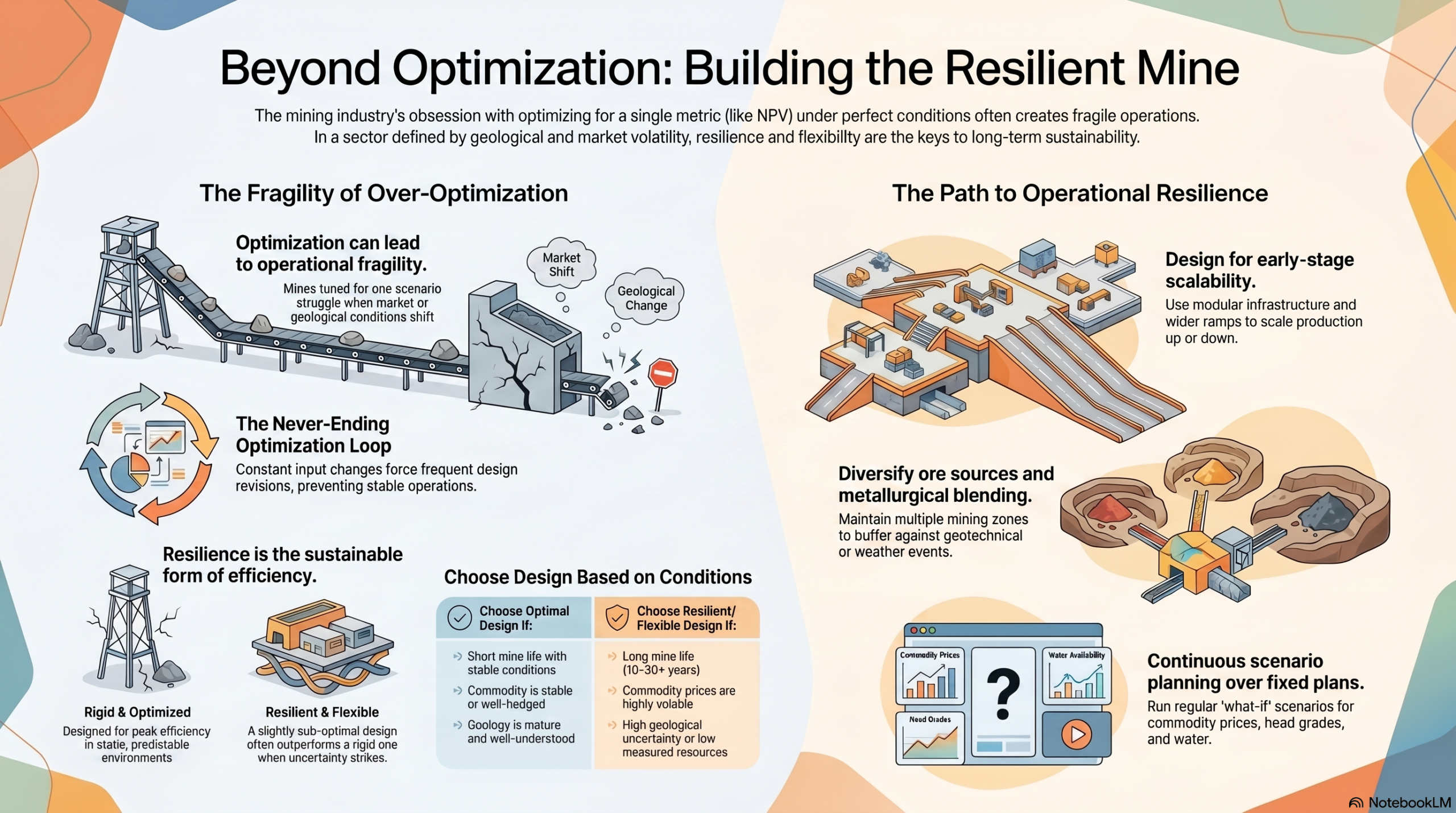
The answer may be that the industry is confusing optimization with resilience. A mine tuned to perform perfectly under one set of conditions may become fragile when those conditions shift. And in mining, things are always shifting. Maybe the head grades don’t meet expectations or metal prices collapse. Maybe there is a shift in community sentiment or a geotechnical surprise in the mine.
The pursuit of a single “optimal” outcome might leave projects well engineered, yet poorly equipped for reality. Flexibility (or resiliency) aren’t the enemy of efficiency; they may be the only way to make efficiency sustainable.
Which Aspects Should Be Optimized
 Is the concept of optimization the most important factor in a project’s design? If so, which aspect is the most important to optimize? A danger is optimizing for a single criteria, for example NPV, at the expense of everything else. Selecting the optimal design for one aspect will likely result in being sub-optimal in some of the others.
Once one has selected the aspect to optimize, the next issue becomes what to base the optimization on. Optimization typically is founded on a specific set of inputs. When these change, the optimized design will likely require revision. This then forces a new optimization, which can create a never-ending optimization loop because things are always changing in mining.
The design aspects that I have seen recommended for optimization range from:
-
optimize your drill hole locations
-
optimize your pit size
-
optimize your production schedule
-
optimize your throughput and/or recovery
-
optimize your water consumption
-
optimize your carbon footprint
-
optimize your project design
-
optimize your labour productivity
-
optimize either NPV, IRR, or payback
- optimize your metal production cash cost
There are a lot of suggestions and recommendations and people will have differing opinion on which are the most important optimizations. This opinion is typically driven by their own expertise or field of work, not necessarily by what is best for the project.
Optimal vs Resilient Design
 Optimization of a mining project can yield meaningful cost and efficiency gains. However mines face inherent constraints, such as ore grade variability, geological surprises, equipment life cycles, and regulatory issues.
Company success is typically driven by a broader set of variables: commodity price cycles, capital availability, asset portfolio quality, ESG and social license, M&A timing, and balance sheet strength. A perfectly optimized mine in a declining commodity or in a politically unstable jurisdiction may underperform a less-optimized mine in the right location at the right time.
Chasing optimization can sometimes lead to over-investment in a single asset, reduced flexibility, or operational fragility. The system performs well only under the ideal conditions.
Hence flexibility is important. If the mine plan is so rigid that it cannot pivot when a new high-grade zone is discovered or a pit wall becomes unstable, then one has optimized for a single scenario rather than for long-term resilience. Rather than designing for the “best case,” design for resilience.
Flexibility builds in the ability to scale production up or down, switch mining sequences, or pivot processing approaches as conditions change. Resilience has real value in mining, where geology, markets, and costs are unpredictable.
Flexibility identifies and can mitigate technical, geopolitical, regulatory, environmental, and market risks. The mines that do run into trouble rarely do so because they weren’t optimized; they fail because key risks weren’t anticipated or managed.
Workforce capability, safety culture, and leadership quality are key predictors of operational success. Optimization alone may not be able to address high turnover, poor safety records, and weak supervisory capacity. These can erode profitability far more than sub-optimal scheduling.
In my experience, the best operations have systems for ongoing learning and improvement rather than seeking a one-time optimal design. However, there is still a place for full optimization in some situations.
When does a flexible project design win?
-
Commodity prices are volatile up and down
-
Geological uncertainty is high (low proportion of Measured Resource)
-
Mining uncertainty (limited geotechnical investigations)
-
Long mine life (10–30+ years), where conditions will certainly change
-
Regulatory or social environments are unpredictable
-
Capital markets may require staged investment rather than full financing
When does an optimal project design win?
-
Shorter mine life where conditions are unlikely to change materially
-
Commodity is stable, well-hedged, or under long term offtake contract pricing
-
Geology and processability is well-understood (mature, well drilled-out deposit)
-
Capital is constrained and upfront efficiency is critical (you need to get it right)
Unfortunately some might view flexibility as a weakness. If a company has to change a plan or pivot, some will view that as a sign that the company is poor at planning and they don’t know what they are doing. In some cases, this might be true. Conversely the company may simply be reacting to unforeseeable outside influences.
The Path to Resiliency
 If one decides to pursue the path of operational flexibility, what are the things that help make it happen?
-
Design for flexibility at the start: Build project components that can scale up or down as needed. This might include wider pit ramps, larger infrastructure, some modularization in the processing system and the mine. Building a single rigid optimal design can be a trap. Open pit mines may be inherently more flexible than underground mines.
-
Maintain multiple ore sources: Maintain flexibility across different mining areas and ore zones with different metallurgy or head grades means one can blend ore as needed. Multiple mining areas provide flexibility in the case of geotechnical or weather events. Multiple stockpiling is also part of flexibility in design and operation.
-
Be careful consuming all high grade ore: In order to boost NPV, often most of the high grade ore is consumed early in the schedule, meaning the back part of the schedule relies on low grade material. This reduces economic flexibility if prices decrease in the future and may also miss out on the benefits if prices rise.
-
Real-time data collection and adaptive planning: Real time control systems let operations respond to actual conditions rather than following a fixed weekly plan. The idea is to shorten the time between observation and reaction, not to automate rigidly but enable the system to adapt rapidly.
-
Keep a cross-trained workforce: Operational flexibility may be enhanced if people can fill multiple roles. Cross-training operators means one can redeploy people as needed when conditions change.
-
Maintain financial health: A company with low debt, high cash assets, and easy credit access can keep a mine on basic functionality (or care-and-maintenance) rather than being forced to sell assets or close the doors during a downturn. Financial health will help ensure operational flexibility. The major miners already know this. The junior miners learn it the hard way.
-
Build supplier and contractor relationships before needed: Much like access to credit, long-term supplier arrangements might mean one can find labor and materials faster than competitors scrambling during downturns or upturns.
-
Scenario-plan continuously: Run multiple what-if commodity price, head grade, geotechnical & water management scenarios regularly during operations, not just at the feasibility or permitting stage. Operations change over time, and teams that have already pre-planned “what if this happens” respond better when it really happens.
Flexible mining operations may sacrifice a little efficiency at peak conditions and not meet the fully optimized vision. However this flexibility is a trade-off for the ability to stay profitable over a range of scenarios.
Conclusion
 Rather than focus on constant optimization in design, it may be wiser to focus on a flexible design. Adaptability, flexibility, and resilience may be more important than being fully optimized.
Modern mine planning is starting to consider Real Options Analysis and stochastic optimization (Monte Carlo simulation) to help quantify the value of flexibility. They may find that a slightly suboptimal design is actually worth more than a rigid optimized one when uncertainty is priced in.
Probabilistic analysis can provide some assistance by highlighting the impact of unforeseen events. However the key is not just to know the event’s impact, but also how will one respond even if there is only a 10% probability of it occurring.
Optimization may be great, but it isn’t everlasting. Squeezing the last dollar out of a plan may be less important than keeping a mine in business. A flexible plan may actually be the optimal plan.
*end*
In case you missed it, the last blog post was “The Surprising Parallels Between Junior Miners and Tech Startups“. The entire blog post library can be found at https://kuchling.com/library/
You can sign up for the KJK mailing list to get notified when new blogs are posted. Follow me on Twitter at @KJKLtd for updates and other mining posts.