


There is a unique paradox sitting at the heart of how the mining industry evaluates its projects. It’s called the Inferred Resource—now you see it, now you don’t.
A company can publish a Preliminary Economic Assessment (PEA) showing a mine life, a robust internal rate of return, and a strong net present value. That study can be based on mineral resources that regulators consider too geologically uncertain to support a production decision. These are the infamous Inferred resources: tonnes, grades, and dollars in the economic model, yet with a classification that effectively flags them as educated guesses. The PEA rules permit their inclusion because early-stage projects need a way to test whether chasing more resource certainty is worth the additional cost.
The paradox occurs when that same project advances to the pre-feasibility (PFS) or feasibility (FS) stage. Suddenly the Inferred ore tonnes are gone; they are now waste rock. The mine plan must be based on more certain Measured and Indicated resources. Theoretically, the life-of-mine production profile that looked compelling in the PEA may now shrink—so the NPV and IRR might shrink too. Nothing has gone wrong in any technical sense. The project simply requires a higher standard of certainty now.
Potentially, some investors who focused on the PEA economics may feel the subsequent feasibility study is a disappointment (especially if costs have also escalated). They’ll say the PEA is garbage. In reality, the project has moved from an aspirational study (i.e., the PEA) toward a bank-financeable study. To compensate for the loss of Inferred material, companies will rely of step out drilling to grow the resource to maintain size.
What Are Inferred Resources?
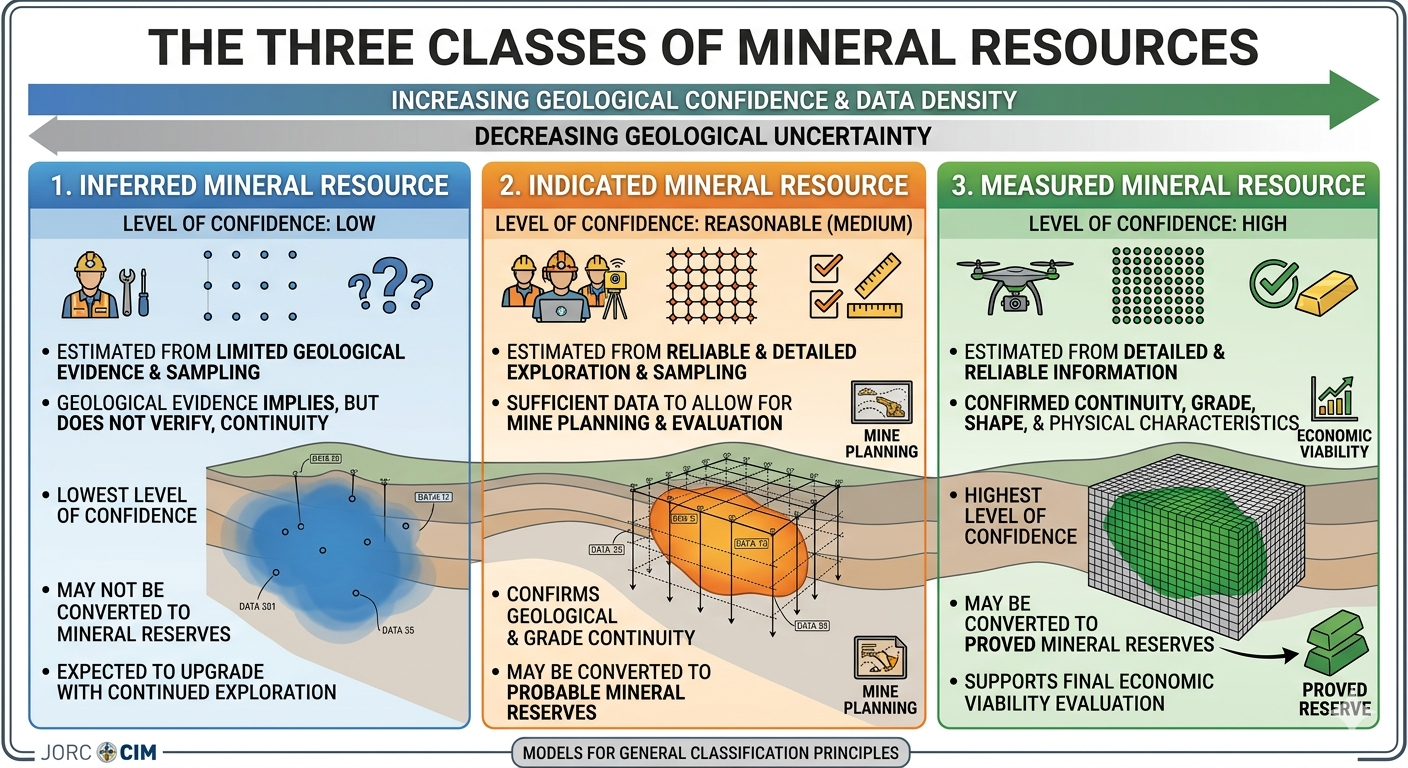 Inferred resources represent the lowest confidence category of mineral resources; typically estimated in zones with limited sampling and unconfirmed geological continuity. They carry the highest geological uncertainty of the three resource categories.
In Preliminary Economic Assessments (PEAs), Inferred resources are allowed—but only under certain conditions:
-
They can be included in mine plans and economic models, which is the reason PEAs exist: to allow early-stage projects to test economic viability using all available resource data.
-
However, any PEA that includes Inferred resources cannot be used to support a production decision and must carry prominent cautionary language. Under NI 43-101, the technical report must explicitly state that the PEA is preliminary in nature, that Inferred resources are too speculative geologically to have economic considerations applied, and that there is no certainty the PEA will be realized. (It seems a PEA without Inferred resources can be used to support a production decision.)
-
Inferred tonnes are routinely used to extend mine life or improve project economics in PEA studies. Investors must understand this risk and should examine the proportion of mined tonnage that is classified as Inferred. This breakdown is normally presented in the Technical Report.
Conversely, in Pre-Feasibility Studies (PFS) and Feasibility Studies (FS), the rules for Inferred material are different:
-
Inferred resources cannot be included in mineral reserve estimates or in the economic analysis underpinning a PFS or FS. Inferred “ore” is treated as waste rock.
-
Only Indicated and Measured resources can be converted to Probable and Proven mineral reserves.
-
Including Inferred material in a PFS mine plan would typically disqualify the study from being used for project financing or a production decision.
-
Some companies might include Inferred material in a PFS as “upside” or as a sensitivity case, but that analysis must be clearly distinguished from the base case.
The resource upgrade requirement (from Inferred to Indicated) creates some interesting dynamics:
-
Companies may need additional funds to drill sufficiently to upgrade the resource before advancing to the PFS/FS stage. The cost and time for this infill drilling can be a major driver of exploration spending and can delay project timelines. Mining projects can take a long time to develop, and this is one reason why.
-
Companies will look at ways to compensate for the Inferred material deduction. Cutoff grade changes and step out drilling are ways to mitigate this impact.
-
A large Inferred resource that cannot be upgraded without great cost (due to depth, remoteness, or lack of ore-zone continuity) can permanently stall a project at the PEA stage. Hence, one may see multiple PEAs completed on the same project (i.e., the PEA loop).
-
In closing, the peculiarity of the Inferred resource is that it is essentially a tiered permission structure. Inferred resources are useful for early economic screening, but they must be converted to higher-confidence categories before they can support a bankable study or project debt financing.
Permitting via a PEA
 Companies sometimes will commence the permitting process based on their PEA study. There are some risks to doing this, and the Inferred resource creates one of these risks.
With limited capital, a junior miner may not be able to afford the $5–20 million cost of a full feasibility study before determining whether a project is even permittable. A PEA, costing a fraction of a FS, can provide enough technical substance to engage regulators and begin the environmental baseline work that must precede any formal permit application.
Baseline studies for hydrology, ecology, and air quality typically require two to three years of data collection. So starting early makes sense, even with only a PEA-level project layout in hand.
Permitting and ongoing technical study work will run in parallel on most projects. Waiting for a completed FS before starting permitting would add years to the project timeline. Companies routinely will concurrently advance environmental impact assessments, indigenous consultation, and baseline data collection with subsequent PFS and FS work.
Jurisdiction may play a role too. Some areas are more receptive to early-stage permitting engagement. Other permitting processes may be more rigorous such that operators want at least a PFS in hand before committing to a full EIA process.
Now, with respect to the Inferred resource, the risk is that a project permitted around a PEA-scale footprint may shrink in size at the feasibility stage. Some reasons for this size reduction will be discussed in a future blog post, as well as the ways companies avoid this with ever increasing ore tonnage. Project shrinkage can result in a company acquiring permits and bonding for a proposed mine plan that no longer exists.
How Can Inferred Resources Affect Permitting
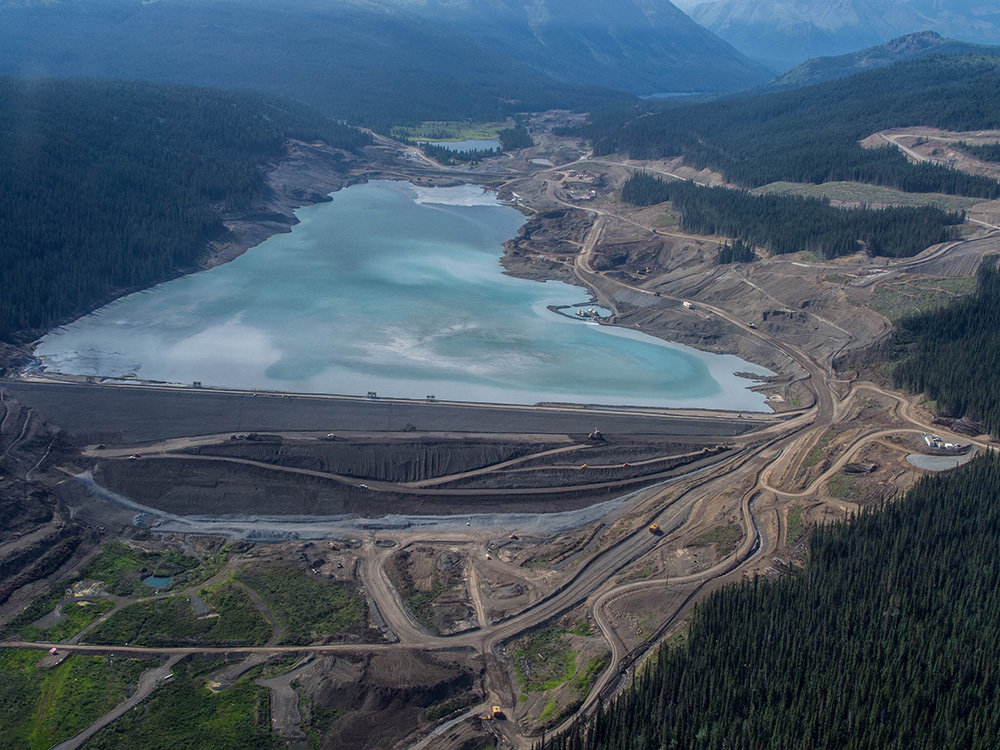 Let us examine some specific aspects of permitting that can be influenced by Inferred resources.
1. Project Footprint and Disturbance Area: Permits are issued for a defined physical footprint, consisting of pit limits, waste dumps, tailings facilities, and infrastructure corridors. If a PEA mine plan is inflated by Inferred tonnes and defines a large footprint versus the feasibility study, the company faces a choice:
(a) Permit the smaller FS footprint and risk under-permitting if Inferred is later upgraded. Requesting future permit modification for a suddenly larger project is sometimes viewed by regulators as “permitting by stealth”.
(b) Permit the larger PEA footprint to provide flexibility, which may trigger more extensive environmental review and higher bonding requirements.
2. Environmental Impact Assessment (EIA) Scope & Cost: A mine plan that includes Inferred material:
– May define a larger disturbance envelope, larger waste dumps, larger tailings facility, all of which require assessment of broader habitat, hydrology, and community impacts. Perhaps the project must advance into a new watershed. This can add permitting cost and time. If the Inferred material is later excluded, the assessment work may have been unnecessarily extensive.
3. Tailings and Waste Facility Sizing: Tailings storage facilities (TSFs) and waste rock dumps are sized to the life-of-mine tonnage. Inferred tonnes included in a PEA can drive facility sizing significantly. Permitting a TSF for a larger tonnage is:
– More difficult and time-consuming to obtain if the height and footprint increase
– Will be subject to more rigorous dam safety and closure review- However this could be potentially beneficial if the Inferred resource is later confirmed during mining
Conversely, I have seen situations where permitting was done on the pre-feasibility level design, thereby excluding Inferred ore from the plan. The operability of a planned co-disposal waste facility relied on relative ratios of clean waste rock, acid generating rock, and tailings. During production, the conversion of Inferred material from “waste” to “ore” would mean more tailings, less waste rock, and could shift the required material balance for co-disposal in a negative way. Permitting based on a PEA might make more sense here.
4. Financial Assurance and Reclamation Bonding: Regulators require bonds or financial assurances sized to the cost of full site reclamation. A larger mine footprint driven by Inferred tonnes means:
– Higher bonding requirements
– Larger financial burden on the company during the project development phase
– Potential difficulty for junior companies in securing bonds for Inferred-inflated footprints that have not been proven out yet.
5. Water Licences and Discharge Permits: Water use and discharge volumes scale with throughput and mine life. A longer mine life driven by Inferred tonnes may require expanded water licences. If those tonnes are later excluded, the licence may be oversized. Keep in mind that obtaining an amendment to increase a water licence later can be harder than acquiring a larger one initially, so there is a trade-off here.
6. Indigenous and Community Consultation: In jurisdictions with consultation requirements (Canada’s duty to consult, FPIC principles, etc.), the scope of consultation is tied to the project’s impact footprint and duration. A mine life extended by Inferred tonnes:
– Triggers consultation over a longer operational period
– May affect benefit agreement negotiations (royalties, employment commitments) tied to mine life or total tonnage
– If mine life subsequently shrinks at FS stage, it can create credibility and trust issues with communities who were counting on a longer mine life.
In closing, personally I feel that project proponents should try to permit to a footprint somewhat larger than the Pre-Feasibility base case to preserve operation flexibility. For more on the benefits of flexibility, see the blog post “Mining’s Obsession with Optimization – Good or Bad”.
Conclusion
 Inferred resources present a unique paradox; they can and can’t be used in mining economic analysis. They can be used to examine project viability but can’t be used to make a production decision.
The manner in which Inferred resources are viewed can also affect permitting. Although they don’t directly enter the regulatory process, they can shape the physical parameters of the mine plan that regulators will evaluate.
Even if a company grows the resource size between the PEA and PFS, there will still be a component of Inferred material within the PFS mine design that might be considered real tonnage or not.
Getting the permitted footprint right relative to the eventual resource confidence level is an underappreciated skill in project development. Each mining project is unique, and there is no easy one-size fits all solution when considering the impact of Inferred resources on project development.
