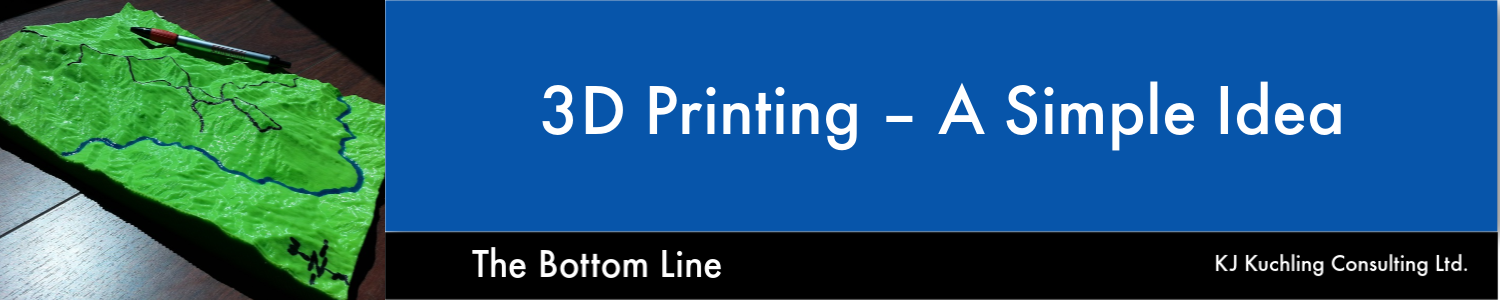
3D Printing – A Simple Idea


 Members of the engineering team were each given their own 3D model to take back to their offices. Putting one of these on your desk helps with familiarity of the overall site and allows you to better understand the siting and drainage issues.
Sometimes the WBS is forgotten
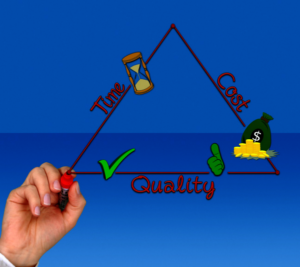 The WBS can provide the following information to the team:
Any study will benefit from a WBS
 Typically a WBS is developed for pre-feasibility and feasibility mining studies but is often ignored at the PEA stage. Some feel it is too detailed for that level of study. I don’t feel this is the case.
Conclusion
 The bottom line is that regardless of the level of study, a WBS should always be created.
 There are numerous factors that will influence the successful completion of a study. They can be related to the quality of the technical team, the budget, the time window, and direction from the Owner. However the key factor that I observed is the competency of the Study Manager (or Project Manager).
Study Managers must wear many hats
Studies can quickly grind to a halt
 The Study Manager also needs to understand the objectives of the Owner and ensure the team is working towards those objectives.
Environmental Assessments need engineering input
 Often the Environmental Impact Assessment is being conducted concurrently with an engineering study. The level of internal and external communication now becomes even more critical due to the large number of new technical disciplines involved.
You should approve the Study Manager
Conclusion
 The bottom line is that when a project Owner has received proposals for a study and is in the process of awarding that job, the most important consideration is who will be the Study Manager. If possible meet or chat about how they will manage the study and what their experience is. Check references if possible.
The RFP doesn’t need to be complicated
 Owner’s Perspective: preparing an RFP gives the opportunity to collect the Owner’s team thoughts on the scope of study needed, on the deliverables required, and on the timing. The RFP will outline this for the consultants and simultaneously help the owner’s team to get on the same page themselves.
What to include in the RFP
 The RFP sent to bidding consultants should contain (at a minimum) the items listed below. A sole sourced study can have a scaled back RFP document, but many of these key items should be maintained.
Specifying format makes it easier to compare proposals
 If a company is competitively bidding the study, it can be easier to compare multiple proposals if certain parts are presented in the exact same format. Usually different consulting firms have their own proposal format, which is fine, however certain sections of the proposal should be made easily comparable.
Conclusion
 The bottom line is that an owner should always take the time to prepare some type of RFP for any mining study they want to undertake. The owner should also request a consultant proposal based on that RFP, even if it is being sole sourced to just one consultant.

It’s like looking for a needle in a haystack.
 Data rooms are typically created for due diligence exercises, or during advanced an engineering stage. Regardless of the purpose, it is helpful for all involved to have a document control person who understands what is in the data room, what is important, and what is non-essential.
Organization of the mining data room is key
When using a cloud-based data room or FTP site, try to select one that allows bulk downloading of documents rather than only allowing one file download at a time.Conclusion
Read More on the Subject
 Over the past few decades I have worked in different consulting roles; as an independent consultant; as a member of a large consulting team; and as owner’s representative managing consultants. I have worked on projects where the mining company has their own external consultants that they have worked with for years (decades), learning that there are roles for both the independent consultant and larger consulting firms.
Independent Consultants
 Independent consultants part of the management team will differentiate themselves from large engineering firms in several ways.
Consultants and Stocks Options

Conclusion

 In my personal experience I find that larger consultants are best suited for managing the large scale feasibility studies. This isn’t because they necessarily provide better technical expertise. Its because they generally have the internal project management and costing systems to manage the complexities of such larger studies.
Sub-contracting Parts
 For certain aspects of a feasibility study, one may get better technical expertise by subcontracting to smaller highly specialized engineering firms. However too much subcontracting may become an onerous task. Often the larger firms may be better positioned to do this.
What about smaller studies?
 One of the purposes of an early stage study is to see if the project has economic merit and would therefore warrant further expenditures in the future. An early stage study is (hopefully) not used to defend a production decision. The objective of an early stage study is not necessarily to terminate a project (unless it is obviously highly uneconomic).
Conclusion
 A previous blog post, titled “PEA’s – Not All PEA’s Are Created Equal” , discussed that different PEA’s will consist of varying levels of detail. This is dictated by the amount of technical data available (or not available). But so too will different chapters in the same PEA be based on different data quality.
The level of detail justifiable
Conclusion
The bottom line is that it is important for the Study Manager and project Owner to ensure the entire technical team is on the same page.
 My recollection is that many years ago larger consulting firms would offer to do an entire study in-house. They would have the in-house team to cover almost the entire study. That approach seems to have changed and now the multi-company path is the norm.
The Study Manager is Key
The Study Manager must ensure that everyone understands what their deliverables are. Generally this is done using a “Responsibility Matrix”, but these can sometimes be too general.Make it important to speak up

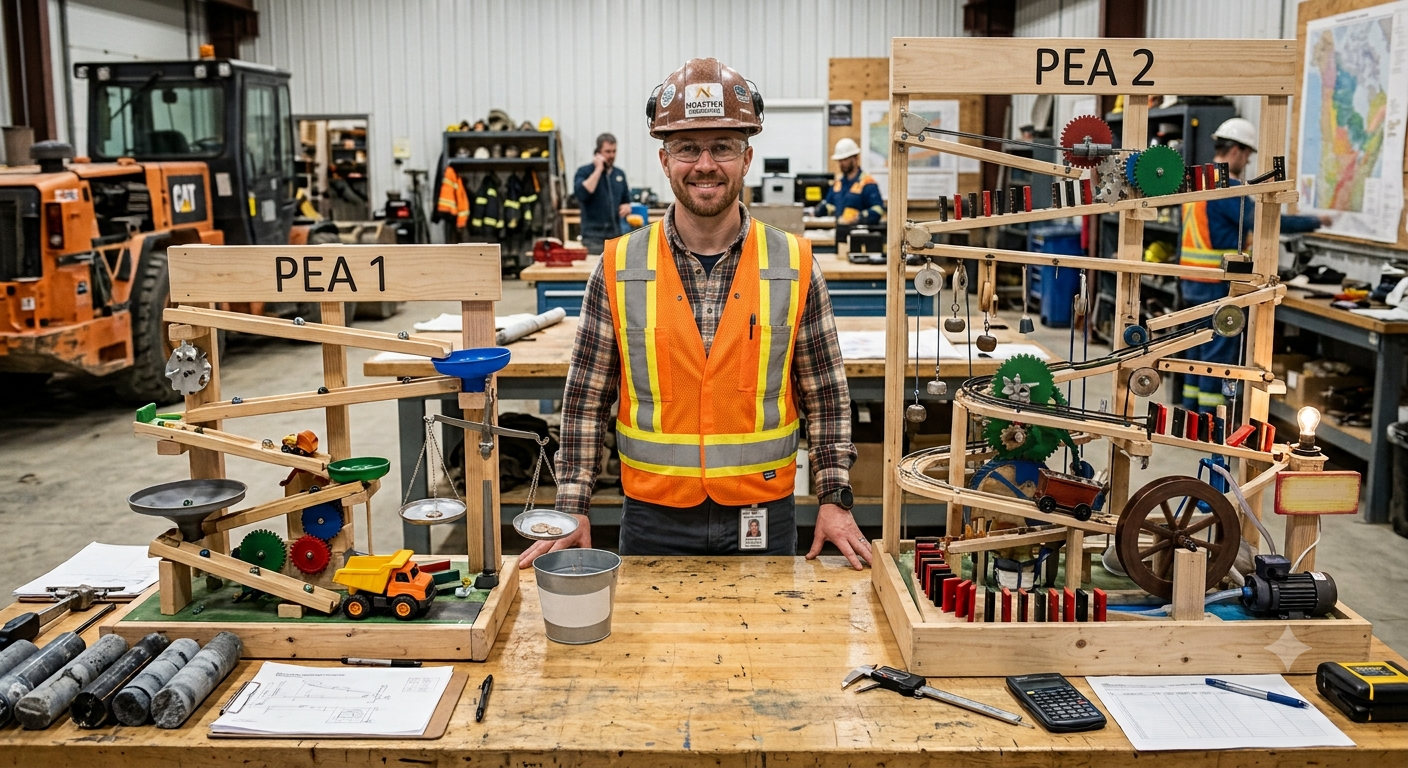 A Preliminary Economic Assessment (“PEA”) is defined by NI 43-101 as “…a study, other than a pre-feasibility or feasibility study, that includes an economic analysis of the potential viability of mineral resources”. The term “other” is fairly broad which provides plenty of flexibility. While there are generally accepted industry norms for a pre-feasibility (PFS) or feasibility study (FS), the mining PEA can actually have a broad technical scope. Some are more complicated than others.
Sequential PEA’s
 The PEA is developed at a fairly early stage in the project life. The initial PEA may be superseded with a series of updated PEA’s as more information is collected. Why is this done?
There is no right or wrong as to what constitutes a PEA.
 The securities commissions and NI43-101 consider that the cautionary language is an important component of any PEA Technical Report. They may red-flag it if cautionary language not in all the right places (that’s why you see it so often).
Conclusion
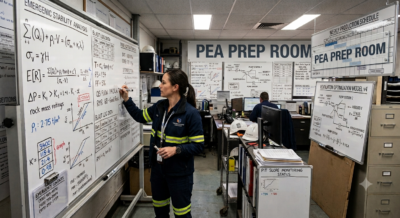 Often it seems that share prices do not move much with the disclosure of a new PEA. There is a lack of confidence in them. Conversely, one also hears that it is better for future financings if a mining project has at least reached the PEA stage. PEA’s … we either hate them or love them.
