
 Over my career I have been involved in a range of mine studies, from desktop conceptual to definitive feasibility. Each type of study has a different purpose and deserves a different level of input and effort Each can have significantly different costs to undertake.
I have sat in on some junior miner management discussions regarding whether they should be doing a PEA or a Pre-Feasibility Study, or a Feasibility instead of a Pre-Feasibility Study. Everyone in the room had their opinion on how to proceed based on their own reasoning. Ultimately there is no absolute correct answer but there likely is one path that is better than the others. It depends on the short and long term objectives of the company, the quality of data on hand, and the funding available.
4 types of mining studies
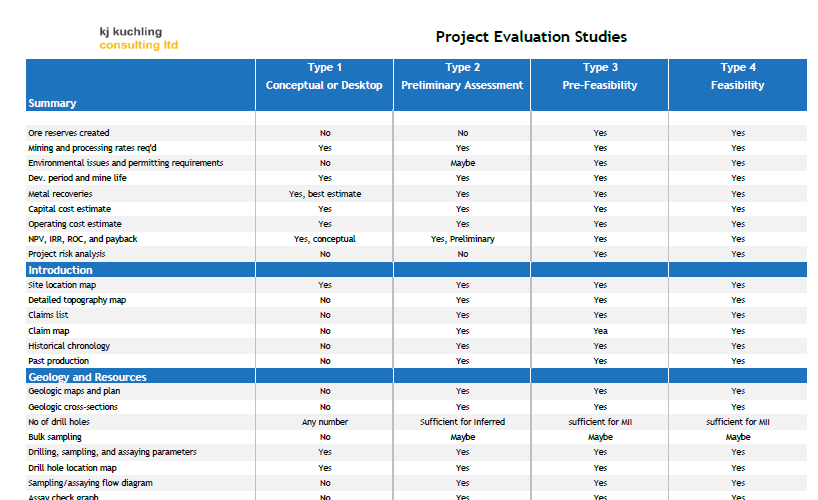
In general there are 4 basic levels of study, which are listed below. In this blog I am simply providing an overview of them. On the web there are detailed comparison tables, but anyone can contact me at KJKLTD@rogers.com for an a full copy of my table (an excerpt is shown below).
1. Desktop or Conceptual Mining Study
This would likely be an in-house study, non-43-101 compliant, and simply used to test the potential economics of the project. It lets management know where the project may go (see a previous blog at the link “Early Stage “What-if” Economic Analysis – How Useful Is It?”. I recommend always doing a desktop study, and preparing some type of small internal document to summarize it. It doesn’t take much time and is not made public so the inputs can be high level or simply guesses. This type of early stage study helps to frame the project for management and lets one test different scenarios.
2. Preliminary Economic Assessment (“PEA”)
The PEA (or scoping study) is generally 43-101 compliant and presents the first snapshot of the project scope, size, and potential economics to investors. Generally the resource may still be uncertain (largely Inferred classification), capital and operating costs are approximate (+/- 40%) since not all the operational or environmental issues are known at this time. Companies should avoid promoting the PEA as an “almost” feasibility level study. Investors should not view the PEA as a feasibility study just because it is 300 pages long with a lot of tables and charts.
Don’t Announce a PEA Until You Know the Outcome
I also recommend not announcing the start of a PEA until one is fairly confident in what the outcome of that PEA will be. A reasonable desktop study done beforehand will let a company know if the economics for the PEA will be negative, marginal, or great. I have seen situations where companies have announced the start of a PEA and then during the course of the study, things not working out economically as well as planned. The economics were poorer than hoped and so a lot of re-scoping of the project was required. The PEA was delayed, and shareholders & analysts negative suspicions were raised in the meantime.
The PEA can be used to evaluate different development scenarios for the project (i.e. open pit, underground, small capacity, large capacity, heap leach, CIL, etc.). However the accuracy of the PEA is limited and therefore I suggest that the PEA scenario analysis only be used to discard obviously sub-optimal cases. Scenarios that are economically within a +/-30% range of each other many be too close to discard at this PEA stage. This is where the PFS comes into play.
3. Pre-Feasibility Study (“PFS”)
The PFS will be developed using only Measured and Indicated resources (no Inferred resource allowed) so the available ore tonnage may decrease from a previous PEA study. The PFS costing accuracy will be greater than a PEA. Therefore the PFS is the right stage to evaluate any remaining mine development optional scenarios. Make a decision on the single path forward going into the Feasibility study.
Use the PFS to determine the FS case
More data will be required for the FS, possibly a comprehensive infill drilling program to upgrade more of the the resource classification from inferred to indicated. Many companies, especially those with smaller projects might skip the PFS stage and move directly to Feasibility. I don’t disagree with this approach if the project is fairly simple and had a well defined scope (i.e. mining method, throughput rate, site layout) at the PEA stage.
4. Feasibility Study (“FS”)
The Feasibility Study is the final stage study prior to making a production decision. The feasibility study should preferably be done on a single project scope. Try to avoid doing more scenario option analysis at this stage.
Smaller unsure companies should be careful about entering the FS stage. Once the FS is complete, shareholders will be expecting a production decision. If the company only intends to sell the project with no construction intention, they have now hit a wall. What is there to do next?
Sometimes management feel that a FS may help sell the project.
I don’t feel that a FS is needed to attract buyers and sell a project. Many potential buyers will do their own in-house due diligence, and possibly some alternate design and economic studies. Likely information from a PFS would be sufficient to give them what they need. A well advanced Environmental-Socio Impact Assessment may provide more comfort than a completed Feasibility Study would. Based on my review of project timelines, the Feasibility Stage is generally a significant trigger for someone with the intent to build the mine themselves. To learn more about Mine Builder vs Mine Vendors, one can find a blog at this link.
Conclusion