In a previous article I outlined my thoughts on the usefulness of early stage financial modelling (“Early Stage “What-if” Mine Economic Analysis – Its Valuable”). My observation was that it is useful to take a few days to build a simple cashflow model to help your team better understand your project.
By “simple” I mean really simple.
This blog describes one of the techniques that I use to take a super-quick look at any project; whether it is for a client wishing to understand his project at a high level; or whether it is a project that I have read about. There isn’t any actual study or production schedule available yet. Maybe there is only a mineral resource estimate available.
It takes about 10 minutes to plug the numbers into my template to get fast results. The image below is an example of the simple model that I use, but anyone can build one for themselves.

Screenshot of Simple Economic Model
I use the term one dimensional (“1D”) model since it doesn’t use the typical X-Y matrix with years across the top and production data down the page.
The 1D model simply relies simple on life of mine (“LOM”) totals to estimate the total revenue, total operating cost, and total profit. This determines how much capital expenditure the project can tolerate.
The only caveat is that you need to have some sense for operating and capital costs for similar projects. This analysis can be on both a pre-tax and simple after-tax basis.
Using estimated metal prices and recoveries, the first step is to calculate the incremental revenue generated by each tonne of ore (see a previous article “Ore Value Calculator – What’s My Ore Worth?”).
Next that revenue per tonne is multiplied by the total ore tonnage to arrive at the total revenue over the life of mine.
The second step is to determine the life of mine operating cost, and again this simple calculation is based on estimated unit operating costs multiplied by the total tonnages being handled.
The third step is to calculate the life of mine profit based on total revenue minus total operating cost.
The potential net cashflow would be calculated by deducting an assumed capital cost from the life-of-mine profit. The average annual cashflow is estimated based on the net cashflow divided by the mine life. An approximate NPV can be calculated by determining the Present Value of a series of annual payments at a certain discount rate.
The reasonableness of the 1D model will be examined via benchmarking and this will be summarized once completed. I will include a link to that future blog here.
You need to understand your project
 One can easily evaluate the potential impact of changing metal prices, changing recoveries, ore tonnages, operating costs, etc. to see what the economic or operational drivers are for this project. This can help you understand what you might need in order to make the project viable.
Conclusion
The bottom line is that a 1D economic calculation is very simplistic but still provides a vision for the project. The next step in the economic modelling process would be a 2D model based on an annual production schedule. The 1D approach is just a quick first step in looking at the potential. You can do it even when you only know the head grades and some generalized orebody information.
The two ways you can apply the simple 1-D model are:
-
evaluate the potential of early stage projects using cost inputs from other studies,
-
examine a project’s sensitives (units costs, recoveries, prices) by calibrating your simple model to the published study (i.e. use the same parameters and make changes as needed.
The entire blog post library can be found at this LINK with topics ranging from geotechnical, financial modelling, and junior mining investing.
Note: If you would like to get notified when new blogs are posted, then sign up on the KJK mailing list on the website.



 So there likely is a significant network of experienced people out there. It’s just a matter of being able to tap into that network when someone needs specific expertise.

 Mining companies are constantly in the media with stories of cost over-runs, mine shutdowns, fatalities, strikes & protests, and environmental incidents.
 The larger mining companies will always have their investors like pension funds and mutual funds, however the junior miners may be a different story.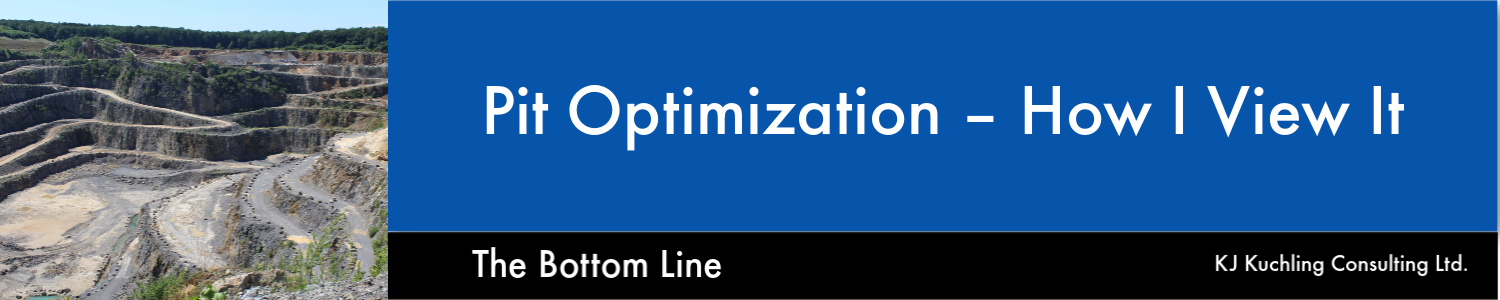
 One of the first steps in an open pit design is the pit optimization analysis. Pit optimization is used to define the most profitable pit shell for a given set of economic parameters. The economic parameters include the metal prices, processing recoveries, and site operating costs. Normally when optimization is done, a range of metal prices or Revenue Factors (“RF”) is used to develop a series of nested shells to understand how the pit will expand or contract with increasing or decreasing metal prices.
 Once the optimization step is complete, mining engineers will then design the pit inside that shell, introducing benches and ramps. The pit design should mimic the selected optimized shell as closely as possible.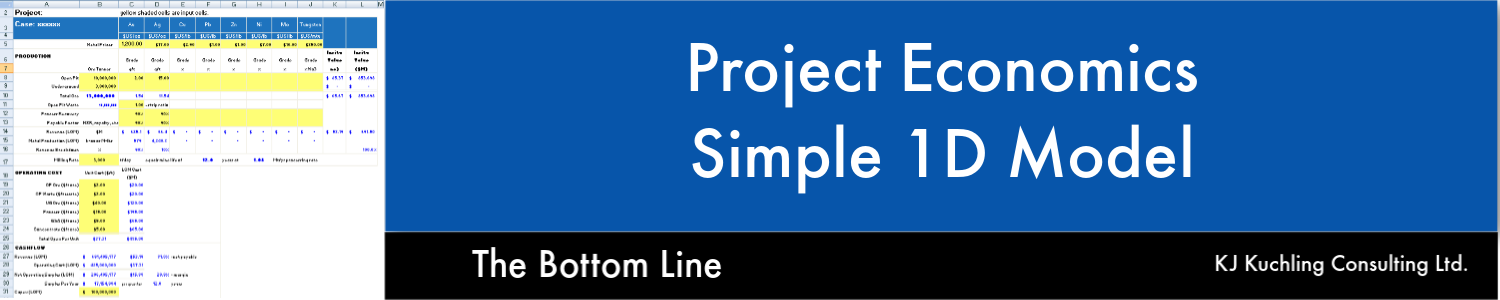





 There are numerous factors that will influence the successful completion of a study. They can be related to the quality of the technical team, the budget, the time window, and direction from the Owner. However the key factor that I observed is the competency of the Study Manager (or Project Manager).
 The Study Manager also needs to understand the objectives of the Owner and ensure the team is working towards those objectives.
 Often the Environmental Impact Assessment is being conducted concurrently with an engineering study. The level of internal and external communication now becomes even more critical due to the large number of new technical disciplines involved.
 The bottom line is that when a project Owner has received proposals for a study and is in the process of awarding that job, the most important consideration is who will be the Study Manager. If possible meet or chat about how they will manage the study and what their experience is. Check references if possible.
 One of my past roles was as a mine engineer on the Diavik diamond mine team. Pit geotechnical and hydrogeology were under my domain during project design and permitting from 1997 to 2000.
 The bottom line is that the directional drilling innovation makes a lot of sense and mine operators should take a look at it. It might help improve their pit dewatering systems.
 Data rooms are typically created for due diligence exercises, or during advanced an engineering stage. Regardless of the purpose, it is helpful for all involved to have a document control person who understands what is in the data room, what is important, and what is non-essential.