Watching the television news in Canada these days, one sees the environmental opponents of the oil sands parading around with signs that say “Stop the Tar Sands”. One way to distinguish whether someone is for or against the oil sands is to see what terminology they use. Do they call them “oil sands” (i.e. pro groups) or “tar sands” (i.e.anti groups)? Personally raw bitumen seems more tar-like than oil-like so the enviro’s seem to have it right.
Is it Oil Sands or Tar Sands
Going back many decades the oil sands were originally called the tar sands. I’m not sure when the terminology shifted, but in the mid-1960’s the first large scale mining operation was called Great Canadian Oil Sands (GCOS). I’m not sure why the terminology shift from tar to oil, but maybe it was related to the fact that “tar” was considered something of low perceived value while “oil” was considered something of high economic value.
 Look at what oil did for the economic situation of Jed Clampett on the Beverly Hillbillies. How about the show “Dallas”? There was also a lot of money and scotch drinking.
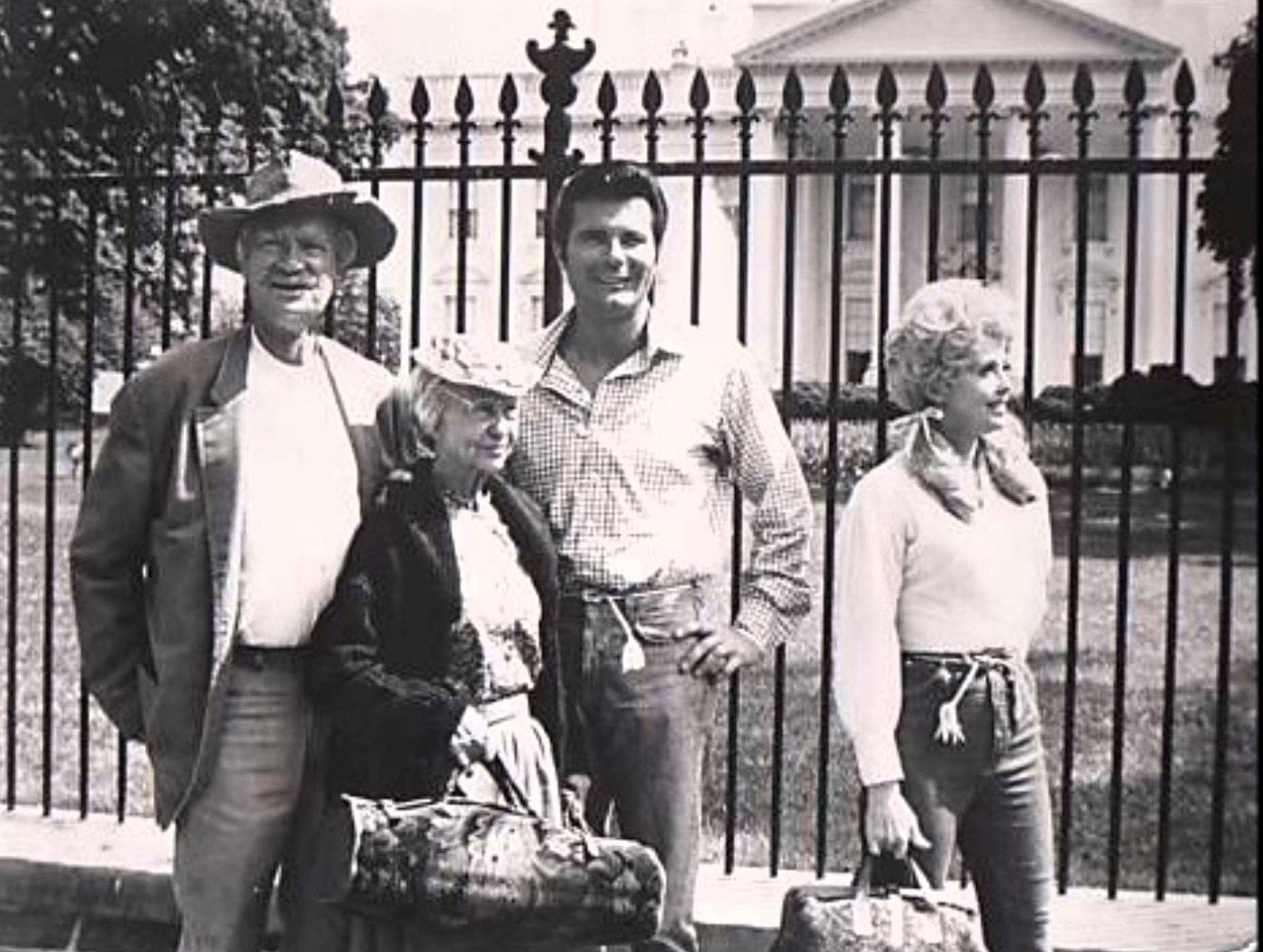
Back then we all wanted to discover an oil well in our backyard so perhaps the term “oil” implied some level of elegance and prosperity.
These days when one sees the term “oil” in the news, it tends to be associated with negatives. We see oil references to rail explosions, pipeline ruptures, tanker spills, job layoffs, fracing, carbon emissions, Middle East wars, and protests.
These days I don’t know if there is any intangible benefit in using the term “oil” to describe your product anymore. Maybe there is actually some intrinsic harm in doing so.
 Tar (or bitumen) on the other hand, is a molasses-like substance generally viewed by the public as a material used to repair our streets and patch our roofs. A tar spill is not going to flow anywhere; it will barely flow out of the tank it is held in. What is there not to like about tar?

So next time there is a protest with signs being held up to “Stop the Tar Sands”, the oil companies should shrug their shoulders, jump on the band wagon, and say “Yeah, tar, that’s us. So what are you worried about?”.
They should try to commandeer the word “tar” back from the protest groups since there really is nothing wrong with tar. There seems to be a lot wrong with oil.


 The WBS can provide the following information to the team:
 Typically a WBS is developed for pre-feasibility and feasibility mining studies but is often ignored at the PEA stage. Some feel it is too detailed for that level of study. I don’t feel this is the case.
 The bottom line is that regardless of the level of study, a WBS should always be created.


 There are numerous factors that will influence the successful completion of a study. They can be related to the quality of the technical team, the budget, the time window, and direction from the Owner. However the key factor that I observed is the competency of the Study Manager (or Project Manager).
 The Study Manager also needs to understand the objectives of the Owner and ensure the team is working towards those objectives.
 Often the Environmental Impact Assessment is being conducted concurrently with an engineering study. The level of internal and external communication now becomes even more critical due to the large number of new technical disciplines involved.
 The bottom line is that when a project Owner has received proposals for a study and is in the process of awarding that job, the most important consideration is who will be the Study Manager. If possible meet or chat about how they will manage the study and what their experience is. Check references if possible.
 One of my past roles was as a mine engineer on the Diavik diamond mine team. Pit geotechnical and hydrogeology were under my domain during project design and permitting from 1997 to 2000.
 The bottom line is that the directional drilling innovation makes a lot of sense and mine operators should take a look at it. It might help improve their pit dewatering systems.


 The RFP sent to bidding consultants should contain (at a minimum) the items listed below. A sole sourced study can have a scaled back RFP document, but many of these key items should be maintained.
 If a company is competitively bidding the study, it can be easier to compare multiple proposals if certain parts are presented in the exact same format. Usually different consulting firms have their own proposal format, which is fine, however certain sections of the proposal should be made easily comparable.


 Data rooms are typically created for due diligence exercises, or during advanced an engineering stage. Regardless of the purpose, it is helpful for all involved to have a document control person who understands what is in the data room, what is important, and what is non-essential.

 Over the past few decades I have worked in different consulting roles; as an independent consultant; as a member of a large consulting team; and as owner’s representative managing consultants. I have worked on projects where the mining company has their own external consultants that they have worked with for years (decades), learning that there are roles for both the independent consultant and larger consulting firms.
 Independent consultants part of the management team will differentiate themselves from large engineering firms in several ways.


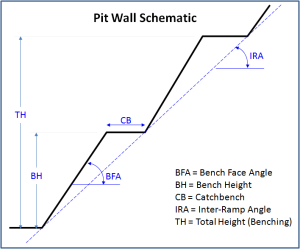
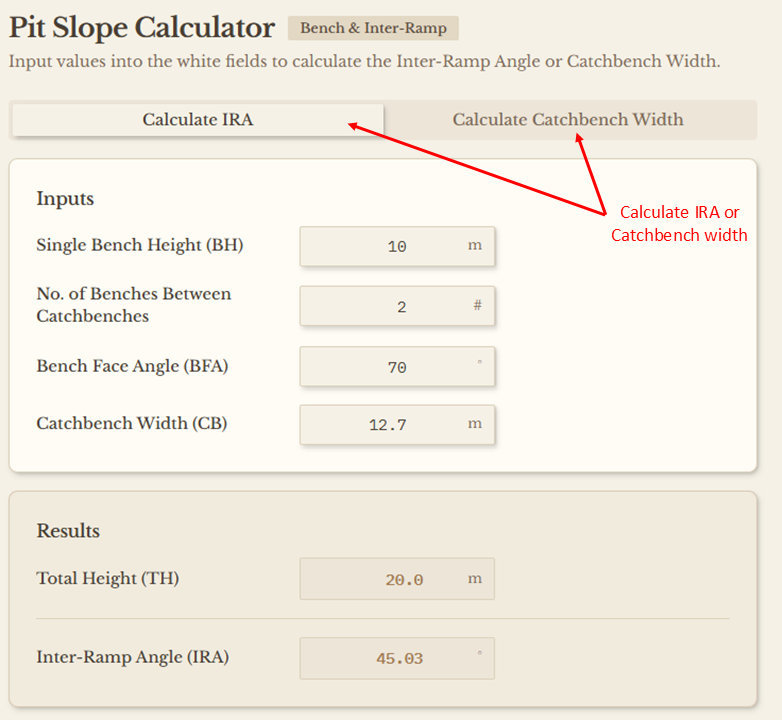
 An open pit wall will consist of a series of stacked benches. Geotechnical engineers will normally provide the pit slope design criteria based on the inter-ramp angle (“IRA”) for various sectors around the pit. The IRA represents the toe-to-toe slope angle, as shown in the diagram below.