Disrupt Mining Challenge – Watch for it at PDAC

Update:  This blog was originally written in January 2016, and has been updated for Jan 2018.

Gold Rush Challenge

In 2016 at PDAC, Integra Gold held the first the Gold Rush Challenge.  It was an innovative event for the mining industry.  It was following along on the footsteps of the Goldcorp Challenge held way back in 2001.
The Integra Gold Rush Challenge was a contest whereby entrants were given access to a geological database and asked to prepare submissions presenting the best prospects for the next gold discovery on the Lamaque property.  Winners would get a share of the C$1 million prize.
Integra Gold hoped that the contest would expand their access to quality people outside their company enabling their own in-house geological team to focus on other exploration projects.   In total 1,342 entrants from over 83 countries registered to compete in the challenge.  A team from SGS Canada won the prize.

Then Disrupt Mining came along

In 2017, its seem the next step in the innovation process was the creation of Disrupt Mining sponsoerd by Goldcorp.  Companies and teams developing new technologies would compete to win a $1 million prize.
In 2017, the co-winning teams were from Cementation Canada (new hoisting technology) and Kore Geosystems (data analystics for decision making).
In 2018, the winning team was from Acoustic Zoom, an new way to undertake seismic surveys.

The 2019 winners will be announced at PDAC.  The entry deadline has passed so you’re out of luck for this year.

Conclusion

At PDAC there are always a lot of things to do, from networking, visiting booths, presentations, trade shows, gala dinners, and hospitality suites.
Now Disrupt Mining brings another event for your PDAC agenda.
Note: You can sign up for the KJK mailing list to get notified when new blogs are posted.
Share

Meetups and Mining Millennials

mining millenials
Over the last year I have had many encounters with the Toronto tech start-up community.  I have noticed some similarities with the junior mining industry but some differences also.
The tech start-up model is similar to the junior mining business model as it relates to early stage funding followed by additional financing rounds.  One obvious difference is that mining mainly uses the public financing route (IPO’s) while the tech industry relies on private equity venture capital (VC’s).

There are also some less obvious differences.
Generally the tech industry is young, vibrant, technology-savvy, and applies the latest in social technology to collaborate.  The mining industry seems to be lagging behind on many of these aspects.
The following article will describe a few of my observations. As you read through this, ask yourself “Should the mining industry be doing these things?”

Tech Meetups and Networking

My first experience with the tech industry was associated with the many after-hours networking meetings called “meetups”.  They are held weeknights from 6 to 9 pm  and consist of guest speakers, expert panels, and for general networking purposes.   Often guest speakers will describe their learnings in starting new companies and failures they had along the way.

The meetups may also provide “how-to” advice for techniques like Google Analytics, Facebook advertising, Google Adwords, email marketing, etc.).
Attending these meetups is usually free.  They are typically held after hours at different tech company offices and they often provide free beer and pizza. One can see the entire industry working together for the betterment of the industry.

How to Organize Meetups

Scheduling of meetups is done via the online software platforms Meetup or eventbrite.  Both of  these work well for announcing the meeting notice and tracking signups and attendees.
By the way, meetups are not only tech-related; they are also held for interest groups for hiking, theatre, writing, yoga, business marketing, etc.  The platforms provide a good way to manage communities.  Unfortunately here in Toronto there are no geology or mining related meetups so the mining industry may be missing out on a good way to build a more collaborative community.
The mining industry does have some local meetings, as far as I know there are mainly three after-hour mining events.  The CIM has a monthly luncheon with a cost of $50-$65 (not exactly inclusive to everybody).   There is a Toronto Geological Discussion Group that holds monthly meetings and seems to be comprised of the older geologist demographic.  The third event is Mining 4 Beer, which a small group that meets intermittently at a local bar.  These few events limit the amount of buzz for those working in the mining industry.  There are a lot of mining companies here with a lot of mining people but not a lot of vibrancy.

Where to hold an event

Most of the tech meetups are held in local tech offices.  These offices are great. They have an open concept, pool tables, ping pong, video games, fully stocked kitchen. Who wouldn’t want to work there?
The last time I was in the offices of a large engineering firm I felt like a lab rat in a cubical maze.   I’m not saying engineering offices can switch to a tech office layout, but more enjoyment of the office environment might help draw more people to the mining industry.
Perhaps it’s easier to have a positive work attitude when money is being thrown at you (as is happening in the tech world) rather than having to scratch and claw for funds like mining must do right now.   However I suggest if one wants more smart young people to come into the industry then one needs to adapt.  This means more than just buying the latest 3D geological software.  It means creating an environment that people want to work in.
In the late 1990’s I was working in the Diavik  engineering office in Calgary.  They provided a unique office layout whereby everyone had an “office” but no front wall on the office so you couldn’t shut yourself in.  There were numerous map layout tables scattered throughout the office to purposely foster discussion among the team.


A similar type philosophy is used by Apple in their office layout design where even the kitchen placement has a purpose.  People should mingle and run into one another to promote conversation.  Discussion is good. Camping out in an office is not good.

Keep it short and to the point

Another thing I noticed with the tech industry is that when start-up tech companies are given an opportunity to tell their story, typically they only have 5 to 10 minutes to pitch.  No long winded thirty page PowerPoint presentation to explain what they are doing.
The tech industry is also big on the “elevator pitch”, a one minute verbal summary of what they are doing.  The tech people are taught to be concise.  If you can’t explain it in plain language in one minute then it’s too complicated.
For comparison, many mining investor presentations can be long, highly technical, and tailored to other technical people and not the average person.   One must ask who is the real target audience for those presentations?

Communication methods

The tech industry relies a lot on remote workers.   They might be overseas or spread around Canada. For communication and collaboration, they use various online systems such as Slack, Google Hangout, Trello.  No more  long email threads with five people cc’d on each email.   Slack uses a chatting approach, similar to text messaging, which makes it easier to follow the conversation and share files.
Can the mining industry be taught to use something new like Slack?  I don’t see a problem with that as long as one honestly wants to learn it. It’s really not that complicated.
For interest, another blog provides some more discussion on online collaboration software “Online Collaboration and Management Tools“.

Conclusion

The bottom line is that I can see a great difference in the attitude and atmosphere in the tech industry compared to the mining industry.  The junior mining game was the precursor for the tech start-up industry but has not kept pace with evolving work techniques.
As senior personnel retire from mining, the loss of this mining experience will be felt.  However the new ideas that may follow could be a positive outcome.
Share

New Mining Software and 43-101 Legal Issues

43-101 issues
NI 43-101 puts a fair amount of legal liability on the Qualified Person preparing a resource or reserve estimate or sign off on an advanced study.  The QP is to be responsible for the accuracy of their work and take legal responsibility.
Every so often some new mining software comes along and I often wonder what are the risks in using it? Some examples of new mining software that I have heard about (but not personally used) nor have seen mentioned in any 43-101 studies are SimSched, the ThreeDify’s software packages, NPV One, and Bentley.

Is the software doing everything correctly?

Given that as a QP I am legally responsible for my work, I am  bit apprehensive about how I can be assured the new software will provide reliable and accurate results for which I accept legal liability.  The last thing I would want to do is issue a public technical report which is found to be in error due to a software bug.
Irrespective of 43-101, if you are working at a mining operation the last thing you want to do is present management with an incorrect reserve, pit design, or production plan.
If you are a consultant, how agreeable will your client be when you tell him that his study was done using a novel software package and not one of the industry standard packages, and there was an error in it?
I recall working with a major mining company and there was a reluctance to adopt any new software that was unproven and not an industry standard.  Money was not the issue; the company’s concern  was with the risk in using unproven software.

What if you have a limited budget?

How do you view new software if you have a limited budget?   The new software may be cheaper, may appear to be be great, and may be a technological improvement and all at a lower cost.  However the software risk still remains.  There is no guarantee that all software output is correct simply because it comes from a computer.
As a QP, I suggest the onus is on the software developers to demonstrate that they can produce reliable and comparable results under all conditions.  They need to be able to convince the future users that their software is accurate.
Perhaps over time the new software will gain wider adoption and be generally accepted.  We may see more 43-101 reports that use it and hence it will get more overall acceptance.
Another question when developing a market for new software is whether it is better to focus on more consultant adoption or more mining company adoption?
Will mining companies use the software if their consultants are using it, or will consultants use it if more companies adopt it?  It’s an interesting discussion that new software vendors must deal with in trying to grow their market share.


Note: If you would like to get notified when new blogs are posted, then sign up on the KJK mailing list on the website. The entire blog post library can be found at this LINK with topics ranging from geotechnical, financial modelling, and junior mining investing.
Share

3D Printing – A Simple Idea

3D models
We hear more and more about 3D printing and what it is able to do. 3D printers have come down in price and can be bought for under $500.   Here is an example of using a 3D printer from a recent project that I consulted on.
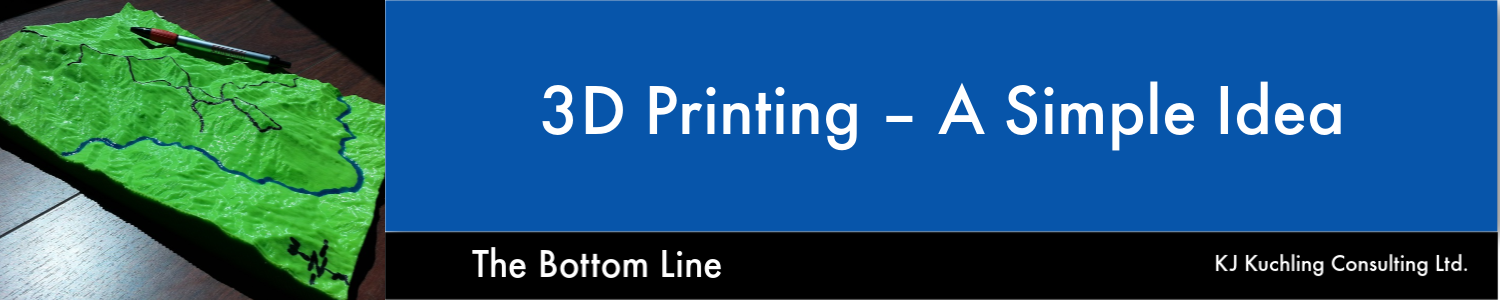
The open pit was going to be located in hilly terrain, and issues related to haul road access, waste dump sites, and leach pad location were all important.   The client used a 3D printer to create a small desktop model of the terrain, which was given to each of the consulting firms.
The photo below shows the scale of the model.
3D printed topographyMembers of the engineering team were each given their own 3D model to take back to their offices.  Putting one of these on your desk helps with familiarity of the overall site and allows you to better understand the siting and drainage issues.
Topographic maps may give data on actual elevations and distances, but even a small 3D model gives you a feel for the site.    The model shown above was for undisturbed topography but one could easily print off a similar model once the final pit and dump design is done.
With the current three-dimensional printing capabilities, creating simple 3D topographic models for the engineering team is feasible and I recommend doing so.
At the same time provide the Owner’s team with their own models, helping them understand the site issues that must be dealt with.
Share

Google Earth – Keep it On Hand

Mining studies
In a previous blog post “Mine Site Visit – What Is the Purpose?” I briefly discussed the requirements for a mine site visit to be completed by one or more Qualified Persons (“QP”) in a 43-101 compliant study.    Unfortunately normally the entire study team cannot participate in a site visit; however the next best thing may be Google Earth.

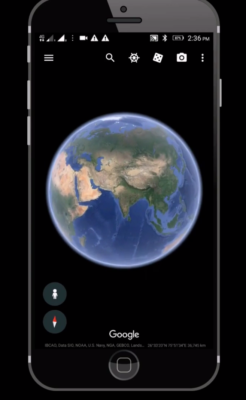
See the Mine Site with Google Earth

Gather your team around their computers and fire up screen sharing software like Teams, GoToMeeting, Skype, or Zoom.  Give control of the mouse to someone who knows the site well.  Here are some of the things you can do on your group tour.
  • You can fly-around the project site examining the topography.
  • You can view regional features, regional facilities, land access routes, and existing infrastructure.
  • You can measure distances (or areas), either in a straight line or along a zigzag path.
  • You can view historical aerial photos (if they exist) to show how the area may have changed over time.
  • You can import GPS tracks and survey waypoints.  If a member of the study team has visited the site with a GPS, they can illustrate their route and their observations.
My recommendation, at the start of a study, is to always have a Google Earth session with your technical team to examine the project site and the regional infrastructure.
A group session like this ensures that everyone sees and hears the same thing. It’s like taking a helicopter tour of the site with your entire study team at once.   A “helicopter tour” would be a good agenda item at the very first kickoff meeting.
Another option is to check the aerial photos and Bird’s Eye views on the Bing Maps website (www.bing.com/maps).  Sometimes those images will be different than what you will find in Google Maps or Google Earth.
As mentioned above, for those still interested the  previous blog post is at “Mine Site Visit – What Is the Purpose?
Note: If you would like to get notified when new blogs are posted, then sign up on the KJK mailing list on the website.  
Share