


There have been some LinkedIn discussions about why the mining industry needs to attract more young people. One of the selling points often mentioned is how mining gives a person the opportunity to experience the world.
 Based on my own career, mining has definitely provided me with a chance to travel the world. It will also help anyone overcome their fear of travel. One will also learn that both international and domestic travel can be as equally rewarding. There is nothing wrong with learning more about your own country.
The main purpose for my mining travel was due to either being a QP on a 43-101 study or visiting a site as a member of a due diligence team. Other reasons have been to provide engineering support at a mine site or to meet with management teams for risk or strategy planning sessions.
Over the last year I haven’t traveled as much as in the past. One reason is that not every QP working on a 43-101 report has to make a site visit. Fortunately, even when one doesn’t make a site visit, one still learns something about the local politics, legal system, infrastructure, and socio-economic situation in that country.
The map below shows places where I have been in my travels. It also shows the locations of studies I was involved it. Mining really is a global business. My map isn’t as cluttered as that of some geologists I know. Exploration and resource geologists will visit many more destinations that an engineer will. After all, every project needs exploration drilling and a resource estimate, but not all projects advance to the engineering stage.

For those thinking of getting into mining, here is my list of pros and cons based on my own travel experience. Not everything is great about travel but some aspects of it can be fantastic.
What’s Good
-
I had the opportunity to visit many places for which there is a zero probability that I would have ever gone as a tourist.
-
Typically long duration long distance flights are in business class. You get lounge access and the perks associated with executive travel. Less onerous short flights might be economy only, so be aware of your company policy.
-
All travel expenses, hotels, taxis, meals, etc. are paid for. Just don’t get too exorbitant when wining and dining. That’s the job of the senior person you are travelling with.
-
Upon arrival, often there will be a company representative to meet you at the airport. They speak the local language and will take you where you need to go. This saves you scrambling around an airport looking for a safe taxi to use.
-
You will get to meet local employees, go to dinner with them, travel around their country, and chat in the evenings. It’s a great way to learn about the people in the country you are visiting.
-
You will get to meet other technical people from around the world. They might be expats working at a mine site or simply part of a multidisciplinary engineering team on the same visit.
-
You will be whisked away from tourist traps and thus have an opportunity to see the real countryside.
-
You will hit the ground running, get to visit mine sites, see some real live rocks, drill core, pit walls, equipment at work, and things happening. You won’t get to see that while sitting in your downtown office.
What’s not so good
-
Unfortunately business trips are mostly of a very short duration since you’re not going there as a tourist. You’re being paid for your time and expertise.

-
Mining trips are usually not to majors centers, so once arriving in the country you really haven’t arrived yet. There might be more air flights or long pickup truck rides to get to the final destination. There can be a lot of waiting and the days can be long (and frustrating). I remember on trip in northern Russia where four of us with luggage were jammed into a Volkswagen Rabbit in a snowstorm. That two hour trip took five hours, but we were just happy to make it back to the hotel.
-
Sometimes your accommodations will be less than stellar, i.e. one star hotels or tents. So you’ll need to learn how to appreciate the charm of those places and not complain that it isn’t the Four Seasons Hotel.
-
Some travel locations can be potentially unsafe and require travelling security. That can lead to a bit of uneasiness. I recall a trip to northern Mexico where we had two armed guards travelling with us. I’m not sure if they were really needed and it was strangely more calming without them once they left.
-
Long east-west trips can leave you jet lagged and dog-tired. However the expectation is that at 7 am next morning you’re ready for breakfast and then head straight into the office. You’re being paid to get to work, not to sleep.
-
The site visits will be focused on collecting or reviewing data and then immediately travelling back home to write your report. Sightseeing opportunities can be limited other than what you will see during the course of your work. Sometimes you’ll get back home and think that you never really saw the place.
Conclusion
 Business travel has always been one of the best parts of my mining career. I can remember the details about a lot of the travel that I did. Unfortunately the project details themselves will blur with those of other projects.
When I do travel now, it’s a nice change if just one flight gets you to your final destination.
During this Covid period, international travel is greatly restricted. It will be interesting to see how soon things can return to normal, if they ever do. To miss out on the travel aspect of a mining career would be a shame, unless the only travel you want to experience is sitting on public transit for a few hours each day.
By the way, my all time favorite place for a mining trip is…..Argentina. It’s a long way from Toronto, but well worth it.


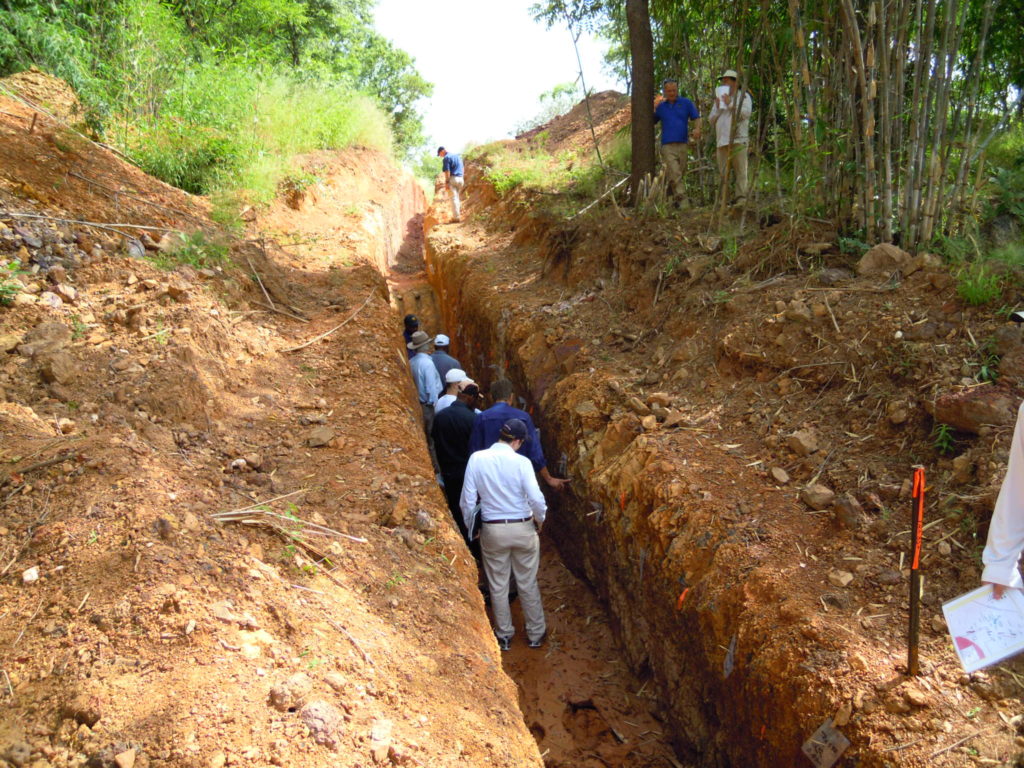 While waiting for various third-party due diligences to be completed, the company continue to do exploration drilling. There were still a lot of untested showings on the property and geologists need to stay busy.
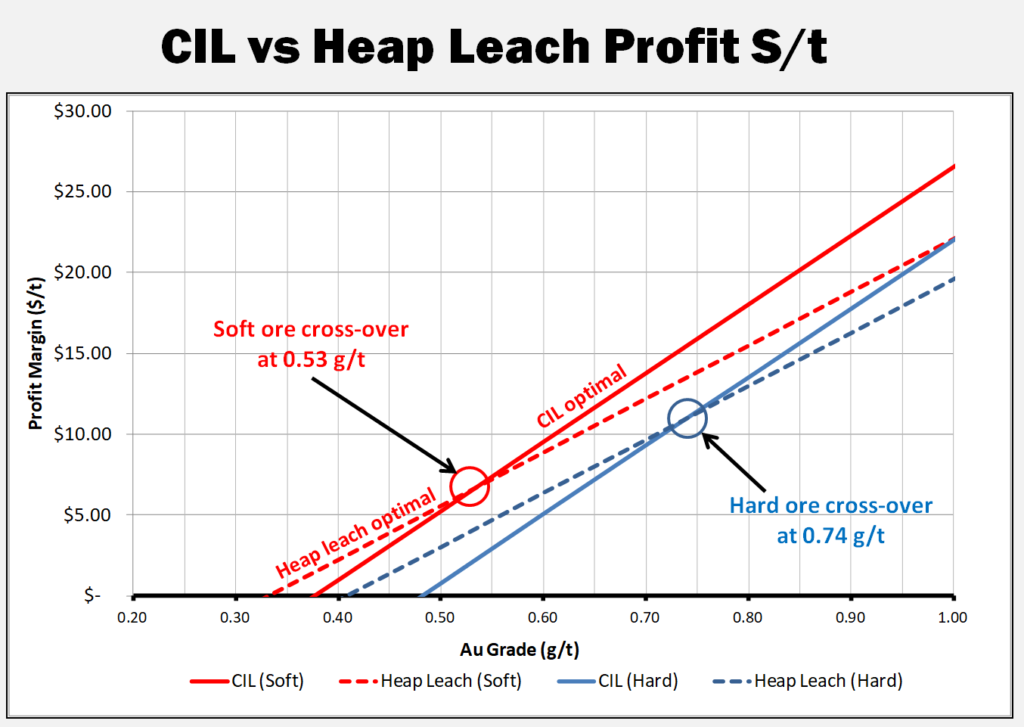
 With regards to the Heap Leach PEA, we did not wish to complicate the Feasibility Study by adding a new feed supply to that plant from mixed CIL/HL pits. The heap leach project was therefore considered as a separate satellite operation.
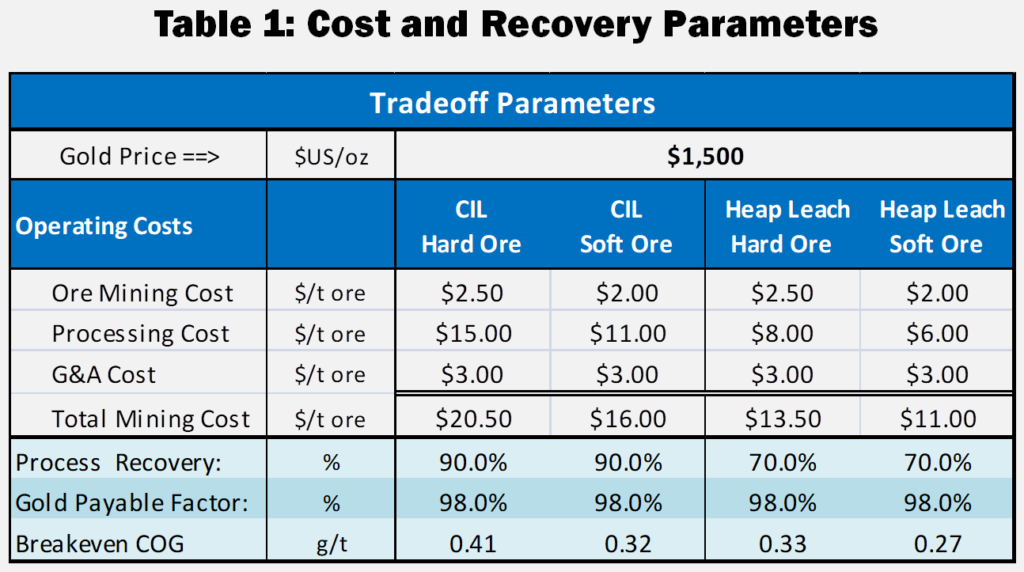
 I have updated and simplified the trade-off analysis for this blog. Table 1 provides the costs and recoveries used herein, including increasing the gold price to $1500/oz.
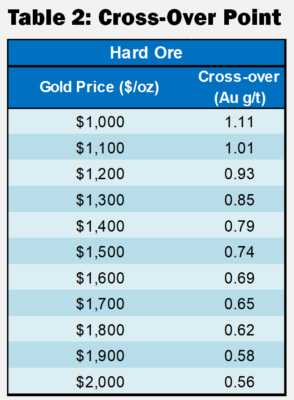 These cross-over points described in Table 2 are relevant only for the costs shown in Table 1 and will be different for each project.
 Normally I don’t write about mining stock markets, preferring instead to focus on technical matters. However I have seen some recent discussions on Twitter about stock price trends. For every stock there are a wide range of price expectations. Ultimately some of the expectations and realizations can be linked back to the Lassonde Curve.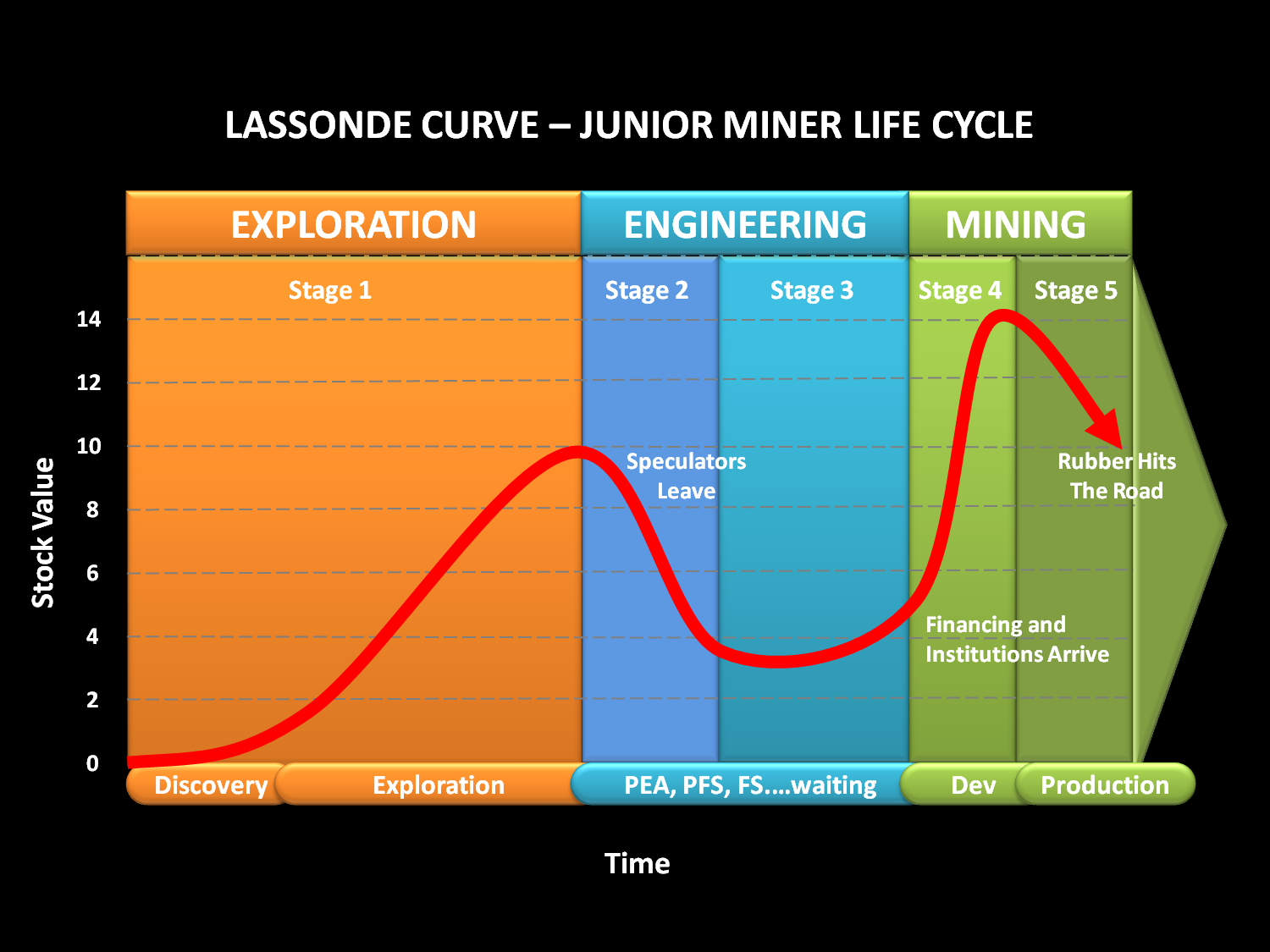

 Stage 5 is the start-up and commercial production period, possibly nerve-racking for some investors. This is where the rubber hits the road. The stock price can fall if milled grades, operating costs, or production rates are not as expected.
 Some corporate presentations will highlight the Lassonde Curve, particularly when they are rising in Stage 1. You are less likely to see the curve presented when they are rolling along in Stages 2 or 3.
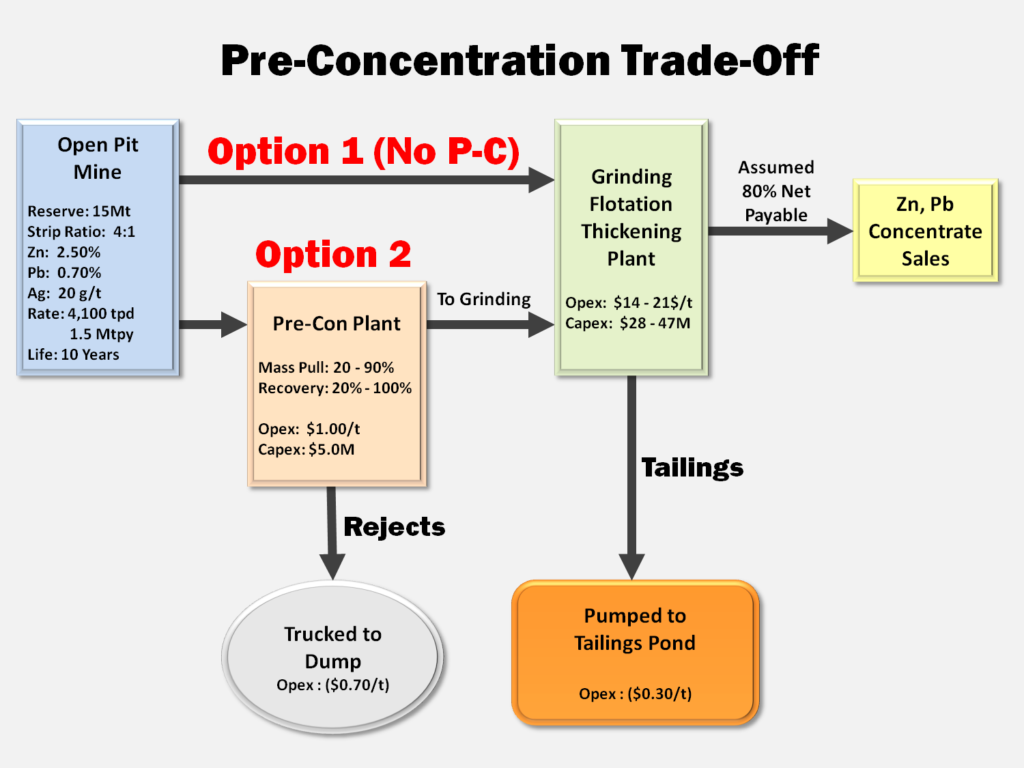
 Concentrate handling systems may not differ much between model options since roughly the same amount of final concentrate is (hopefully) generated.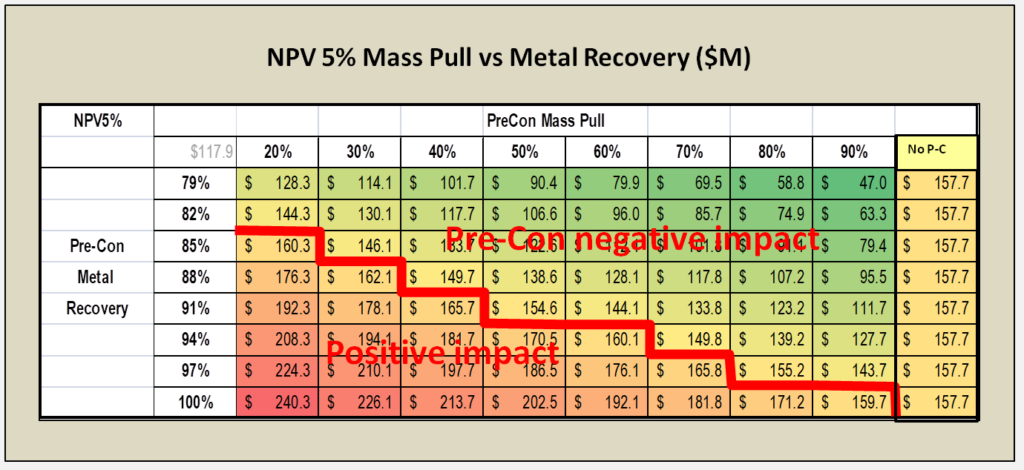
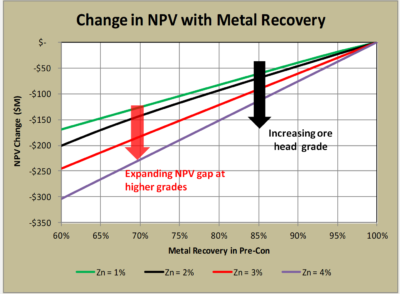 4. The head grade of the deposit also determines how economically risky pre-concentration might be. In higher grade ore bodies, the negative impact of any metal loss in pre-concentration may be offset by accepting higher cost for grinding (see chart on the right).
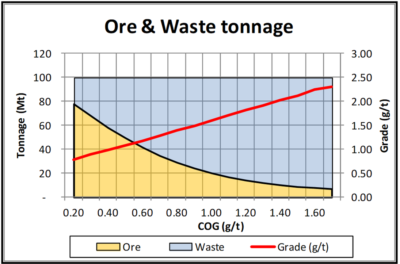 I had a grade tonnage curve, including the tonnes of ore and waste, for a designed pit. This data is shown graphically on the right. Essentially the mineable reserve is 62 Mt @ 0.94 g/t Pd with a strip ratio of 0.6 at a breakeven cutoff grade of 0.35 g/t. It’s a large tonnage, low strip ratio, and low grade deposit. The total pit tonnage is 100 Mt of combined ore and waste.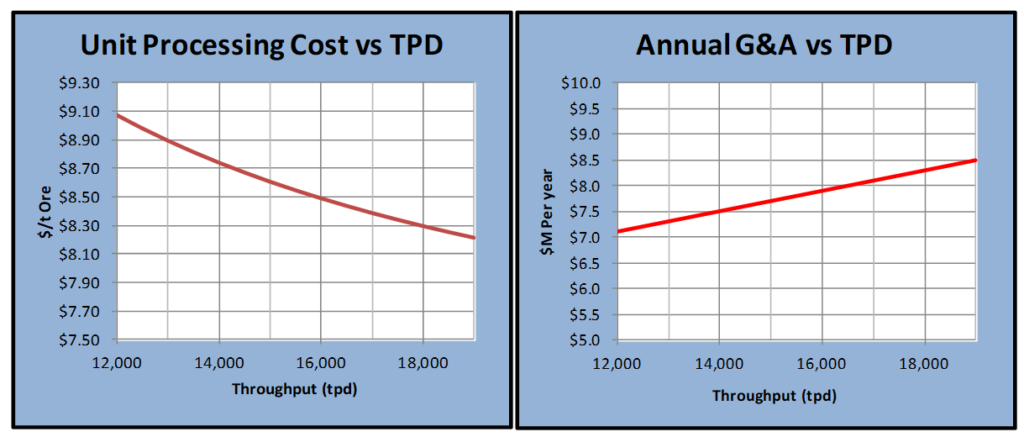

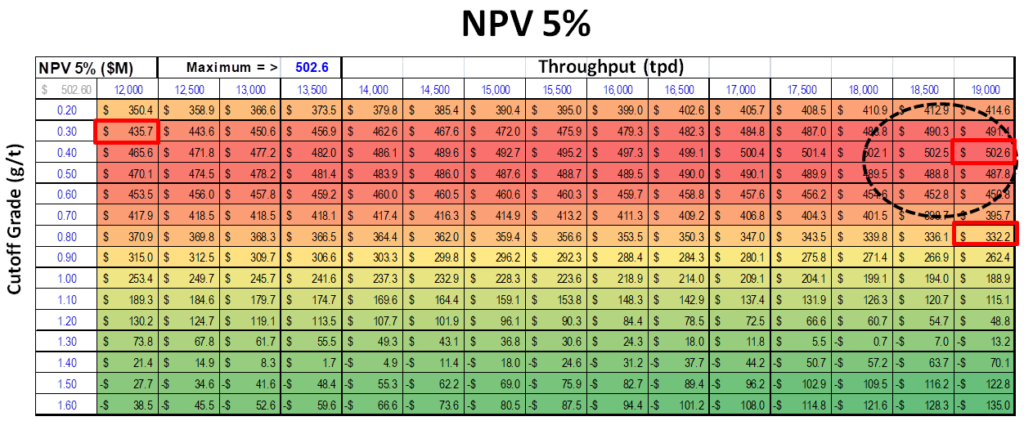

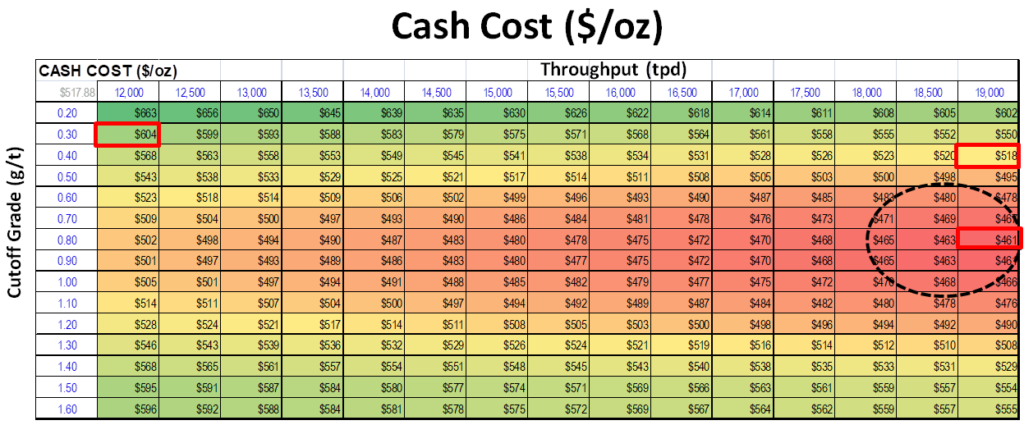
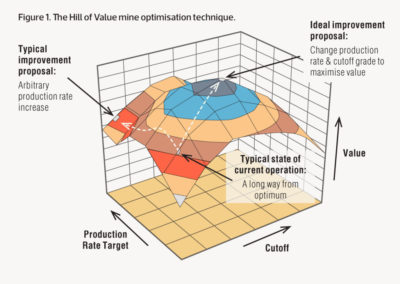
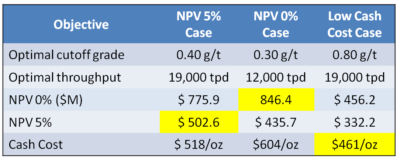 The Hill of Value is an interesting optimization concept to apply to a project. In the example I have provided, the optimal project varies depending on what the financial objective is. I don’t know if this would be the case with all projects, however I suspect so.

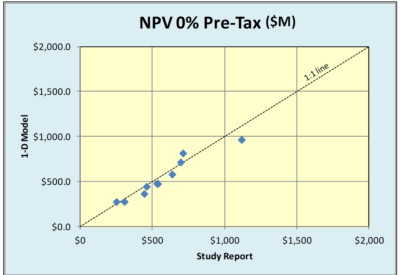 One of the questions I have been asked is how valid is the 1D approach compared to the standard 2D cashflow model. In order to examine that, I have randomly selected several recent 43-101 studies and plugged their reserve and cost parameters into the 1D model.
 There is surprisingly good agreement on both the discounted and undiscounted cases. Even the before and after tax cases look reasonably close.
 Perhaps with technology, like Zoom, one can replicate the personal feel of a trade show booth. One can still have back and forth conversations with investors rather than just doing lecture style webinars.
 Management teams should introduce more than just the CEO or COO. Include VP’s of geology, engineering, corporate development, from time to time. Don’t hesitate to let the public meet more of your team. Trade show booths are often manned by different team members.
 Better communication with investors can increase confidence in a management team. Although some investors may not enjoy technical discussions, I think there is a subset that will find them very helpful and interesting. There will likely be an audience out there.
 As an aside, if you are using Zoom make sure the host has configured the right settings. There are instances where anonymous participants can suddenly share their own computer screen, i.e. with questionable videos, to the group. It’s been referred to as “zoom bombing”.
 The number of independent mining consultants is increasing daily as more people reach retirement age or are made redundant.
 GLG (
GLG ( Digbee (
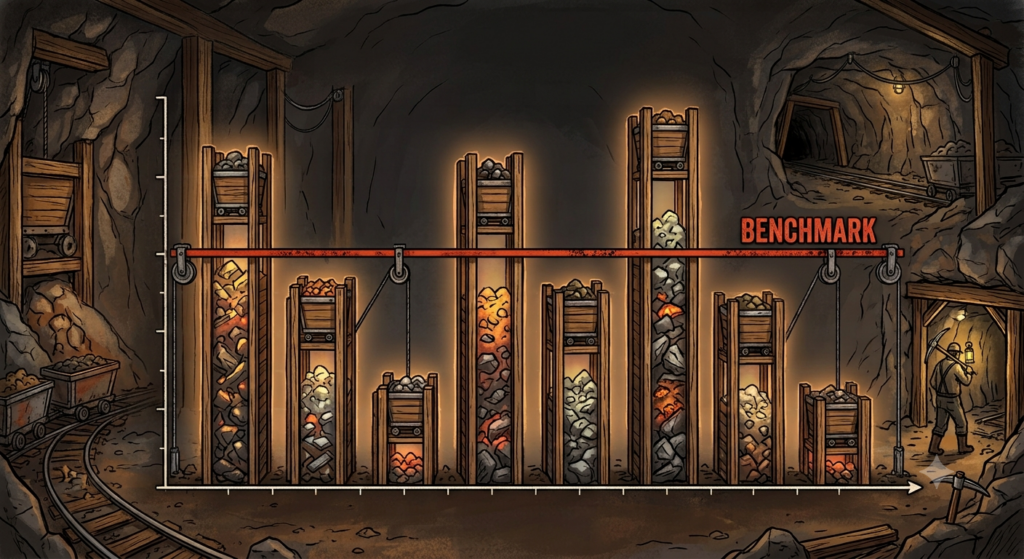 Benchmarking companies is the process of measuring performance of a company’s attributes against those of another. Ideally the benchmarking comparison is made against what are considered to be the best in the industry. Sometimes however the comparison is simply made between industry peers.
 We often see junior mining companies benchmarking themselves against others. Sometimes corporate presentations provide graphs of enterprise value per gold ounce to demonstrate that a company is always undervalued.
 Lenders may have observers at site monitoring both construction progress and cash outlays. Shareholders and analysts are watching for news releases that update the capital spending. Their concerns are well founded due to numerous cases of significant cost over-runs.
 It would be a positive thing if the mining industry (or other concerned parties) could work together to create open source project databases. These databases would incorporate summary information and cost information for global mining projects. The information is already out there, it just needs to be compiled.
 Benchmarking can be a great tool when done correctly. Benchmarking capital costs might bring more transparency to the project development process. It may help convince nervous investors that the proposed costs are reasonable.
 Reading it further, it was apparent that their study consultant, Ausenco, was being paid in company stock in lieu of cash. The arrangement included an initial financing of $750k with a further $375k to follow once the pre-feasibility study was 75% complete. Upon completion of the study another share payment was due.
 I have never been in a situation where I was consulting with company shares as my compensation. Neither have I ever managed a study where outside consultants were being paid in shares. However I can see the possibility of interesting dynamics at play.
 Regarding the first item “impartiality”, in the past there have been questions raised about the impartiality of engineering firms. I first recall reading this claim many years ago in a public response to a mining EIA application. Unfortunately I cannot find the exact source now.
 It would be interesting to know how many consulting firms would be willing to accept compensation solely in shares. Stock prices move up and down and the outcome of the study itself can have an impact on share performance.