


Recently I wrote a blog about how the adoption of new technology in the mining industry will increase the risk of cyber crime. However this is just one of many risks the industry faces today. This raises the question as to what are the main risks impacting all global businesses. Luckily for us, the World Economic Forum undertakes an annual survey on exactly this subject.
 Each year business leaders are queried about what they view as their major risks. The survey results are summarized in the Global Risk Report.
The 2019 report can be downloaded at this link. http://www3.weforum.org/docs/WEF_Global_Risks_Report_2019.pdf.
The study rates risks according to the categories “likelihood” and “impact”. A risk could have a high likelihood of occurring but have a low economic impact. One might not lose sleep over these ones.
Another interesting feature in the report is seeing how the top risks change from year to year. Some risks from 10 years ago are no longer viewed as key risks today.
2019 risk situation
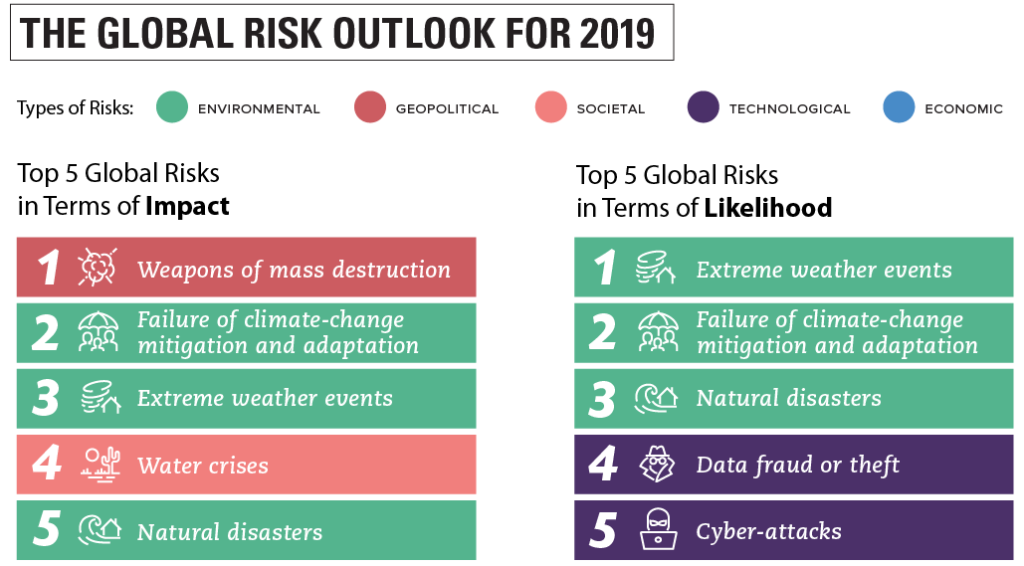
In 2019 environmental related risks dominate the survey results. They account for 4 of the top 5 risks by “impact” and 3 of the top 5 by “likelihood”. Technology related concerns about data fraud and cyber-attacks were also viewed as highly likely (#4 and #5). See the image below for the top 5 risks in each category.
Although the Global Risk survey wasn’t specifically directed at the mining industry, all of the identified risks do pertain to mining.
10 year risk trend
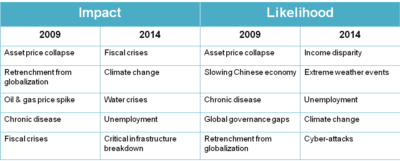 It is also interesting to look at the detailed 10 year table in the report to see how the risk perceptions have changed over the last decade.
None of the top five “Impact” risks from ten years ago are still in the top five now and only two from 2014 still exist. In the “likelihood” category, a similar situation exists.
It will be interesting to compare the 2024 list with 2019 list to see how risks will continue to evolve.
How about the mining industry
EY Global Mining & Metals also undertake a risk survey, focused on mining only. You can read their article at this link “The Top Risks Facing Mining and Metals”. Their top 10 risks are listed below, many are different than those from the World Economic Forum ranks. You must read the EY article to fully understand the details around their risk items.
-
License to operate (difficulty to acquire)
-
Digital effectiveness (lack thereof)
-
Maximizing portfolio returns (can this be done)
-
Cyber security (increasing risk of attack)
-
Rising costs (can costs be controlled)
-
Energy mix (acceptable power sources)
-
Future of workforce (lack of interest in the sector)
-
Disruption (falling behind competitors)
-
Fraud (increasing sophistication)
-
New world commodities (versus reduced demand for some commodities)
Conclusion


 The mining industry will see positive impacts from digitalization. Unfortunately more reliance on technology also brings with it significant risks. These risks are related to cyber security.
 As your mining company continues to move into the digital world, you must ask:
 The bottom line is that there is no stopping the digitalization of the mining industry. It is here whether anybody likes it or not. At the same time, there is likely no stopping the growth of cyber crime.
 Mining companies are always on the hunt for new projects to grow their cashflows. They would all like to find the “perfect” project; one with ideal conditions and great attributes.
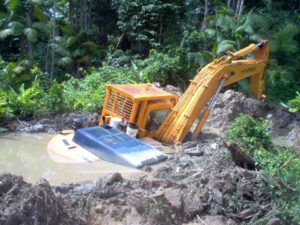 Now take an honest look at some recent (or past) projects that you have been involved with. How many of the perfect attributes listed above would be represented? It would be surprising to see them all checked off. Unfortunately that means certain flaws (risks) must be accepted when developing a project.
 The bottom line is that management understandably have a difficult task in making go/no-go decisions. Financial institutions have similar dilemmas when deciding on whether or not to finance a project.

 The study concluded that accessing potential deposits at depths of around 1000 m is economically feasible only if curved wells are used. The most relevant operational parameters are sufficient permeability in the ore zone and an adequate contact surface between the ore and leaching solution. The depth of the deposit is indirectly relevant, but more importantly the well installation cost per volume of deposit is critical. Hence curved wells are optimal.
 I am also curious about the ability to finance such projects, given the caution associated with any novel technology. Many financiers prefer projects that rely on proven and conventional operating methods.
 Previously I posted a blog about different approaches that mining engineers use to forecast dilution in an open pit setting. You can read the blog at
 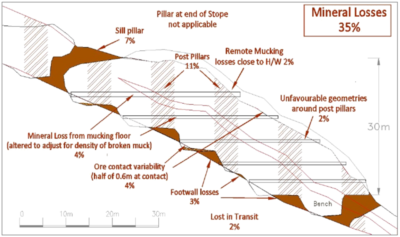 I am not going into detail on Paul’s paper, however some of my key takeaways are as follows. Download the paper to read the rationale behind these ideas.
 The bottom line is that not everyone will necessarily agree with all the conclusions of Paul’s paper on underground dilution. However it does raise many issues for technical consideration on your project.
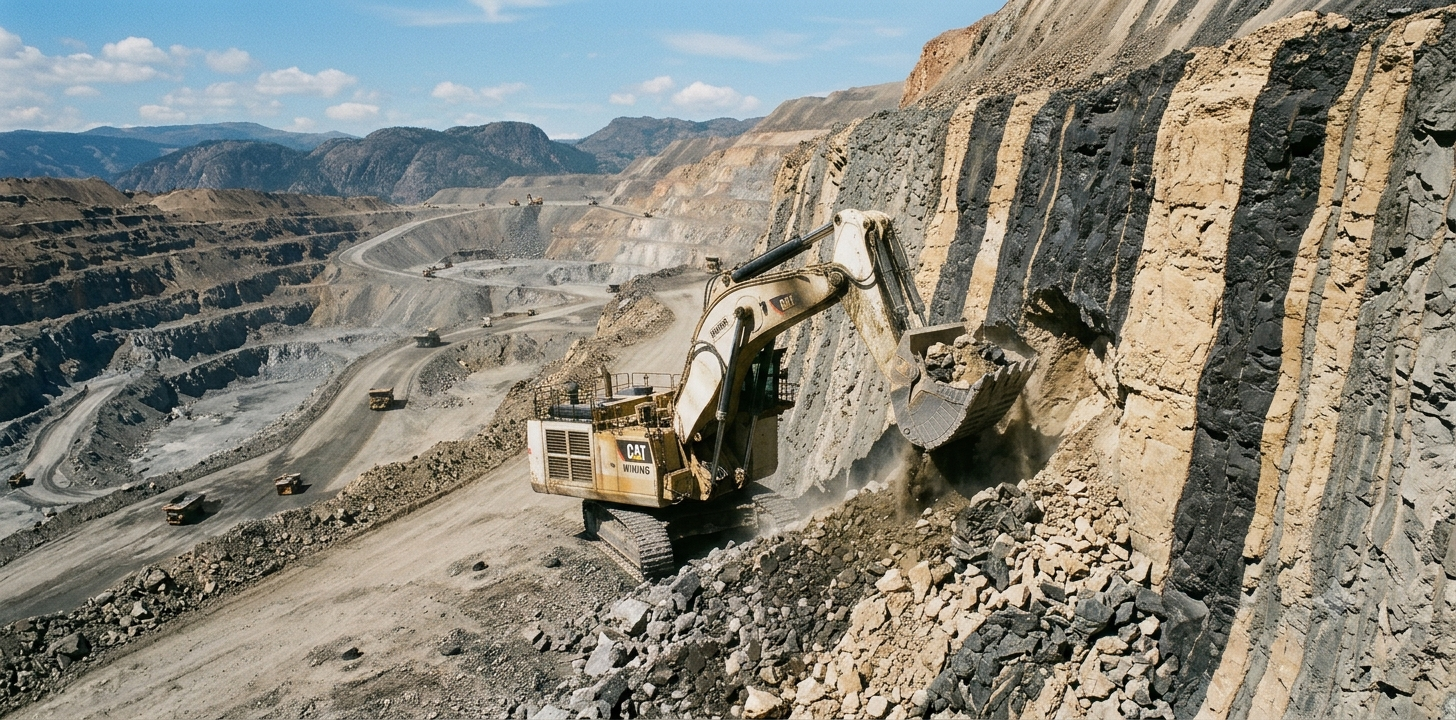 Over the years of working on studies and reviewing them, ore dilution often does not see much discussion but it is one of the most important technical and operational issues. It plays a key role in the success of a mining operation, particularly underground operations. In studies, it can be too low or too high, too optimistic or too pessimistic.

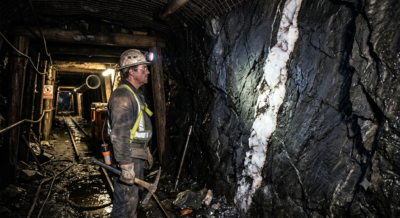 The goal of dilution estimation is not to demonstrate fancy mathematics, but to forecast what it will actually be. My personal experience is that people tend to focus on the value of the dilution percentage and whether it seems reasonable in the end. There seems to be less focus on the logic for the dilution approach used. It is not easy to forecast dilution yet it can be an incredibly important number.
 His topic is interesting and relevant to today’s mining industry. Paul raised many thoughtful points supported by data. He gave me permission to share his information.
 I agree with many of the points raised by Paul in his study. The mining industry has some credibility issues based on recent performance and therefore understanding the causes and then repairing that credibility will be important for the future.


 Sensors are the answer
 Their belt conveyor systems (