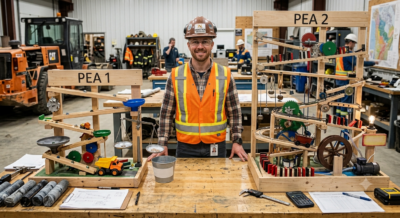
Mining PEA’s – Is it Worth Agonizing Over Details

Mining PEA
A previous blog post, titled PEA’s – Not All PEA’s Are Created Equal , discussed that different PEA’s will consist of varying levels of detail.  This is dictated by the amount of technical data available (or not available).   But so too will different chapters in the same PEA be based on different data quality.
I have seen PEA’s where some of the chapters were fairly general, relying on limited data.  Meanwhile other sections in the same study had a lot of depth and detail.   Does it make sense to use varying detail in a study?  Detailed work cost more money, but is it wisely spent money?

The level of detail justifiable

If the Resource supporting the PEA mine plan is largely Inferred material, then the mine design and production plan will have a significant degree of uncertainty.  So there is not a lot of justification for other engineers to prepare a detailed tailings design associated with that mine plan.
Similarly there is little value in developing a very detailed operating cost model or cashflow model for a study that has many underlying uncertainties.  Certainly an IRR to two decimals is impressive, but unwarranted.  Overly detailed work may be a waste of time and money, adding to the PEA duration, increasing engineering costs, and giving the unintended (or maybe intended) impression that the study is more accurate than it really is.
Different levels of detail in the same study can crop up when diverse technical teams are each working independently on their own aspects of the study.   Some teams may feel they are working with highly accurate data (e.g. a production tonnage) when in reality the data they were provided with is still highly speculative.

Conclusion

The bottom line is that it is important for the Study Manager and project Owner to ensure the entire technical team is on the same page.
The team should understand the type of information they are working with, to ensure the technical detail in the final study is consistent throughout.
Experienced reviewers will recognize where the key data gaps are in a study.  Hence they may view the entire study with that in mind regardless of how detailed some of sections in the report appear to be.
You can read more on the subject of uncertainty in PEA’s in the previous blog post at this link Mining PEA’s – Not All PEA’s Are Created Equal“.
Note: You can sign up for the KJK mailing list to get notified when new blogs are posted. Follow me on Twitter at @KJKLtd for updates and other mining posts.   The entire blog post library can be found at https://kuchling.com/library/
For some free mining calculator apps, including project timelines and a simplified cashflow modeller, check out this website https://sites.google.com/view/drillingdown
Share

Mine Site Visit – What Is the Purpose?

Mining due diligence
National Instrument NI43-101(6.2) specifies that “before an issuer files a technical report, the issuer must have at least one qualified person (“QP”) who is responsible for preparing or supervising the preparation of all or part of the technical report complete a current inspection on the property that is the subject of the technical report.
In most technical reports one may see a list of QP’s but most often only one or two of those QP’s will actually have been to the mine site. I have worked on numerous mining studies and not been involved in the site visit.
Normally the limited number of people taking  the site visit may be due to the high cost for travel, especially if the site is remote. The logistics of travelling around with a large team, and the associated cost can be onerous.  In some cases the number of personnel visiting the site may be restricted simply because there isn’t much to see at the property, yet the company needs to meet the NI43-101 requirement.

Get the best bang for your buck

Site inspections that I have taken part in ranged from simple tours of the property only taking photographs to more detailed data room reviews, meeting the owner’s team, meeting with vendors and contractors.
Exploration Program in AndesIn my opinion the more advanced the study the more important the site visit becomes.  However, given the cost, this requires that one maximizes the scope of the trip.
At the feasibility stage it is important that several QP’s complete one or more site visits at the same time, if possible.  They need to see and hear the same things.  Obviously the QP’s will be focusing on different technical areas, but the over-riding message should be consistent to the entire team.
For an earlier study stage (e.g. PEA), it is less critical that a large team complete the site visit.   However I would recommend that the QP making the site visit be in prior contact with the team members to determine what information they will want to see.
The visiting QP should then be responsible for collecting their data.  Sorting through information files covering different disciplines may be difficult for one person, but inspecting and photographing key parts of the site may be of value to everyone.
In addition it is useful to make first contact with local vendors and contractors on behalf of others.   Ultimately spending an extra day or two at site is relatively inexpensive compared to the fixed cost of getting there.
Once back at the office, the QP should distribute and explain his findings to the rest of the team, thereby benefiting everyone with better information.   I often see that post-site visit information sharing does not happen.

Conclusion

The bottom line is that rarely I have seen pre-site visit data gathering lists prepared for the QP .  In many cases the QP simply collects the information they themselves personally need.  Generally the pre-trip planning is focused on timing, travel, and hotel logistics and less so on the team’s information needs.
Quick drive-by site visits meet the requirements of NI 43-101 but they don’t add much to the study quality.
If you site is complex, and would benefit from a group visit, one way to help do this by using Google Earth.   I have another blog post the explains how a Zoom or Skype fly-around by someone knowledgeable with the site is useful.  You can read that post at “Google Earth – Keep it On Hand“.


Note: You can sign up for the KJK mailing list to get notified when new blogs are posted.
Share

Early Stage “What-if” Mine Economic Analysis – Its Valuable

Mining study economics
Over my career I have worked with large and small mining companies and seen how they studied projects and potential acquisitions.
Large mining companies have their in-house evaluation teams that will jump on a potential opportunity that comes around and start examining it quickly.  These evaluation teams may consist of a specialized head office group supported by people temporarily pulled in from their mining operations.
They are experienced at what they do and can provide management with solid advice even if working with only limited data.  This help management decide very early on whether to further pursue the opportunity or walk away immediately.
Early stage economics are normally part of this evaluation approach.   Although they are not correct all of the time, more than often they save their company from wasting money on projects unlikely to fly.
However if you are a small mining company, what are your options?
You don’t have an in-house technical team sitting around ready to go.  Management still needs to know if this project has a chance.  If the project is early stage, sometimes management thinks its fine to take a gamble, acquire the project, and then put money into the ground rather than spending on early studies.

It is possible to do both

Management and the exploration team usually have a vision for their projects, even those projects with only limited information.   Each person may have a different opinion on the potential size and scope of what may ultimately exist there.  However the question is whether any of those visions have sufficient accuracy to warrant spending more shareholder money on the project.
Some of the junior mining management teams that I have worked with have found it beneficial early on to have a basic internal cashflow model on hand.   If properly constructed, these are simple to tweak to examine “what-if’s” scenarios.  Input the potential deposit size and mine life, potential head grades, expected metallurgy, and typical costs to see what the economic outcome is.  Does this project have a chance and, if not, what tonnage, head grade, recovery, or metal price is required to make it work?   The simple cashflow model can tell you all of this.

Early stage modelling adds value

The tangible benefits to very early financial modelling are:
  • It helps management to conceptualize and understand their project.  If done honestly, it will reveal both the opportunities and threats to success.
  • It helps management to understand what technical parameters will be most important for them to resolve and what technical factors can be viewed as secondary. This helps guide the on-going exploration and data collection efforts.
  • Periodically refreshing the economic model with new information will reveal if the economic trends are getting better or worse.

Its not 43-101 compliant

I must caution that this type of early stage economic analysis is not 43-101 compliant and hence can not be shared externally, no matter how much one might wish to.
Another caution is that in some cases these early stage un-engineered projections become “cast in stone”, with management treating them as if they are accurate estimates.  Then suddenly all subsequent advanced studies must somehow agree with the original cost guesses, thereby placing unreasonable expectations on the project and the people doing the work.
The early stage economic models can consist of simple one-dimensional tables using life-of-mine tonnages or two-dimensional tables showing assumed annual production by year.  Building simple cashflow models may take only 2-3 days of effort.  That is not an onerous exercise compared to the overall benefit they can provide.
The bottom line is that it is useful to take a few days to develop a simple cashflow model.  “Simple” also means that management themselves can tweak the models and don’t need to be modeling expert on hand at all times.  “Simple” means the model should be well.  In another block post I discuss why to avoid demonstrating one’s Excel skills in building models. Read more on that at this link  Financial Spreadsheet Modelling – Think of Others.
Most companies have a CFO that can easily undertake this type  of modelling, with the help of some technical input.  Be careful though, often CFO’s take the simple cashflow model to an unwarranted level of complexity.
The simplest of all models is the one-dimensional approach.  To learn more about the concept behind a simple 1D financial models, read the blog post “Project Economics – Simple 1D Model” .
The entire blog post library can be found at this LINK with topics ranging from geotechnical, financial modelling, and junior mining investing.
Note: If you would like to get notified when new blogs are posted, then sign up on the KJK mailing list on the website.  Otherwise I post notices on LinkedIn, so follow me at: https://www.linkedin.com/in/kenkuchling/.
Share