Resource Estimates – Are Independent Audits A Good Idea?

mining reserves
Question: How important is the integrity of a tailings dam to the successful operation of a mine?
Answer: Very important.
Tailings dam stability is so important that in some jurisdictions regulators may be requiring that mining companies have third party independent review boards or third party audits done on their tailings dams.  The feeling is that, although a reputable consultant may be doing the dam design, there is still a need for some outside oversight.
Differences in interpretation, experience, or errors of omission are a possibility regardless of who does the design.  Hence a second set of eyes can be beneficial.

Is the resource estimate important?

Next question is how important is the integrity of the resource and reserve estimate to the successful operation of a mine?
Answer: Very important.  The mine life, project economics, and shareholder value all rely on it.     So why aren’t a second set of eyes or third party audits very common?

NI 43-101 was the first step

In the years prior to 43-101, junior mining companies could produce their own resource estimates and disclose the results publicly.  With the advent of NI 43-101, a second set of eyes was introduced whereby an independent QP  could review the company’s internal resource and/or prepare their own estimate.  Now the QP ultimately takes legal responsible for the estimate.
Nowadays most small companies do not develop their own in-house resource estimates.  The task is generally awarded to an independent QP.

Resource estimation is a special skill

Possibly companies don’t prepare their own resource estimates due to the specialization needed in modelling and geostatistics. Maybe its due to the skills needed to operate block modeling software.   Maybe the companies feel that doing their own internal resource estimate is a waste of time since an independent QP will be doing the work anyway.

The QP is the final answer..or is it?

Currently it seems the project resource estimate is prepared solely by the QP or a team of QP’s.   In most cases this resource gets published without any other oversight. In other words no second set of eyes has taken a look at it.  We assume the QP is a qualified expert, their judgement is without question, and their work is error free.

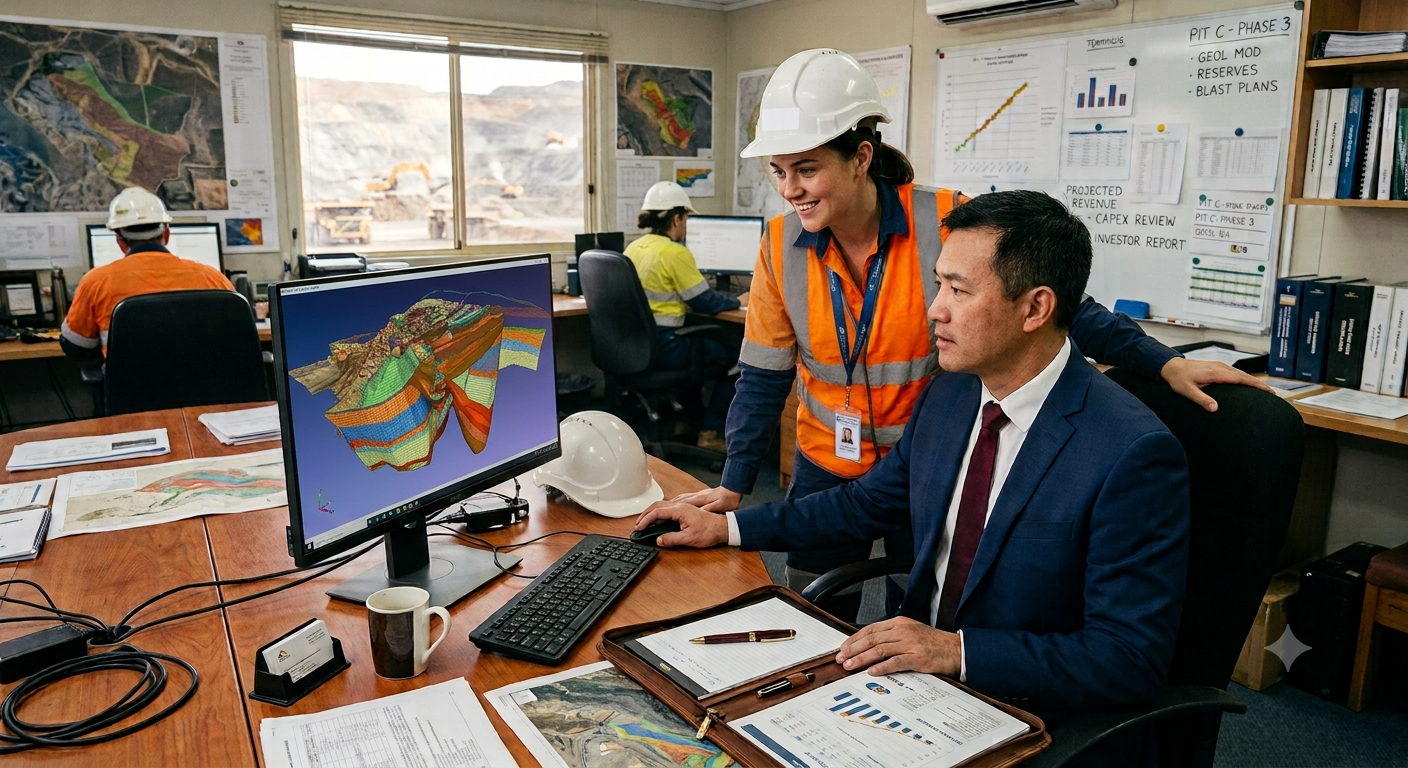
Leapfrog Model

As we have seen, some resources estimates have been mishandled and disciplinary actions have been taken against QP’s.   The conclusion is that not all QP’s are perfect.
Just because someone meets the requirements to be a Competent Person or a Qualified Person does not automatically mean they are competent or qualified. Geological modeling is not an exact science and will be based on their personal experience.

What is good practice?

The question being asked is whether it would be good practice for companies to have a second set of eyes take a look at their resource estimates developed by independent QP’s?
Where I have been involved in due diligence for acquisitions or mergers, it is not uncommon for one side to rebuild the resource model with their own technical team.  They don’t have 100% confidence in the original resource handed over to them.   The first thing asked is for the drill hole database.
One downside to a third party review is the added cost to the owner.
Another downside is that when one consultant reviews another consultant’s work there is a tendency to have a list of concerns. Some of these may not be material, which then muddles the conclusion of the review.
On the positive side, a third party review may identify serious interpretation issues or judgement decisions that could be fatal to the resource.
If tailings dams are so important that they require a second set of eyes, why not the resource estimate?  After all, it is the foundation of it all.
Note: If you would like to get notified when new blogs are posted, then sign up on the KJK mailing list on the website.  Otherwise I post notices on LinkedIn, so follow me at: https://www.linkedin.com/in/kenkuchling/.
Share

Disrupt Mining Challenge – Watch for it at PDAC

Update:  This blog was originally written in January 2016, and has been updated for Jan 2018.

Gold Rush Challenge

In 2016 at PDAC, Integra Gold held the first the Gold Rush Challenge.  It was an innovative event for the mining industry.  It was following along on the footsteps of the Goldcorp Challenge held way back in 2001.
The Integra Gold Rush Challenge was a contest whereby entrants were given access to a geological database and asked to prepare submissions presenting the best prospects for the next gold discovery on the Lamaque property.  Winners would get a share of the C$1 million prize.
Integra Gold hoped that the contest would expand their access to quality people outside their company enabling their own in-house geological team to focus on other exploration projects.   In total 1,342 entrants from over 83 countries registered to compete in the challenge.  A team from SGS Canada won the prize.

Then Disrupt Mining came along

In 2017, its seem the next step in the innovation process was the creation of Disrupt Mining sponsoerd by Goldcorp.  Companies and teams developing new technologies would compete to win a $1 million prize.
In 2017, the co-winning teams were from Cementation Canada (new hoisting technology) and Kore Geosystems (data analystics for decision making).
In 2018, the winning team was from Acoustic Zoom, an new way to undertake seismic surveys.

The 2019 winners will be announced at PDAC.  The entry deadline has passed so you’re out of luck for this year.

Conclusion

At PDAC there are always a lot of things to do, from networking, visiting booths, presentations, trade shows, gala dinners, and hospitality suites.
Now Disrupt Mining brings another event for your PDAC agenda.
Note: You can sign up for the KJK mailing list to get notified when new blogs are posted.
Share

Claim Fees Paid for a Royalty Interest – Good Deal or Not?

mineral property acquisition
In 2016 I read several articles about how the junior mining industry must innovate to stay relevant.    Innovation and changing with the times are what is needed in this economic climate.
One company that was trying something new is Abitibi Royalties.  They were promoting a new way for them to acquire royalty interests in early stage properties.  They were offering to fund the claim fees on behalf of the property owner in return for a royalty.
Their corporate website states that they would pay, for a specified period of time, the claim fees/taxes related to existing mineral properties or related to the staking of new mineral properties.
In return, Abitibi Royalties would be granted a net smelter royalty (“NSR”) on the property.  It may be a gamble, but it’s not a high stakes gamble given the relatively low investment needed.

Not just anywhere

Abitibi were specifically targeting exploration properties near an operating mine in the Americas. They were keeping jurisdiction risk to a minimum.   Abitibi stated that their due diligence and decision-making process was fast, generally within 48 hours.  No waiting around here but likely this is possible due to the low investment required and often the lack of geological information to do actually do a due diligence on.
To give some recent examples, in a December 14, 2015 press release, Abitibi state that the intend to acquire a 2% NSR on two claims in Quebec and will pay approximately $11,700 and reimburse the claim owner approximately $13,750 in future exploration expenses. This cash will be used by the owner towards paying claim renewal fees and exploration work commitments due in 2016.   Upon completion of the transaction, these will be the ninth and tenth royalties acquired through the Abitibi Royalty Search.  For comparison, some of their other royalty acquisitions cost were in the range of $5,000 to $10,000 each (per year I assume).   I think that those NSR interests are being acquired quite cheaply.
The benefit to the property owner may be twofold; they may have no other funding options available and they are building a relationship with a group that will have an interest in helping the project move forward.  The downside is that they have now encumbered that property with a NSR royalty going forward.
The benefit to Abitibi Royalties is that they have acquired an early stage NSR royalty quite cheaply although there will be significant uncertainty about ever seeing any royalty payments from the project.   Abitibi may also have to continue to make ongoing payments to ensure the claims remain in good standing with the owner.
It’s good to see some degree of innovation at work here, although the method of promotion for the concept may be more innovative than the concept itself. Unfortunately these Abitibi cash injections investments are not enough to pay for much actual exploration on the property and this is where the further innovation is required, whether through crowd funding, private equity, or some other means.   I’m curious to see if other companies will follow the Abitibi royalty model but extend it to foreign and more risky properties.
Note: You can sign up for the KJK mailing list to get notified when new blogs are posted.
Share

Junior Mining – Are People Still Investing?

small mining companies
Update: This blog was originally written in June 2015, however many of the observations made then still hold in late 2018.
The general consensus over the last couple of years is that the junior mining sector is still in a state of flux.
I briefly touched on this in a previous article “12. Financings – It Helps to Have a Credible Path Forward”.
It is still difficult for junior miners to get funding and the stock prices of have been on a downward trend.   Some observers say this just a temporary phase and the stock prices will cycle, as they have in the past.   I’m not convinced that this will be the case, although I am hoping.

Metal prices may recover, but will stock prices?

I am reasonably confident that metal prices will improve over time, but I am not sure that alone will result in the junior mining sector invigorating.  I think there is a long term shift in how personal investments are being made and how the mining industry is being viewed.  The following blog has some personal opinions on the present and the future.
Mining companies are constantly in the media with stories of cost over-runs, mine shutdowns, fatalities, strikes & protests, and environmental incidents.

In addition, the junior mining sector has had a few notable scams that nobody ever forgets about.
In some instances management were over promoting sub-optimal projects simply for the purpose of raising the stock price and cashing out.  Not many companies fell into this category, but enough to create an unfavorable image of the industry.
I think it will take time to recover from the image being created by the events described above. Unfortunately new incidents only build on the perceived legacy.
The implementation of sustainable and green mining practices is an attempt to rehabilitate the image of mining, but is anyone out there listening?

Are investment practices changing?

Regarding today’s investment practices, I have three general observations:
  1. Yield Investors: When many of us baby boomers were younger with a steady job, we were willing to speculate on mining stocks hoping for the big payoff.  At the time there were some well publicized payoffs. Also there wasn’t much else to speculate on.
    Now those same baby boomers are moving into retirement and financial planners are push them into fixed income and dividend paying investments.  Be happy with a 2% to 5% yield.  The risk tolerance for many of these investors has shifted from speculation / growth to income / capital retention.
    I’m not sure how many of these people will ever re-enter the mining stock market.  The majority of miners don’t pay any significant yield.   Looking at the yield for Barrick (2%), Goldcorp (0.8%), and Yamana (0.85%), their yields are lower than those for the more conservative bank stocks (4%-6%).
  1. Where to speculate now?  Where might the 30 to 40 year old’s speculate today? Younger people today may still speculate with their free cash, but they are not hoping to be investors in the next Voisey’s Bay, Kidd Creek, or Hemlo.  They have never even heard of them.
    They are hoping to be investors in the next Apple, Google, or Facebook, or a cannabis company.  The dot.com bubble of 1999–2000 was a case of junior mining speculators jumping into technology and it was a bust.  However currently several of the new breed of dot.com companies that have IPO’d are getting huge share price increases.  Is it still a tech bubble? Not so much anymore.
    I don’t know whether the younger speculators will ever have interest in the mining sector since they never heard of it.  There is so much other investing activity happening out there.
  2. The perception of mining: The mining and energy news shown in the media is not helping the industry by focusing mainly on the negative aspects. The resource business appears to be somewhat analogous to the meat industry. Everyone likes their nicely packaged rows of chicken and beef at the grocery store but nobody wants to see how it actually gets to the store.  Everyone also loves their metallic gadgets and the energy used to power them, but please don’t show how it actually gets from mine to store shelf.  It can be quite upsetting.
  3. Complexity:  To invest in a mining stock or understand a mining IR presentation, one needs a basic understanding of mining and geology.   To understand a tech stock or bank stock, one does not need to be an expert in that industry. People will intuitively have a better comfort level with them.

Can mining companies provide more yield?

An interesting group of companies are the mid tier producers that have operating mines and generate profits, but do not pay a dividend.  I will be curious to see how these companies shares will perform since they don’t satisfy the yield investor nor may they satisfy the pure speculator looking for order of magnitude capital gains.
The larger mining companies will always have their investors like pension funds and mutual funds, however the junior miners may be a different story.
Possibly private equity and equity-based crowdfunding will be one of the long term solutions.
I have heard of one geological consulting firm that was trying to foster a plan to help crowdfunders with their 43-101 report even though they don’t yet have the money to pay for the report.
I also understand that Canada now has a few private equity stock exchanges that allow PE to change hands, which may facilitate more private equity involvement.

Conclusion

The bottom line is the mining industry needs to have a self-examination with respect to what the future holds.  There is talk that mining needs to change its business model, but very little suggestion regarding what changes to make.
The growing population changing demographics, competition for equity funding, and society’s urbanization may result in fundamental, and permanent, changes to how the financial side of the junior mining industry can function.  Just my opinion.
Note: If you would like to get notified when new blogs are posted, then sign up on the KJK mailing list on the website.  Otherwise I post notices on LinkedIn, so follow me at: https://www.linkedin.com/in/kenkuchling/.
Share

Open Pit Optimization – How I View It

Mining feasibility study
One of the first steps in an open pit design is the pit optimization analysis.  Pit optimization is used to define the most profitable pit shell for a given set of economic parameters.  The economic parameters include the metal prices, processing recoveries, and site operating costs. Normally when optimization is done, a range of metal prices or Revenue Factors (“RF”) is used to develop a series of nested shells to understand how the pit will expand or contract with increasing or decreasing metal prices.
Once the optimization step is complete, mining engineers will then design the pit inside that shell, introducing benches and ramps.  The pit design should mimic the selected optimized shell as closely as possible.
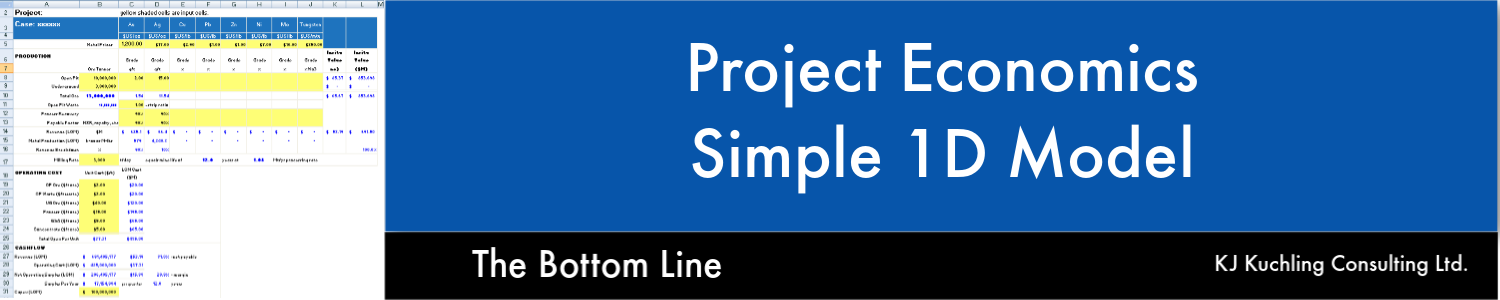
The pit design may (or may not) closely replicate the optimization shell depending on the slope angles used in the optimization and where the haul ramps are located in the design.
Hence the actual ore and waste tonnages mined may be different that the tonnages defined by the optimizer.
Various experts in pit optimization will use approaches of differing complexity.  Some may apply variable mining costs with pit depth; apply variable process recoveries linked to head grade; apply variable pit slopes by sector or depth, apply dilution and ore losses; etc.   One can make the pit optimization step as simple or detailed as one wants it.
The question is whether detailed pit optimization is warranted.  My view is that overly detailed pit optimization is  not required, other than if one wants to test parameter sensitivity on the resulting pit size and shape.  There are just too many uncertainties in the parameters being used in optimization.

Open Pit Optimization Uncertainties

Some of the uncertainties involved in the optimization approach are listed below:
  • Pit optimization can generate large pits that would have a long mine life.  However one doesn’t really know the metal prices far into the future.   So will that final pit ever get mined, or might it even be larger than shown.
  • Pit optimization is typically done at the start of a study, so one doesn’t have the detailed operating costs yet. The size of the project may be unknown and one has to use rough estimates for future costs and possibly even assume preliminary process recoveries.
  • Operating costs will also change in the future, and the optimization step is just a snapshot using current information.
  • Sometimes the optimization includes the use of Inferred resources, which are uncertainty.   Sometimes optimization is done only using Measured and Indicated resource, yet there may be areas if Inferred resource that ultimately convert to M &I and these will have been ignored.  So, either way you do it, you are not sure what ore the pit can captured and will  to shape the pit.
  • The smaller pits, if developed, would consist of smaller operations and may have different operating costs than assumed in the optimization.   Similarly larger pits may have different throughput rates and  operating costs than assumed in the optimization.
  • The ore and waste split reported within the pit will be based on a specific life-of-mine cutoff grade.  This is based on the fixed metal price and operating cost assumptions applied.
  • Overall pit wall slopes may differ for shallow pits versus deep pits.  Slopes may vary above the groundwater table and below it.  In many instances during pit optimization the wall angles are maintained at the same angle irrespective of the pit depths.   Sometimes geotechnical programs have not yet been completed, so optimization slope angles are simply educated guesses.
  • Dilution may be applied globally during pit optimization (unless one is working with a diluted block model).  In reality, dilution may differ in different parts of the ore body, and that may not be considered in the optimization stage. For more discussion on dilution in general, read the blog “Ore Dilution Prediction – Its Always an Issue“.

Conclusion

The bottom line is that pit optimization should be viewed as a guide to the pit design, but not as a highly precise calculation.  There are too many uncertainties in the parameters used.
There is always opportunity for future miner operators to examine pushback to grow the pit larger than initially envisioned.  Having said all that, one should still understand how future changes in metal prices can impact on the pit size, and then assess whether practical pushbacks are possible.   Thin sliver pushbacks are operationally difficult so this should be understood at the start.
While open pit optimization is not a precise science, there is still merit in examining how the pit size and shape reacts to changes in different parameters.  There are many ways to examine this and help select which shell should be advanced into the design stage. It can be more than just looking at the NPV versus Revenue Factor chart.   You can read this post at this link “Pit Optimization – More Than Just a “NPV vs RF” .
Note: If you would like to get notified when new blogs are posted, then sign up on the KJK mailing list on the website.   Follow us on Twitter at @KJKLtd for updates and insights.
Share

Mining Project Economics – Simple 1D Model

mining desktop study
In a previous article I outlined my thoughts on the usefulness of early stage financial modelling (“Early Stage “What-if” Mine Economic Analysis – Its Valuable”).     My observation was that it is useful to take a few days to build a simple cashflow model to help your team better understand your project.

By “simple” I mean really simple.

This blog describes one of the techniques that I use to take a super-quick look at any project; whether it is for a client wishing to understand his project at a high level; or whether it is a project that I have read about.  There isn’t any actual study or production schedule available yet.  Maybe there is only a mineral resource estimate available.
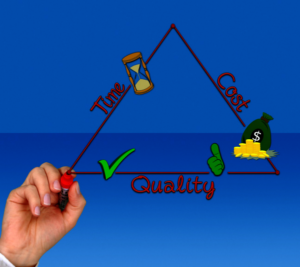
It takes about 10 minutes to plug the numbers into my template to get fast results.  The image below is an example of the simple model that I use, but anyone can build one for themselves.

Screenshot of Simple Economic Model

I use the term one dimensional (“1D”) model since it doesn’t use the typical X-Y matrix with years across the top and production data down the page.
The 1D model simply relies simple on life of mine (“LOM”) totals to estimate the total revenue, total operating cost, and total profit.  This determines how much capital expenditure the project can tolerate.
The only caveat is that you need to have some sense for operating and capital costs for similar projects. This analysis can be on both a pre-tax and simple after-tax basis.
Using estimated metal prices and recoveries, the first step is to calculate the incremental revenue generated by each tonne of ore (see a previous article “Ore Value Calculator – What’s My Ore Worth?”).
Next that revenue per tonne is multiplied by the total ore tonnage to arrive at the total revenue over the life of mine.
The second step is to determine the life of mine operating cost, and again this simple calculation is based on estimated unit operating costs multiplied by the total tonnages being handled.
The third step is to calculate the life of mine profit based on total revenue minus total operating cost.
The potential net cashflow would be calculated by deducting an assumed capital cost from the life-of-mine profit.  The average annual cashflow is estimated based on the net cashflow divided by the mine life.  An approximate NPV can be calculated by determining the Present Value of a series of annual payments at a certain discount rate.
The reasonableness of the 1D model will be examined via benchmarking and this will be summarized once completed.  I will include a link to that future blog here.

You need to understand your project

One can easily evaluate the potential impact of changing metal prices, changing recoveries, ore tonnages, operating costs, etc. to see what the economic or operational drivers are for this project.  This can help you understand what you might need in order to make the project viable.
Conclusion

The bottom line is that a 1D economic calculation is very simplistic but still provides a vision for the project.  The next step in the economic modelling process would be a 2D model based on an annual production schedule.  The 1D approach is just a quick first step in looking at the potential.  You can do it even when you only know the head grades and some generalized orebody information.
The two ways you can apply the simple 1-D model are:
  1. evaluate the potential of early stage projects using cost inputs from other studies,
  2. examine a project’s sensitives (units costs, recoveries, prices) by calibrating your simple model to the published study (i.e. use the same parameters and make changes as needed.
The entire blog post library can be found at this LINK with topics ranging from geotechnical, financial modelling, and junior mining investing.


Note: If you would like to get notified when new blogs are posted, then sign up on the KJK mailing list on the website.  
Share

Work Breakdown Structures – Don’t Forget About The WBS

mining project WBS
Normally at the start of a mining study, the team members receive a matrix of responsibilities.  This table shows which people (or groups) are responsible for different aspects of the study, i.e. who is responsible for geology, for mine design, for process design, infrastructure, etc.  This is great tool and a necessity in making sure that everyone knows what they are supposed to do.
Next we generate a project schedule based on some work plan.  In realty this isn’t the correct sequence.

Sometimes the WBS is forgotten

What often gets forgotten in early stage studies is providing the team members a Work Breakdown Structure (“WBS”).   I consider the WBS an equally important component as the responsibility matrix and both should always be provided.
The WBS is a hierarchical breakdown of the project into phases, deliverables, and work packages usually associated with cost estimation. It is a tree based structure, developed by starting with the final objective and then dividing that into manageable components based on size, duration, and responsibility.  Typically this is done for the capital cost estimate, breaking it down into individual cost areas and cost components.  A WBS can also be used for the operating cost estimate.
request for propoalsThe WBS can provide the following information to the team:
  • It assigns the costing responsibility to specific people or group so each know what must be delivered.
  • It provides a consistent format for developing and reporting the capital costs (and operating costs).
  • It helps ensure that no cost components get omitted and no costs get double counted.
  • It provides the cashflow modeler with a clean format to import the capital cost into the cashflow model.
  • The WBS should be developed before the project schedule, not after it.

Any study will benefit from a WBS

Typically a WBS is developed for pre-feasibility and feasibility mining studies but is often ignored at the PEA stage.  Some feel it is too detailed for that level of study.  I don’t feel this is the case.
The WBS is a communication tool to confirm responsibilities.  Thus even a simplified WBS is still useful at the PEA stage.
I have seen some instances where a WBS has been created but does not get wide distribution to the entire team.  The WBS should be provided to everyone and ideally a team session be held to walk through the WBS structure.
The idea is not make everyone a costing expert, but rather to ensure all understand how the project cost estimate will be structured.

Conclusion

The bottom line is that regardless of the level of study, a WBS should always be created.

Some will say the WBS is not required for early stage studies but I have found benefits in having one, at least for the capital cost estimate.   Obviously the level of detail in the WBS should be appropriate to the level of the study.
Once the WBS is in place, then go ahead and build your project schedule.
A competent Study Manager can easily create an initial WBS, thereby mitigating some headaches when the final study is being assembled.   You may even want a basis WBs at the proposal stage.
By the way, before awarding a study to anyone, try to have a prepared Request for Proposal beforehand.   I have written about the benefit of this document in a blog post titled “Request For Proposal (“RFP”) – Always Prepare One
My entire blog post library can be found at this LINK with topics ranging from geotechnical, financial modelling, and junior mining investing.


Note: If you would like to get notified when new blogs are posted, then sign up on the KJK mailing list on the website.  
Share

Request For Proposal (“RFP”) – Always Prepare One

Mining request for proposal
When it comes to time to undertake any type of mining study, whether small or large, whether sole sourced or competitively bid, it is always a good idea to prepare a Request For Proposal (“RFP”) document.
I know that it can be an annoyance, but an RFP document is a lot better than a simply phone calling a consultant describing what you want.  Its also better than a cursory email outlining what you want. In many cases the RFP doesn’t need to be a complex document; however RFP’s are appreciated by everyone involved.   It provides the documentation that can help make things go smoothly.

The RFP doesn’t need to be complicated

executive meetingOwner’s Perspective: preparing an RFP gives the opportunity to collect the Owner’s team thoughts on the scope of study needed, on the deliverables required, and on the timing.   The RFP will outline this for the consultants and simultaneously help the owner’s team to get on the same page themselves.
The RFP is the opportunity for the owner to tell the consultants exactly what they are looking for in the mining study.  It also specifies what they want to see in the proposal to help them compare multiple proposals if needed.
Consultant’s perspective: receiving an RFP is great to them since having a detailed scope of work laid out means they don’t need to guess the scope when preparing their cost estimate.  It will be clear to the consultant what work is “in scope”.  If extra services are required in the future, then “out-of-scope” work can be defended.
An RFP also gives the consultant some reassurance that the Owner has put thought into exactly what they want them to do.

What to include in the RFP

The RFP sent to bidding consultants should contain (at a minimum) the items listed below. A sole sourced study can have a scaled back RFP document, but many of these key items should be maintained.

Much of this RFP information can be a single template document that will be modified if different scopes of work will be sent to different consultants (e.g. tailings design, pit geotechnical, groundwater, feasibility study, etc.).
  • Project Introduction (a high level overview of the project and the Owner).
  • Table of Responsibilities for the Study (if other consultants are being involved in different areas).
  • Scope of Work (for this Proposal), and highlight any specific exclusions from the scope.
  • Additional Requirements (update meetings, monthly reports, timesheets, documentation, etc.)
  • Schedule (the timing for the proposal, job award date, study kickoff, and completion date).
  • Instructions to the Bidder (e.g. what information should be provided in each proposal and in what format).
  • Other (the legal rights of the Owner, confidentiality statement, how proposals will be evaluated, etc.).

Specifying format makes it easier to compare proposals

If a company is competitively bidding the study, it can be easier to compare multiple proposals if certain parts are presented in the exact same format.  Usually different consulting firms have their own proposal format, which is fine, however certain sections of the proposal should be made easily comparable.
The RFP can request that each proposal should contain (at a minimum):
  • Confirmation of the scope of work based on the RFP, which may be more detailed than the RFP itself.
  • List of exclusions.
  • List of final deliverables.
  • Proposed Study Manager, resume and relevant study management experience.
  • Proposed team members, organizational structure by areas of responsibility, and resumes.
  • Cost estimate on a not-to-exceed basis for each area, subdivided by team member, hours and unit rates ,and possibly in a specific table format.
  • A fee table for the various job classifications that would be applied to out-of-scope additional man hours.
  • All indirect costs, administrative costs, indicating mark-ups (if any).
  • Miscellaneous disbursements (i.e., airfares, hotel, vehicles) and indicate if there are mark-ups.
  • Detailed study schedule to completion.
  • Payment schedule.
  • Specify if there are any potential conflicts of interest with other projects.

Conclusion

The bottom line is that an owner should always take the time to prepare some type of RFP for any mining study they want to undertake.  The owner should also request a consultant proposal based on that RFP, even if it is being sole sourced to just one consultant.
Depending on the size and nature of the study, one can use judgement on how detailed the RFP or consultant’s proposal must be, but one should always have the proper documentation in place beforehand.
A key part of any mining study is the project capital cost estimate.  In my view it is important that any RFP includes the requirement to develop a Work Breakdown Structure.  This has many uses, and is discussed further in the blog post “Work Breakdown Structures – Don’t Forget About The WBS
My entire blog post library can be found at this LINK with topics ranging from geotechnical, financial modelling, and junior mining investing.


Note: If you would like to get notified when new blogs are posted, then sign up on the KJK mailing list on the website.  
Share

Junior Miners – Get Your Own Independent Consultant

PEA consultants
Over the past few decades I have worked in different consulting roles; as an independent consultant; as a member of a large consulting team; and as owner’s representative managing consultants. I have worked on projects where the mining company has their own external consultants that they have worked with for years (decades), learning that there are roles for both the independent consultant and larger consulting firms.
A previous blog (“9. Large Consulting Firms or Small Firms – Any Difference?”) discusses where large and small consultants fit into the overall picture.   Large technical teams are required where there are broader scopes of work, significant effort levels, and where multiple skills sets are needed.

Independent Consultants

Independent consultants offer a unique service.  They are well suited for assisting a project Owner directly, either independently or as part of an overall corporate advisory team. They may work on a part time basis, so don’t bring the fixed financial liability of a salaried employee.  Furthermore, non-technical junior mining management should always have easy access to internal technical skills for brainstorming ideas or receiving technical direction.
Even if some of the management are technically oriented, having independent thought is valuable. The question is whether the consultant should be a cheerleader or be a true independent observer.
Independent consultants part of the management team will differentiate themselves from large engineering firms in several ways.

  • They don’t bring a lot of extra personnel onto a job.  They focus  on their niche experience and on what is needed.  One can always pull in other expertise when needed.
  • They can provide unbiased advice.  Larger firm sometimes have business development conflicts. The independent consultant does not have the motivation to win a feasibility study or EPCM contract.   They motivation is to stay employed, so they want to deliver quality input and feedback.
  • A company can develop long term working relationships with their independent consultants.  Everyone gets familiar with each other’s objectives and goals.  Large engineering firms can be revolving doors with people continually moving on to other roles or even other firms.
  • Independents can work efficiently at a pace of their own choosing.  This can result in lower costs and faster deliverables.  I have worked with many independent consultants that work extra time to meet their client targets.
  • Independents can provide long term stability since they generally won’t have any employee turnover.  Personally I was involved for over 15 years with a bauxite mining operating in Suriname.  The expat technical staff at the mine site had regular turnover.  Ultimately I ended up being the only constant for the mine operator, knowing the history and why things were done they way they were.  I even had copies of old reports they could no longer find in their archives.  We avoided re-inventing the wheel each time a new technical manager was brought in.

Consultants and Stocks Options

A point of conversation is whether the independent consultants should receive stock option compensation.  I have worked under both situations.
Awarding stock options might eliminate the “independent” nature of the relationship and hence negate the ability to sign off as an independent QP. However in some circumstances, the company may not require the consultant to be a QP since they mainly act in an advisory role. A question to ask is whether the company wants “independent” advice from someone who may be a shareholder or option holder?
One advantage of awarding stock options is that the consultant may become more beholden to the project.  They feel it is their project too, rather than simply acting as a paid adviser.  They may have a longer term interest in being involved with the project and the company, and are less likely to move on.
Conversely the company may prefer the consultant doesn’t have any direct ownership so that their advice can be viewed as being unbiased. Having a contrarian viewpoint on corporate plans may be a good thing.
Overall I feel that awarding stock options is a good way to foster long term commitment from the consultant. It can be easier for them to walk away without such an inducement to stay, but there are no guarantees.

Conclusion

The bottom line is that independent consultants have a role to play and should be part of all owner’s teams, whether be on the Board or on an Advisory Panel.   The independent consultants can be selected based on their specific specialization (i.e. exploration, resource modelling, mining, metallurgy, environmental) and provide valuable part time guidance to the company.
The caveat is to ensure that the consultant is technically capable.  I have also seen instances where some advisors actually gave poor advice.  Perhaps they weren’t that technically capable, or maybe were simply friends of  management.
Lastly, decide whether the consultant should be an honest advisor or a cheerleader.  Companies should want to hear the truth.  If a future 3rd party due diligence team comes in, they will be looking for flaws in the project.  It would be in a company’s self interest to already know what those flaws are before the due diligence team.
One of the things an advisor can help do is help decide the study path the company should take.  To learn more about the possible mining study paths, you can check out this blog post “4 Mining Study Types (Concept to Feasibility)“.
Note: You can sign up for the KJK mailing list to get notified when new blogs are posted. Follow me on Twitter at @KJKLtd for updates and other mining posts.   The entire blog post library can be found at https://kuchling.com/library/
For some free mining calculator apps, including project timelines and a simplified cashflow modeller, check out this website https://sites.google.com/view/drillingdown
Share

Large or Small Mining Consulting Firms – Any Difference?

Mining feasibility pre-feasibility
Some junior mining companies select their mining study consultant based on the assumption that they need a “big name” firm to give credibility to their study.   This creates an interesting dilemma for many smaller mining companies since they the larger firms can cost more.  Its also a dilemma for smaller engineering firms trying to win jobs.  While large consultants may cost more due to higher overheads; their brand name on a study may bring some value.
In my personal experience I find that larger consultants are best suited for managing the large scale feasibility studies.  This isn’t because they necessarily provide better technical expertise.  Its because they generally have the internal project management and costing systems to manage the complexities of such larger studies.
The larger firms are normally able to draw in more management resources; for example, project schedulers, cost estimators, and document control personnel.  Ultimately one will pay for all of these people, albeit they may be a critical part in successfully completing the study.
A feasibility study is more rigorous than a pre-feasibility study, which in turn is more rigorous than a PEA or scoping study.

Sub-contracting Parts

For certain aspects of a feasibility study, one may get better technical expertise by subcontracting to smaller highly specialized engineering firms.  However too much subcontracting may become an onerous task.  Often the larger firms may be better positioned to do this.
In my view, likely the best result will come from a combination of a large firm managing the feasibility study but undertaking only the technical aspects for which they are deemed to be experts.
The large lead firm would be supported by smaller firms for the specialized aspects, as per a previous article “Multi-Company Engineering Studies Can Work Well..Or Not”.

What about smaller studies?

For smaller studies, like scoping studies (i.e. PEA’s), which can be based on limited amounts of technical data, I  don’t see the need to award these studies to large engineering firms.  The credibility of such early studies will be linked to the amount of data used to support the study.  For example, there may be limited metallurgical testing, or limited geotechnical investigations; or the resource is largely inferred.
Not all PEA’s are equal (see “PEA’s – Not All PEA’s Are Created Equal”).  A large firm’s application of limited data may be no more accurate or defensible than a small firm’s use of the same data.
One of the purposes of an early stage study is to see if the project has economic merit and would therefore warrant further expenditures in the future.  An early stage study is (hopefully) not used to defend a production decision.  The objective of an early stage study is not necessarily to terminate a project (unless it is obviously highly uneconomic).
I have seen instances where larger firms, protecting themselves from  limited data, were only willing to use very conservative design assumptions in early stage mining studies. This may not be helpful to a small mining company trying to decide how to advance such a project.

Conclusion

The bottom line is that for early stage studies like a PEA, smaller engineering firms can do as good a job as larger firms.  However one must select the right firm.  Review some of their more recent 43-101 reports to gauge their quality of work.  Don’t hesitate to check with previous client references.
For the more advanced feasibility level studies, be wary if a smaller firm indicates they can do the entire study. Perhaps they can be responsible for some parts of the feasibility study as a sub-contractor to a larger firm. Managing these large study may be beyond their experience and internal capabilities.
Whether you are considering a small or large engineering firm, know their strengths and weaknesses as they will relate to the specific’s of your study.
In another blog post I have expanded the discussion about the importance of the study manager role. You can read that post at this link “Importance of a Study Manager – That’s the Key“.
Another blog post discusses undertaking studies using multiple engineering teams and the pitfalls to watch out for.  That blog post is at “Multi-Company Mining Studies Can Work Well…or Not“.
Note: You can sign up for the KJK mailing list to get notified when new blogs are posted.
Share