Articles tagged with: 43-101

Mining Cashflow Sensitivity Analyses – Be Careful

cashflow sensitivity
One of the requirements of NI 43-101 for Item 22 Economic Analysis is “sensitivity or other analysis using variants in commodity price, grade, capital and operating costs, or other significant parameters, as appropriate, and discuss the impact of the results.”
The typical result of this 43-101 requirement is the graph seen below (“a spider graph”, which is easily generated from a cashflow model.  Simply change a few numbers in the Excel file and then you get the new economics.  The standard conclusions derived from this chart are that metal price has the greatest impact on project economics followed by the operating cost.   Those are probably accurate conclusions, but is the chart is not telling the true story.
DCF Sensitivity GraphI have created this same spider graph in multiple economic studies so I understand the limitations with it.   The main assumption is that all of the sensitivity economics are based on the exact same mineral reserve and production schedule.
That assumption may be applicable when applying a variable capital cost but is not applicable when applying varying metal prices and operating costs.
Does anyone really think that, in the example shown, the NPV is $120M with a 20% decrease in metal price or 20% increase in operating cost?   This project is still economic with a positive NPV.
In my view, a project could potentially be uneconomic with such a significant decrease in metal price but that is not reflected by the sensitivity analysis.  Reducing the metal price would result in a change to the cutoff grade.  This changes the waste-to-ore ratio within the same pit.  So assuming the same size mineral reserve is not correct in this scenario.
Changes in economic parameters would impact the original pit optimization used to define the pit upon which everything is based.


A smaller pit size results in a smaller ore tonnage, which may justify a smaller fleet and smaller processing plant, which would have higher operating costs and lower capital costs.
A smaller mineral reserve would produce a different production schedule and shorter mine life.  It can  get quite complex to examine it properly.
Hence the shortcut is to simply change inputs to the cashflow model and generate outputs that are questionable but meet the 43-101 requirements.
The sensitivity information is not just nice to have.   Every mining project has some flaws, which can be major or minor. Management understandably have a difficult task in making go/no-go decisions. Financial institutions have similar dilemmas when deciding on whether or not to finance a project.   You can read that blog post at this link “Flawed Mining Projects – No Such Thing as Perfection
So if the spider chart isnt he best way to tackle the risk issue, what way is better?  In another blog post I discuss an different approach using the probabilistic risk evaluation (Monte Carlo).  Its isn’t new but now well adopted yet by the mining industry.  You can learn more at “Mining Financial Modeling – Make it Better!
Note: If you would like to get notified when new blogs are posted, then sign up on the KJK mailing list on the website.   
Share

Financings – It Helps to Have a Credible Path Forward

mine economics
Update: This blog was initially written in May 2015, however not much as changed to the end of 2018.
Let me say the obvious; the state of the junior mining market is not great these days.  The number of financings is down and it seems there are a lot of companies struggling to get their piece of the financing pie.   People mention to me that there actually is a fair bit of private equity funding available but only for the right projects.
I have heard from geologist colleagues that financing grass-roots exploration is still extremely difficult.  That is unless company management has had past successes or is well connected to the money scene.
I’m told that 43-101 resource estimates alone no longer generate much excitement.  For projects to be “on the radar” they need to be advanced to at least the PEA stage.  It seems that investors want some vision of what the project might eventually look like.
I have be made aware of more junior mining companies that are struggling for cash while others seemed to have no problem in getting at least some funding to continue their operations.  To me, the biggest differences between these two situations are;
  • If there is top notch management in place,
  • The type of project they had,
  • If their path forward and development plan made sense.

You don’t want to always change management

Management is what it is.  Companies attempt to bring on experienced people to the executive level or to the Board level.   Experienced management can hopefully establish if their project will have a high probability of success or if the project is going to be a hard sell.  This will provide guidance on whether to continue spending money on the project or look for a new project.
From my experience in undertaking due diligence, when a company is looking for financing it is important that  management have the capability to present an orderly, practical, and realistic path forward.  It is important to demonstrate where they will spend the money.
I have participated in due diligence meetings listening to management teams explain that they will have a resource estimate this year and be in production in two years.  Those around the table glance at one another, knowing that they will be lucky to have a feasibility study completed by that time and even more lucky to have their environmental permits in place.   This makes investors nervous.

Keep plans realistic and achievable

It does not help the perception of a management team (or the project itself) if the path forward is unrealistic and unattainable.  The exception being if the management team have done it before.   Similarly low-balling cost estimates and presenting great NPV’s will usually fool no one that has experience. It ultimately may do more harm to credibility than good.
The bottom line is that in order for a project (and the management team) to get serious attention from potential investors is to make sure there is a realistic view of the project itself and have a realistic path forward.
Even a good property can be tarnished by making the technical aspects look over-promotional rather than real.  Make sure the right technical people are involved in the entire process and that company management are listening to them.
Note: If you would like to get notified when new blogs are posted, then sign up on the KJK mailing list on the website.  Otherwise I post notices on LinkedIn, so follow me at: https://www.linkedin.com/in/kenkuchling/.
Share

Mining PEA’s – Is it Worth Agonizing Over Details

Mining PEA
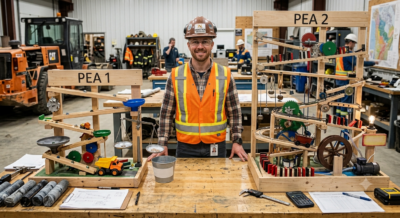
As stated in a previous article (“PEA’s – Not All PEA’s Are Created Equal“) different PEA’s will consist of different levels of detail.  This is driven by the amount of technical data available and used in the study.    The same issue applies to a single PEA whereby different chapters of the same study can be based on different degrees of data quality.
I have seen PEA’s where some of the chapters were fairly high level based on limited data, while other parts of the same study went into great depth and detail. This may not be necessary nor wise.

Think about the level of detail justifiable

If the resource is largely inferred ore, then the mine production plan will have an inherent degree of uncertainty in  it.  So there is not a lot of justification for other engineers (for example) to prepare detailed tailings designs  associated with that mine plan.
Similarly there is little value in developing a very detailed operating cost model or cashflow model for a study that has many underlying key uncertainties.  Such technical exercises may be a waste of time and money, adding to the study duration, increasing engineering costs, and giving the unintended impression that the study is more accurate than it really is.
Different levels of detail in the same study can crop up when diverse teams are each working independently on their own aspect of the study.   Some teams may feel they are working with highly accurate data (e.g. production tonnage) when in reality the data they were provided is somewhat speculative.
The bottom line is that it is important for the Study Manager and project Owner to ensure the entire technical team is on the same page and understands the type of information they are working with.   The technical detail in the final study should be consistent throughout.
Experienced reviewers will recognize the key data gaps in the study and hence view the entire study in that light regardless of how detailed the other sections of the report appear to be.
You can read more on the subject of uncertainty in PEA’s in another blog post at this link Mining PEA’s – Not All PEA’s Are Created Equal“.
Note: If you would like to get notified when new blogs are posted, then sign up on the KJK mailing list on the website.  Otherwise I post notices on LinkedIn, so follow me at: https://www.linkedin.com/in/kenkuchling/.
Share

Metal Equivalent Grade versus NSR for Poly-Metallics

NSR for poly-metallics
Many of the mining studies that I have worked on were deposits containing multiple recoverable metals.  For example this might be Ag-Pb-Zn mineralization or Cu-Pb-Zn-Au-Ag mineralization.    Discussions were held regarding whether to use a “metal-equivalent grade” to quantify the deposit grade or to use a Net Smelter Return (“NSR”) dollar value.
This also becomes an issue since one must decide how to apply a cut-off grade for mine planning and reporting.  It can be applied to the major metal grade only, to the equivalent grade, or to an NSR dollar value.

The NSR represents a $/tonne recovered

I have found that the geologists tend to prefer using a metal-equivalent grade approach.  This is likely due to the simpler logic and calculation required for an equivalent grade formula.  At an early stage it’s also simpler to select a reporting cutoff grade based on similar projects.
Generally I have no major concerns with the metal-equivalent approach at the resource estimate stage.   However from an engineer’s view, an equivalent grade does not provide a meaningful representation of the ore quality.
It is more difficult to relate an equivalent grade to an operating scenario that may rely on different mining or processing methods generating different final products (e.g. dore versus concentrates).  The NSR approach makes it easier to understand the actual quality of the ore.
On the downside, the NSR calculation will require more input data.  Assumptions needed relate to metallurgical recoveries, concentrate characteristics and costs, and smelter payables.  However the end result is an NSR block value that can be related directly to the site operating costs.
For example if a certain ore type has an on-site processing cost of $20/tonne and G&A cost of $5/tonne, then in order to breakeven the ore block NSR value must exceed $25/tonne.   If one decides to include mining costs and sustaining capital costs, then the NSR cutoff value would be higher.   In all cases one can directly relate the ore block value to the operating cost and use that to determine if it is ore or waste.  This is more difficult to do using equivalent grades.
Where the equivalent grade can become a problem is when one cosiders the impact of metal prices.  For example, the rock grades can be aggregated to, say, an Ag- equivalent.  However this does not mean that if the silver price goes up by 20% that the rock value also goes up by 20%.  The other metal prices may not have changed, and hence only the equivalent formula would change.   The rock value would go up, but not by 20%.

Using the NSR approach, the operating margin per block is evident.

One drawback to the NSR block value approach is that the calculation will be based on specific metal prices.  If one changes the metal prices, then one must recalculate all of the NSR block values and re-populate the model.
In some studies, I have seen higher metal prices used for resource reporting and then lower metal prices for mine planning or reserves.  In such cases, one can generate two different NSR values for each block.  One can use the same NSR cutoff value for reporting tonnages.   This two NSR approach is reasonable in my view since Resources and Reserves are different entities.

Pit Optimization

Pit optimization can also be undertaken using the block NSR values rather than ore grade values, so the application of NSR’s should not create any additional problems in this area.
For projects that involve metal concentrates, the cashflow model usually incorporates detailed net smelter return calculations, which include penalties, deductions, different transport costs, etc.  The formula used for the calculation of NSR block values can be simpler than the cashflow NSR calculation.   For example, one could try to build in penalties for arsenic content thereby lowering the NSR block value; however in actuality such ore blocks may be blended and the overall arsenic content in the concentrate may be low enough not to trigger the penalty.
Since the NSR block value is mainly used for the ore/waste cutoff, I don’t feel it is necessary to get overly detailed in its calculation.  The cashflow model should always calculate revenues from individual metals rather than using the block NSR value.
The bottom line is that from an engineering standpoint and to improve project clarity, I always prefer to use NSR values rather than equivalent grades.   Geologists may feel differently.
The cutoff grade is an important parameter in mine planning.  In another blog post I discuss whether in times of high metal prices, should the cutoff grade be lowered, raised, or kept the same.  You can read that at “Higher Metal Prices – Should We Lower the Cut-Off Grade?
Note: You can sign up for the mailing list to get notified when new blogs are posted.
Share

Mining PEA’s – Not All PEA’s Are Equal

Mining Preliminary Assessments
A Preliminary Economic Assessment (“PEA”) is defined in NI 43-101 as “…a study, other than a pre-feasibility or feasibility study, that includes an economic analysis of the potential viability of mineral resources”.  This is a fairly broad definition that provides for plenty of flexibility.  While there are generally accepted industry norms for a pre-feasibility or feasibility study, the mining PEA can have a broad scope.
Some PEA’s might be based on a large database of test work and site information while others may rely on very preliminary data and require design projections based on that data.
Some PEA’s may have production schedules consisting largely on Inferred resources while other schedules may be based on higher proportion of Indicated resource.
Some PEA’s are able to incorporate information from advanced socio-environmental work while other PEA’s may not have access to advanced information.
Therefore one should not view all PEA’s are being created equal. Perhaps that is what investors are doing it seems, in many cases ignoring the results of newly issued PEA’s.
The PEA is normally developed at a fairly early stage in the project life.  The initial PEA may then be superseded with a series of updated PEA’s as more data is acquired.  Typically one would expect to see changes in project size or scope in these updates and hopefully improved economics.  Shareholders appreciate being updated on positive growth trends.

Sequential PEA’s

The sequential PEA approach is a convenient way to continue advancement of the project without making the step to a Pre-Feasibility study or bigger step to a Feasibility study.  Maybe the project is still growing in size and a feasibility study at this stage would not be presenting the true potential, hence the updated PEA.
On the downside of the sequential PEA approach is that investors may get tired of hearing about PEA after PEA.  They may want to see a bigger advance towards a production decision.  They ask “How long can they keep studying this project?”.


There is no right or wrong as to what constitutes a PEA.

The securities commissions consider that the cautionary language an important component of the PEA Technical Report and may red-flag it if it’s not in all the right places.   However this cautionary language is generally focused on the resource.
For example the typical “The reader is cautioned that Inferred Resources are considered too speculative geologically to have the economic considerations applied to them that would enable them to be categorized as Mineral Reserves, and there is no certainty that value from such Resources will be realized either in whole or in part.
In that cautionary statement there is no mention of all the other speculative assumptions that may have been used in the study.
For example, the Inferred resource may not be that significant however the amount of metallurgical test work might be a more significant uncertainty.  The previous cautionary language doesn’t address this issue.  Therefore it is important to consider the chapters in the Report pertaining to risks and recommendations for a more complete picture of the entire report.

Conclusion

The bottom line is that when reviewing a PEA report, be aware of all the uncertainties and assumptions that have been incorporated into the study.   The report may be well founded or built on a shaky foundation.  No two PEA’s are the same and this must be clearly understood by the reviewer.
Currently it seems that share prices do not move much with the issuance of a PEA.  It seems there is a lack of confidence in them.  On the other hand, I have also heard that it is better for future financings if a project has at least reached the PEA stage.
Develop your own personal PEA “checklist” to identify the amount and quality of data used for the different parts of the study to help understand where data gaps may exist.
In another blog post I discuss how it is important for the Study Manager and project Owner to ensure the entire technical team is on the same page and understands the type of information they are working with.   The technical detail in the final study should be consistent throughout.   You can read that blog at “PEA’s – Is it Worth Agonizing Over Details“.
Note: If you would like to get notified when new blogs are posted, then sign up on the KJK mailing list on the website.  Otherwise I post notices on LinkedIn, so follow me at: https://www.linkedin.com/in/kenkuchling/.
Share

4 Mining Study Types (Concept to Feasibility)

Over my career I have been involved in various types of mine studies, ranging from desktop conceptual to definitive feasibility.    Each type of study has a different purpose and therefore requires a different level of input and effort, and can have hugely different costs.
I have sat in on a few junior mining management discussions regarding whether they should be doing a PEA or a Pre-Feasibility Study, or a Feasibility instead of a Pre-Feasibility Study.    Everyone had their opinion on how to proceed based on their own reasoning.   Ultimately there is no absolute correct answer but there likely is one path that is better than the others.  It depends on the short term and long term objectives of the company, the quality and quantity of data on hand, and the funding available.

4 types of mining studies

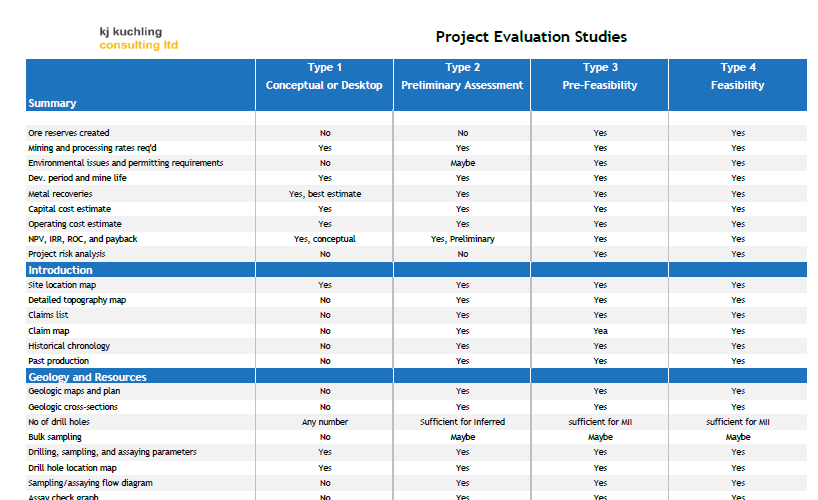
In general there are 4 basic levels of study, which are listed below.  In this blog I am simply providing an overview of them.  On the web there are detailed comparison tables, but anyone can contact me at KJKLTD@rogers.com for an a full copy of my table (an excerpt is shown below).

Four Studies Table

1. Desktop or Conceptual Mining Study
This would likely be an in-house study, non-43-101 compliant, and simply used to test the potential economics of the project.  It lets management know where the project may go (see a previous blog at the link “Early Stage “What-if” Economic Analysis – How Useful Is It?”.    I always recommend doing a desktop study, and preparing some type of small internal document to summarize it.  It doesn’t take much time and is not made public so the inputs can be high level or simply guesses.  This type of early stage study helps to frame the project for management and lets one test different scenarios.
2. Preliminary Economic Assessment (“PEA”)
The PEA (or scoping study) can be 43-101 compliant and present the first snapshot of the project scope, size, and potential economics to investors.  Generally the resource may still be uncertain (inferred classification), capital and operating costs are approximate (+/- 40%) since not all the operational or environmental issues are known at this time.   Avoid promoting the PEA as an “almost” feasibility level study.

Don’t Announce a PEA Until You Know the Outcome

I recommend not announcing the start of a PEA until you are confident in what the outcome of that PEA will be.   A reasonable desktop study done beforehand will let a company know if the economics for the PEA will be favorable.  I have seen situations where companies have announced the start of a PEA and then during the course of the study, things not working out economically as well as envisioned.  The economics were poorer than hoped and so a lot of re-scoping of the project was required.  The PEA was delayed, and shareholders & analysts negative suspicions were raised in the meantime.
The PEA can be used to evaluate different development scenarios for the project (i.e. open pit, underground, small capacity, large capacity, heap leach, CIL, etc.).  However the accuracy of the PEA is limited and therefore I suggest that the PEA scenario analysis only be used to discard obvious sub-optimal cases.  Scenarios that are economically within a +/-30% range of each other many be too similar to discard at this PEA stage.  This is where the PFS comes into play.
3. Pre-Feasibility Study (“PFS”)
The PFS will be developed using only measured and indicated resources (no inferred resource used) so the available ore tonnage may decrease from a previous PEA study.  The PFS costing accuracy will be greater than a PEA.  Therefore the PFS is the proper time to evaluate the remaining mine development scenarios.  Make a decision on the single path forward going into the Feasibility study.

Use the PFS to determine the FS case

More data will be required for the FS, possibly a comprehensive infill drilling program to upgrade more of the the resource classification from inferred to indicated.  Many companies, especially those with smaller projects might skip the PFS stage  entirely and move directly to Feasibility.  I don’t disagree with this approach if the project is fairly simple and had a well defined scope at the PEA stage.
4. Feasibility Study (“FS”)
The Feasibility Study is the final stage study prior to making a production decision.  The feasibility study should preferably be done on a single project scope.  Try to avoid more scenario option analysis at this stage.
Smaller companies should be careful when entering the FS stage.  Once the FS is complete, shareholders will be expecting a production decision.  If the company only intends to sell the project with no construction intention, they have now hit a wall.  What to do next?

Sometimes management feel that a FS may help sell the  project.

I don’t feel that a FS is needed to attract buyers and sell a project.  Many potential buyers will do their own in-house due diligence, and possibly some alternate design and economic studies.   Likely information from a PFS would be sufficient to give them what they need.  A well advanced Environmental-Socio Impact Assessment may provide more comfort than a completed Feasibility Study would.

Conclusion

executive meetingMy final recommendation is that there is no right answer as to what study is required at any point in time.  Different paths can be followed but consideration must be given to future plans for the company after the study is completed.   Also consider what is the best use of shareholder money?
Company management may see pressure from retail shareholders, major shareholders, financial analysts, and the board of directors to “do a study”.  Management must decide which mining study path is in the best longer term interests of the company.  Maybe no study is warranted.
Note: If you would like to get notified when new blogs are posted, then sign up on the KJK mailing list on the website. Follow us on Twitter at @KJKLtd for updates and insights.
Share