


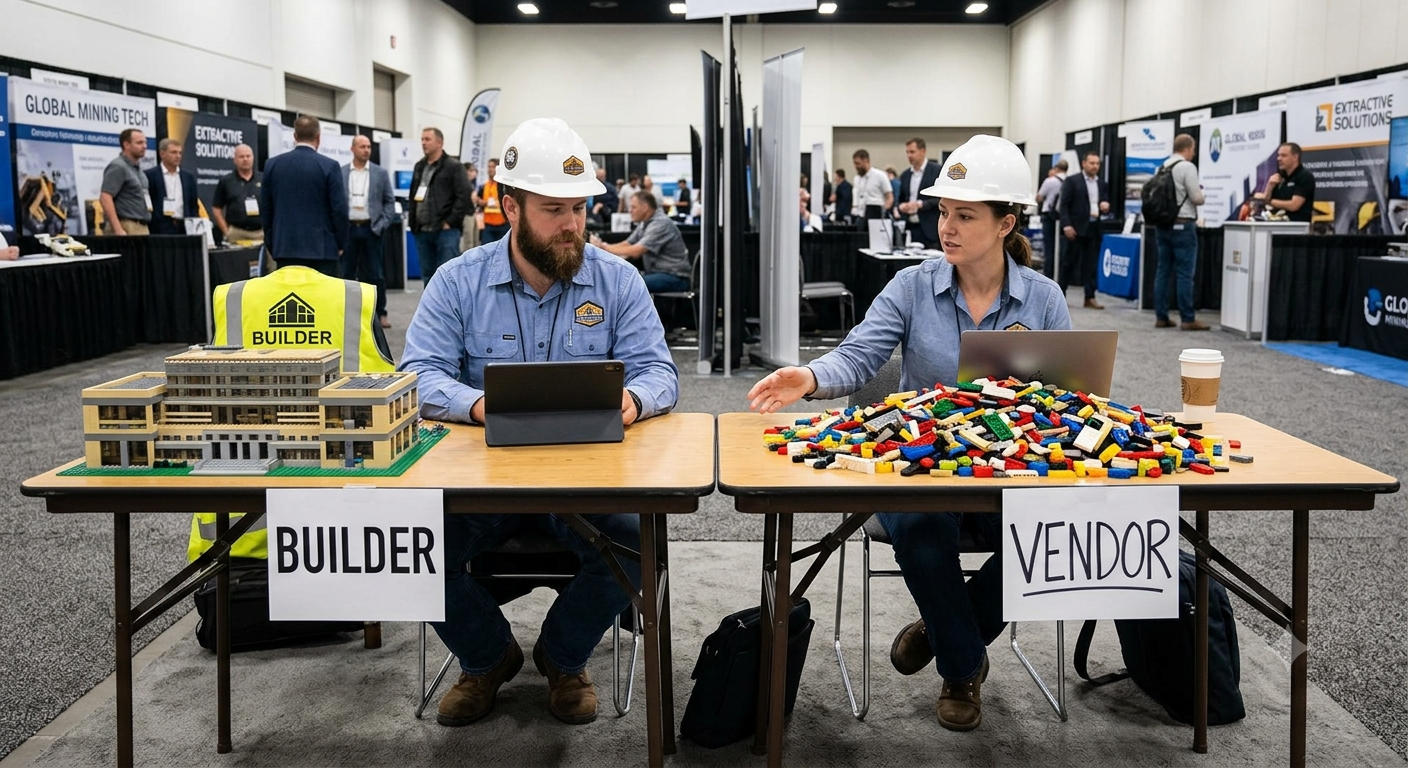
 Normally Major and Intermediate miners advance their projects through the study stages with the ultimate intent to actually build the mine. Sometimes they may opt to sell their project if it no longer fits in their long term strategy or if they desperately need some cash. However, selling the project when it was first acquired was likely not their initial intent. They want to be on a Mine Builder path.
On the other hand, Junior miners will follow one of two paths. They are either on (a) the Mine Builder path, or (b) the Mine Vendor path (i.e. sell the project to someone who will build it). In this article, I will present some examples of companies on each path.
There will also be some discussion on whether the engineers undertaking early stage studies (e.g., PEA’s) should be considering the path their client is intending to follow.
The Mine BUILDER Path
The Mine Builder generally follows a systematic approach, as sketched out in the image below. The project advances from drilling to Mineral Resource Estimate (MRE), scoping study (PEA), then through the Pre-Feasibility Study (PFS) and/or Feasibility Study (FS) stages. Environmental permitting is normally proceeding in conjunction with the engineering work. Once the FS is complete, with permits in hand, the next hurdles for the Mine Builder are financing and construction. The entire path is fairly orderly and can be aggressive.
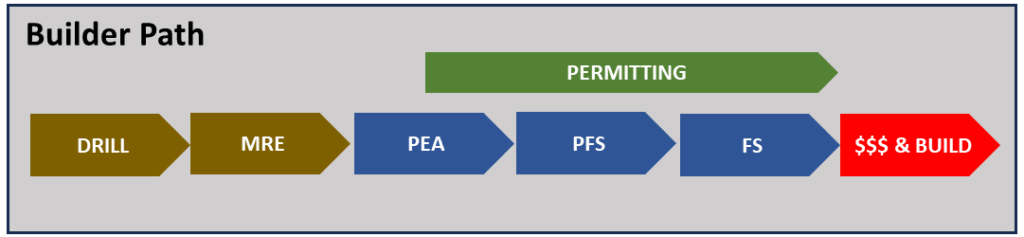
The amount of exploration drilling is only needed to define an economic resource to the Measured and Indicated classifications. There is usually no requirement to delineate the entire mineral resource on the entire property. There will be plenty of time to do that during production. Demonstrating an economic resource, with some geological upside potential, is often sufficient for the Mine Builder. If the resource grows significantly, they can always introduce an expansion phase. They don’t need to have everything fully optimized at the start.
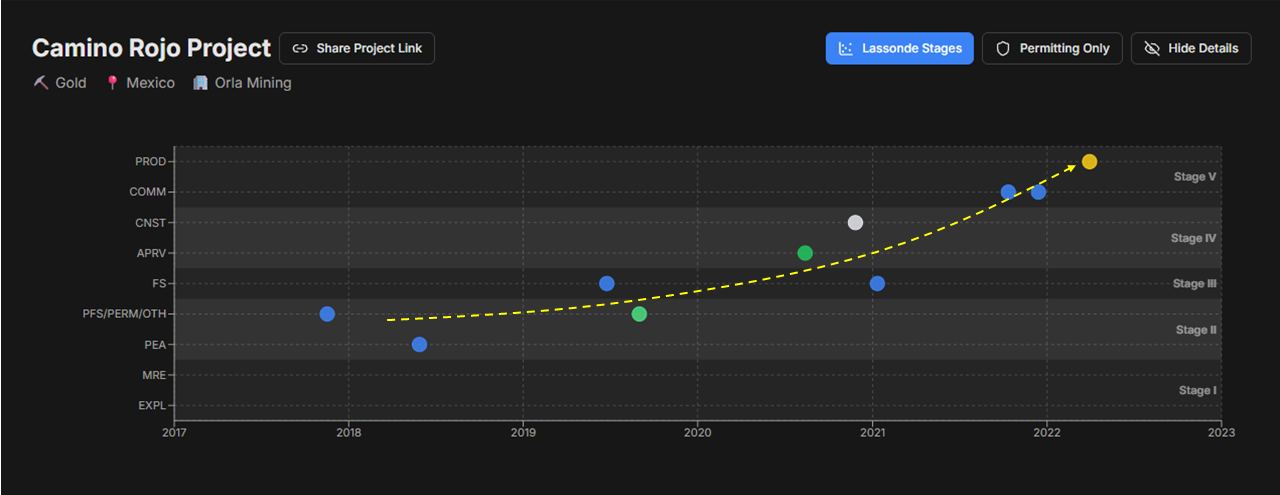
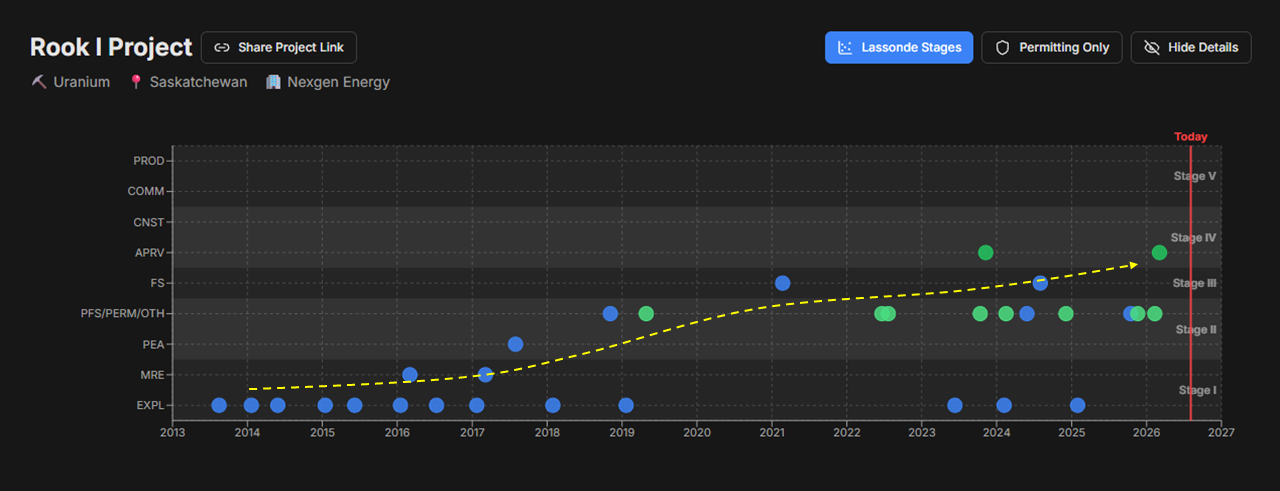
Three examples of companies on the Builder path are shown below; Orla Camino Rojo gold project (in operation), SilverCrest Las Chispas gold project (in operation), and Nexgen Rook uranium project (financing stage). One may question the inclusion of Rook on this list, since its progress appears to be flattening off.
The three plots show the five Lassonde Stages and the dash line highlights the upward path through each stage (shown on the right axis). Individual milestones are on the left axis. For similar charts for other projects, visit the DrillingDown website Timeline Viewer: https://sites.google.com/view/drillingdown/timeline-viewer
Although the duration of each timeline is different due to different project complexities, the development paths are consistent. Most junior miners would not consider themselves on the Builder path.
Mine Vendor type organizations have the primary goal of selling their project. These companies may consist of management teams that don’t have the desire, comfort, or capability to put a mine into production. For example, this is often the case with companies founded by exploration geologists, whereby their concept is to explore, grow the resource, and then sell all (or part) of the project. There is nothing wrong with this approach.
In other cases the Junior miner realizes their project is too large with a massive capital cost. That capital cost is beyond the financial capability of the company. Hence a deep-pocket partner is needed or an outright sale is preferred.
The Mine Vendors tend to follow a different development path than the Mine Builders. They don’t have the same fast track objective as the Mine Builder. Vendors want out at some point.
The Vendor path can be more irregular, with multiple exploration programs interspersed with studies undertaken at different levels of detail. Sometime studies will step back to lower level as more information is acquired. Their object is to make the project look good to potential buyers, and look better than their junior miner competitors also for sale. This ongoing project improvement process is termed “de-risking”.
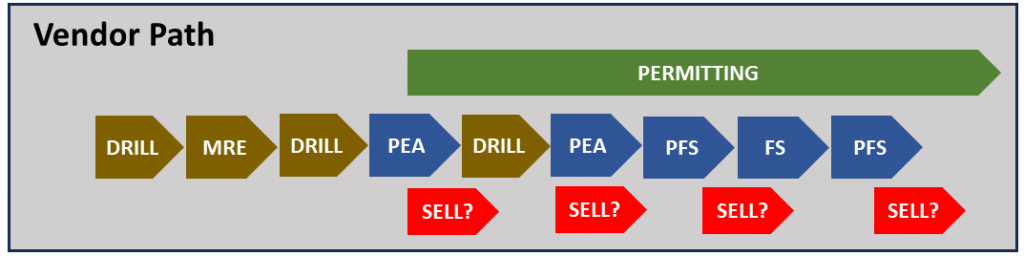
Not only must the Vendors demonstrate an economic resource, they must demonstrate a highly valuable resource to maximize the acquisition price for the shareholders. They will try to do this through multiple drill campaigns followed by multiple studies, each one looking better than the prior one. Rising metal prices helps, inflation hurts.
Sometimes you will see a management team state, if the project isn’t sold, they are going to put it into production themselves. This may be true in some cases, or simply part of the negotiating game to try to maximize the acquisition price.
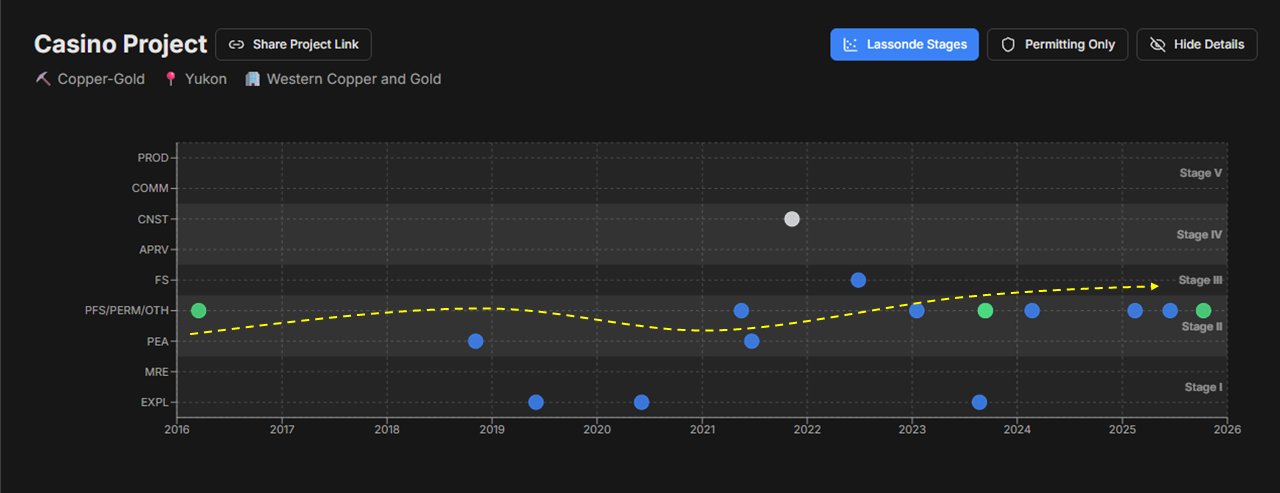
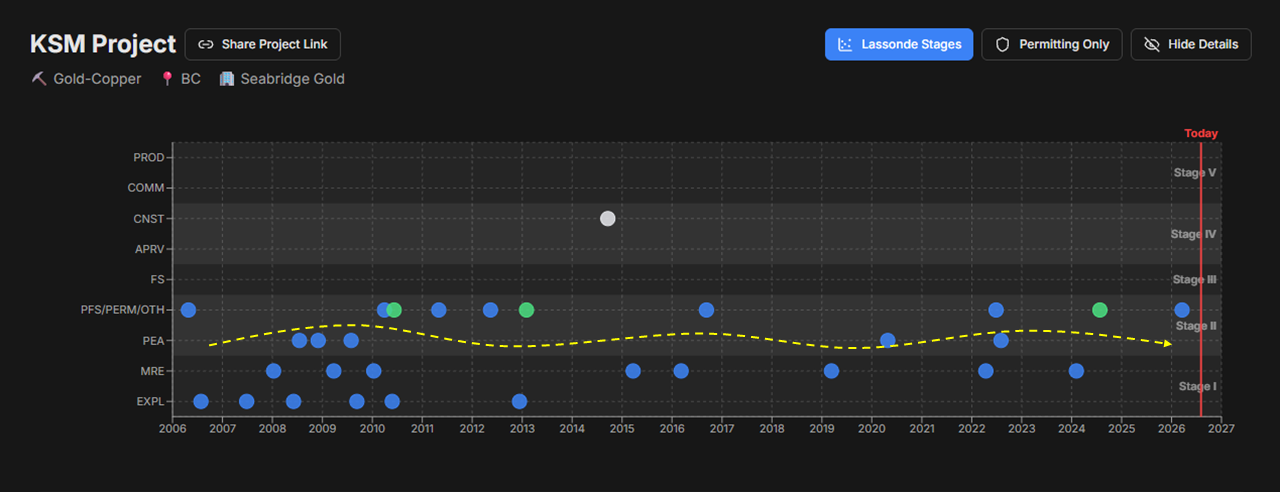
Two quick examples of companies on the Vendor path are shown below: Western Copper Casino project and Seabridge KSM project. The duration of their development timelines are extensive and expensive, while waiting for an interested buyer. During these periods, the companies may continue to spend money de-risk the project further. The defining line tends to be the Feasibility Study – some will delay this stage as long as possible since it can signal the end of the road. Either build or move on.
The hope is that the company can eventually make the project attractive or that changing market conditions will make it attractive for them. Unfortunately, there is always the possibility that no buyer will ever come along. In that case, find another project and work on that while hanging on to the original.
An QP Engineer’s Perspective
A pertinent question is whether the independent geologists and engineers working on the advanced studies should be aware of the path the company is intending to follow. Is the company a Builder or a Vendor?
Some may feel that the focus of the technical work should be independent of the path being followed. Based on my experience as both an owner’s representative and independent study QP, I have a somewhat different opinion. The technical work should be tailored to the intended path.
The Engineer on the MINE BUILDER Path
 If an engineer understands that a Mine Builder’s project will move from PEA to PFS to FS in rapid succession, then there is more incentive to ensure each study is somewhat integrated.
For example, a PEA will use Inferred resources in the economics. However, if the project will advance to the PFS stage, where Inferred cannot be used, then it is important for the PEA to understand the role that Inferred plays in the economics. How much drilling will be needed to upgrade Inferred resource to Indicated for the PFS, if needed at all?
Typically, capital costs tend to increase as advancing studies get more accurate due to greater levels of engineering. A Builder wants to avoid large cost increases when moving from PEA to PFS to FS. Therefore, when costing at the PEA stage, one may wish to increase contingency or use conservative design assumptions. Be realistic. After all, one is not trying to sell or promote the project, but rather move it towards production.
There is no value to the Mine Builder by fooling themselves with low-balled cost estimates. (Although some may argue there is still a desire to low ball costs to get internal management to approve the project, and maybe this does happen sometimes). Conversely Mine Vendors do have some incentive to low ball the costs.
Perhaps some of the recent project capital cost over-runs we have seen is that the Vendor mentality was used at the PEA stage to optimistically set the capital cost baseline. Subsequent studies were then forced to conform to that initial baseline cost estimate. Ultimately construction will be the arbiter on the true project cost. Hence there is no real value in underestimating costs, ultimately making management appear incompetent if costs over-runs do occur.
The Mine Builder will also be advancing environmental permitting simultaneously with their baselines and advanced studies. Hence at the early stage (PEA) it is important to properly define the site layout, processing method, production rate, facility locations, etc. since they all feed into the permitting documents.
Changing significant design details in the future will set back the permitting and construction timelines. Hence, for the Mine Builder, the engineers should focus on getting the design criteria mostly correct at the PEA stage. For the Mine Vendor, this is not as important since multiple studies are being planned for in the future anyway.
The Engineer on the MINE VENDOR Path
 The objective of the Mine Vendor is to make the project attractive to potential buyers. There is less urgency in fast tracking towards detailed engineering.
On this path it is typical to see multiple drilling programs, followed my multiple studies of scenarios with different size, production rate, and layout. The degree of engineering conservativeness in design and costing is less critical since future studies may be on substantially different sized projects. Open pit only studies may move to combined open pit and underground operations as future drill changes the nature of the deposit.
The role that the Inferred resource plays in the economics is also less important at this time, since a lot more infill drilling may be coming. The Vendor’s objective tends to be on maximizing resource size not necessarily optimizing resource classification.
While the Mine Vendor may also be advancing environmental permitting as another way to de-risk the project, the project design may still be in flux as the resource size changes. Major modifications to the plan may cause permitting to stop and re-start, leading to an extended project timeline and wasted money.
There is also risk in starting the permitting with a project definition that isn’t of economic interest to future buyers. Sometimes the Vendor may be making regulatory commitments or design revisions that constrain the operating flexibility of future mine operators. Its easy to commit to environmental conditions when you aren’t the one having to live up to them.
The Mine Vendor will also de-risk the project by moving from PEA to PFS and even to FS. The caution with completing a FS is that it is a costly study and essentially brings one to the end of the study line. Feasibility studies have the dual role of trying to boost the share price and market cap with a great NPV, as well as frame the project for potential buyers. What does the company do now if there is still no buyer?
Feasibility studies also have a shelf life, with the cost estimates and economics becoming inaccurate after a few years. Some companies may re-examine the project, re-frame it, and jump back to the PEA or PFS stages. One can create an on-going study loop, requiring continued funding with no guarantee of a salein sight. Consultants love it.
Conclusion
 As an engineer, it is helpful to understand the objectives of the project owner and then tailor the technical studies to meet those objectives. This does not mean low balling costs to make the study a promotional tool. It means focusing on what is important. It means recognizing the path, and what doesn’t need to be engineered in detail at this time. This may save the client time, money, and improve credibility in the long run.
In many cases, the precise size of the deposit is less important than understanding the site, access, water supply, local community issues, the environmentally acceptable location for dumps and tailings, etc.. It can be more important to focus on these issues rather than having a detailed mine plan with multiple pit phases that immediately becomes obsolete in a few months after the next drilling campaign.
Potential buyers will have their own technical team that will develop their own opinions on what the project should be and what it should cost. Just because a Mine Vendor has a Feasibility Study in hand, doesn’t mean a potential buyer will believe it.

Note: You can sign up for the KJK mailing list to get notified when new blogs are posted. Follow me on Twitter at @KJKLtd for updates and other mining posts. The entire blog post library can be found at https://kuchling.com/library/
For some free mining calculator apps, including project timelines and a simplified cashflow modeller, check out this website https://sites.google.com/view/drillingdown

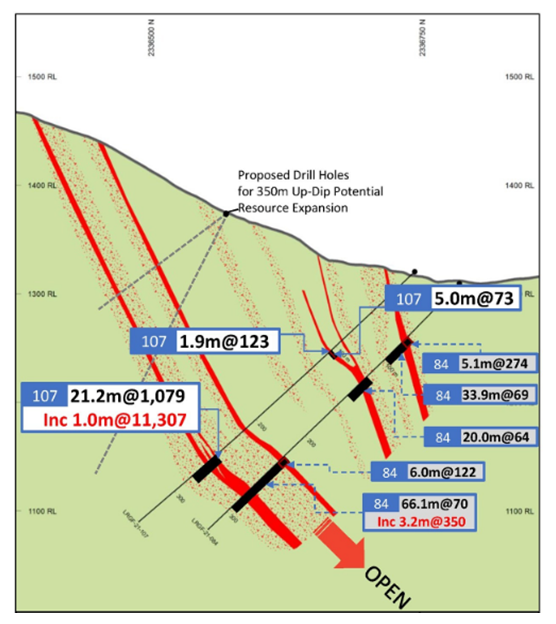 This article is about the benefit of preparing (cutting) more geological cross-sections and the value they bring.
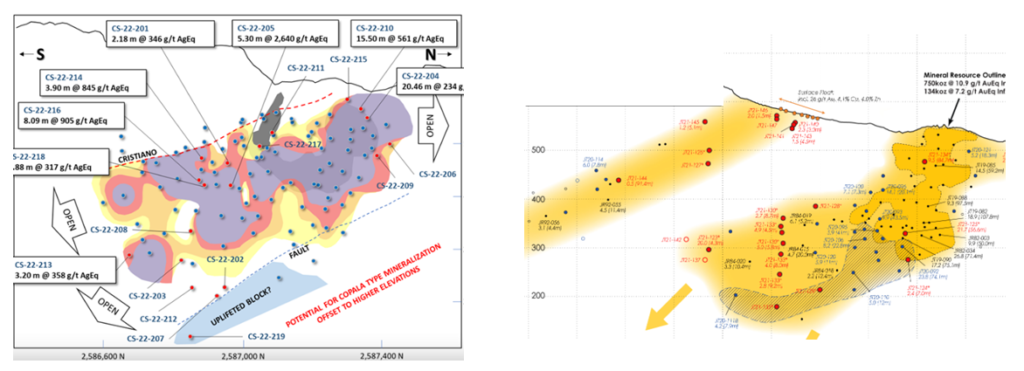 Long sections are aligned along the long axis of the deposit. They can be vertically oriented, although sometimes they may be tilted to follow the dip angle of an ore zone.
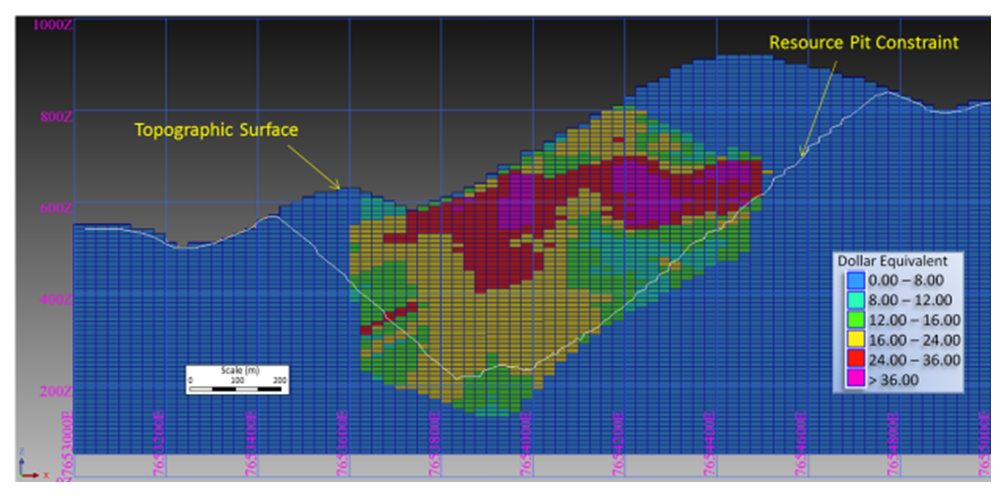 Cross-sections are generally the most popular geological sections seen in presentations. These are vertical slices aligned perpendicular to the strike of the orebody. They can show the ore zone interpretation, drill holes traces, assays, rock types, and/or color-coded resource block grades.
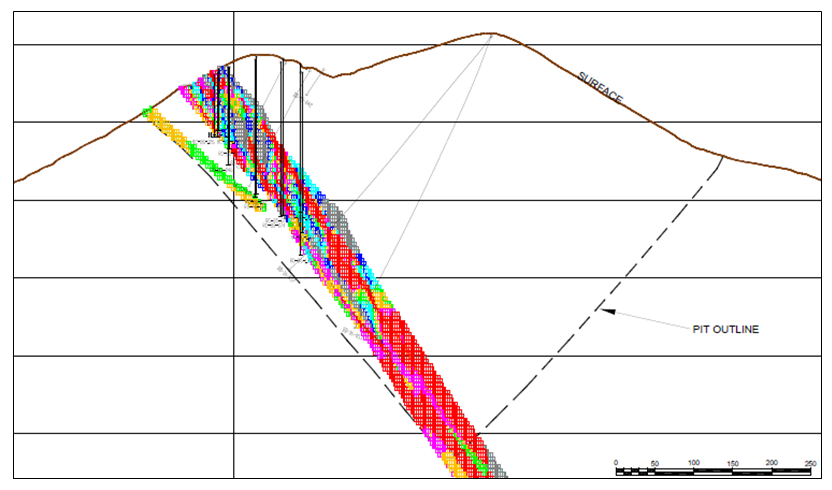 When looking at cross-sections, it is always important to look at multiple cross-sections across the orebody. Too often in reports one may be presented with the widest and juiciest ore zone, as if that was typical for the entire orebody. It likely is not typical.
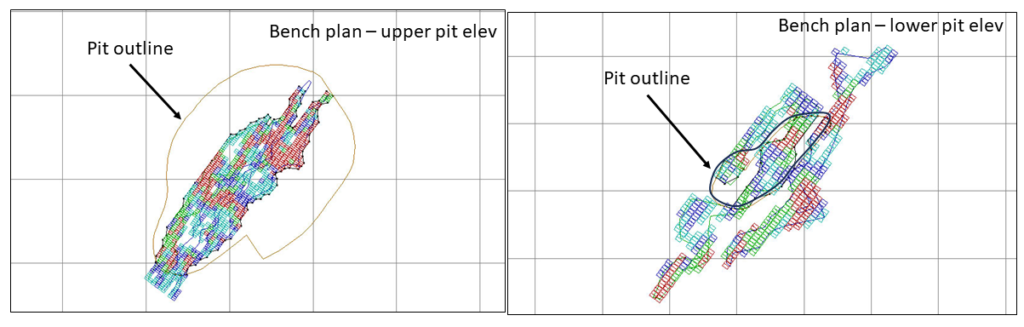 Bench plans (or level plans) are horizontal slices across the ore body at various elevations. In these sections one is looking down on the orebody from above.
 3D PDF files can be created by some of the geological software packages. They can export specific data of interest; for example topography, ore zone wireframes, underground workings, and block model information. These 3D files allows anyone to rotate an image, zoom in as needed and turn layers off and on.
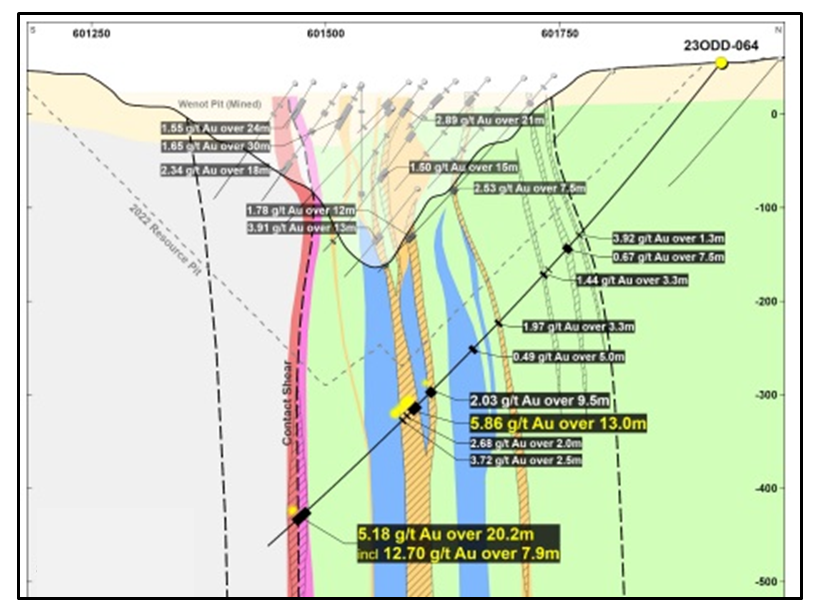 The different types of geological sections all provide useful information. Don’t focus only on cross-sections, and don’t focus only on one typical section. Create more sections at different orientations to help everyone understand better.
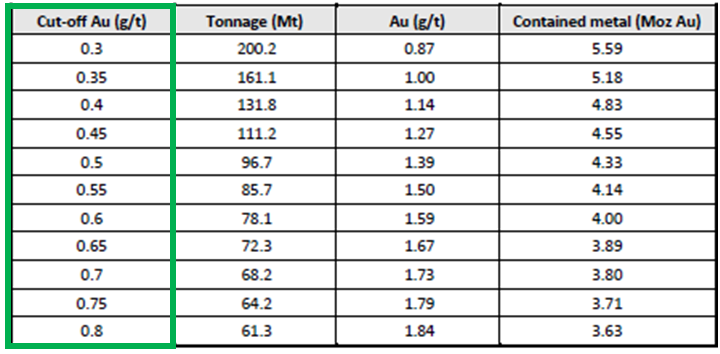
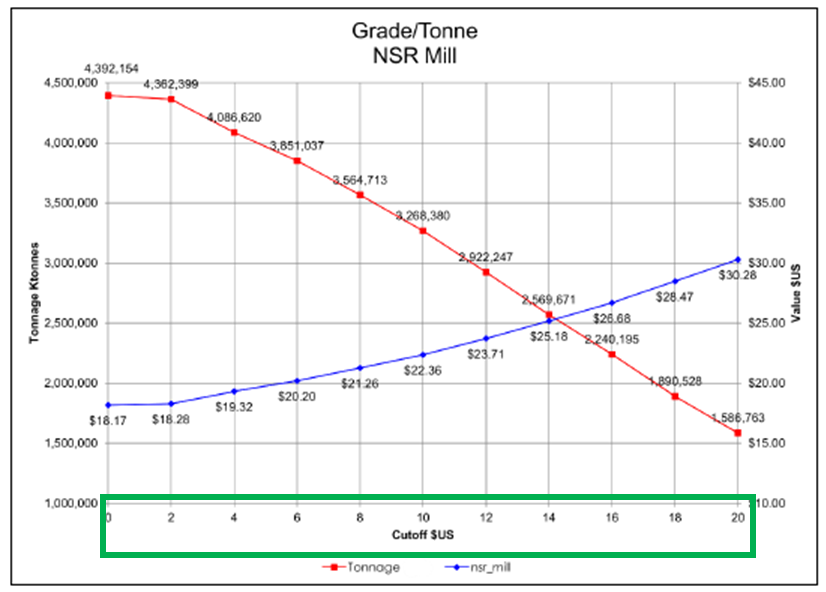
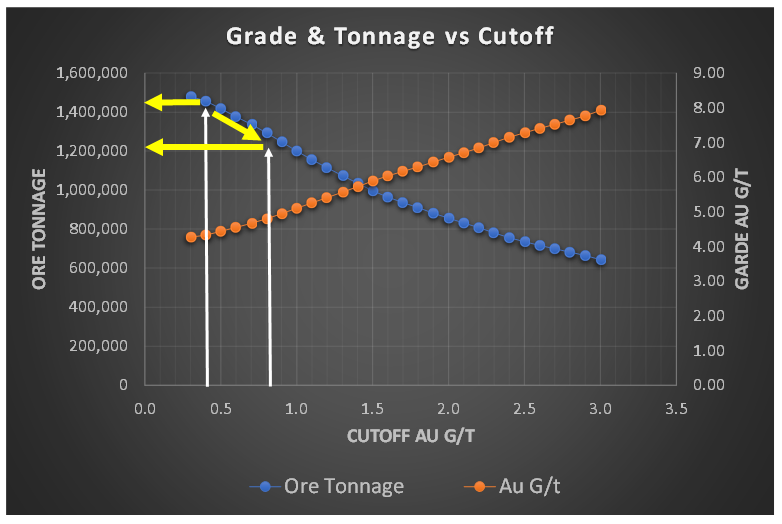 When I am undertaking a due diligence review or working on a study, very early on I like to have a look at the grade-tonnage information. This could be for the entire deposit resource, within a resource constraining shell, or in the pit design.
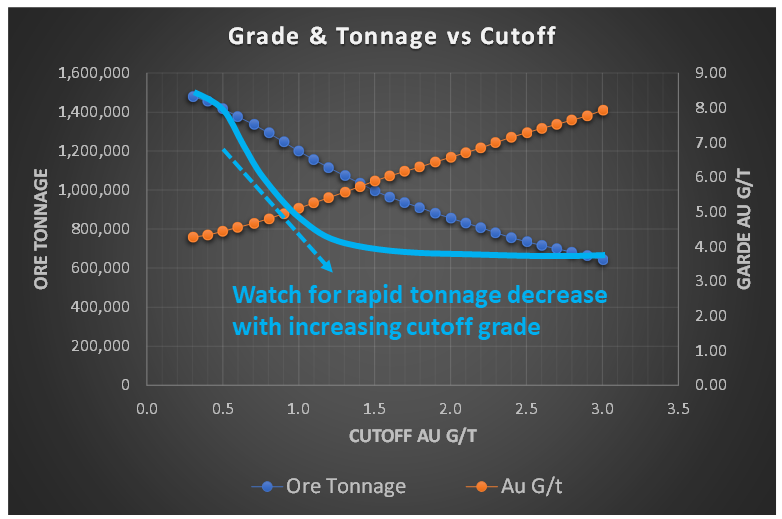 However, if the tonnage curve profile resembled the light blue line in this image, with a concave shape, the ore tonnage is decreasing rapidly with increasing cutoff grade. This is generally not a favorable situation.
 One complaint I have about reporting mineral resources inside a resource constraining shell is the lack of strip ratio information. This applies whether disclosing a single mineral resource estimate or variable grade-tonnage data.
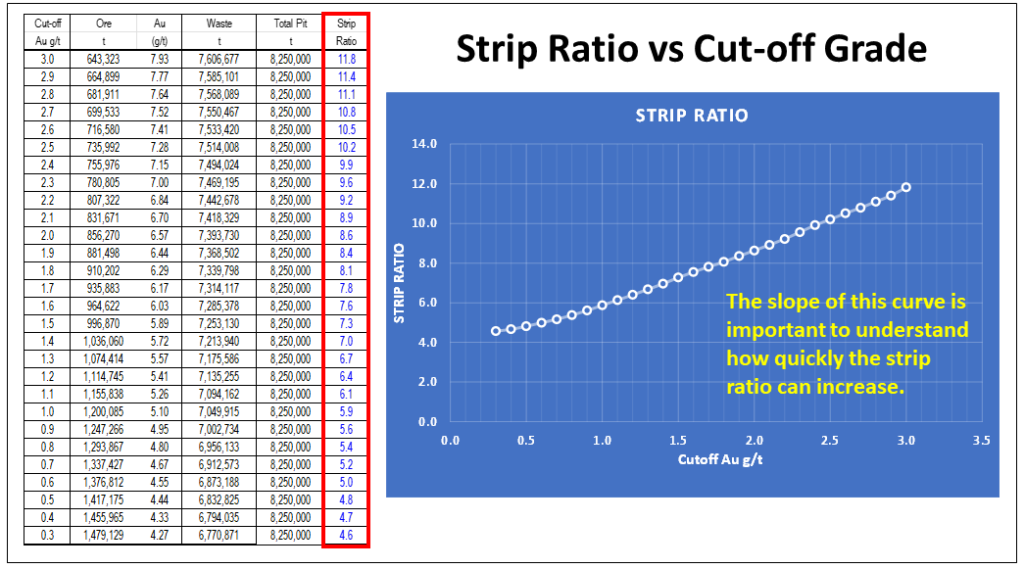 Regarding mineral resources, one should be required to disclose the waste tonnage and strip ratio when reporting resources inside a constraining shell. The constraining shell and cutoff grade are both based on defined economic factors such as unit mining costs, processing cost, process recoveries, and metal prices. With respect to the mining cost component, the strip ratio is a key aspect of the total mining cost, yet it normally isn’t disclosed.
 In 43-101 technical reports, the financial Chapter 22 normally presents the project sensitivities expressed in a spider diagram or a table format.
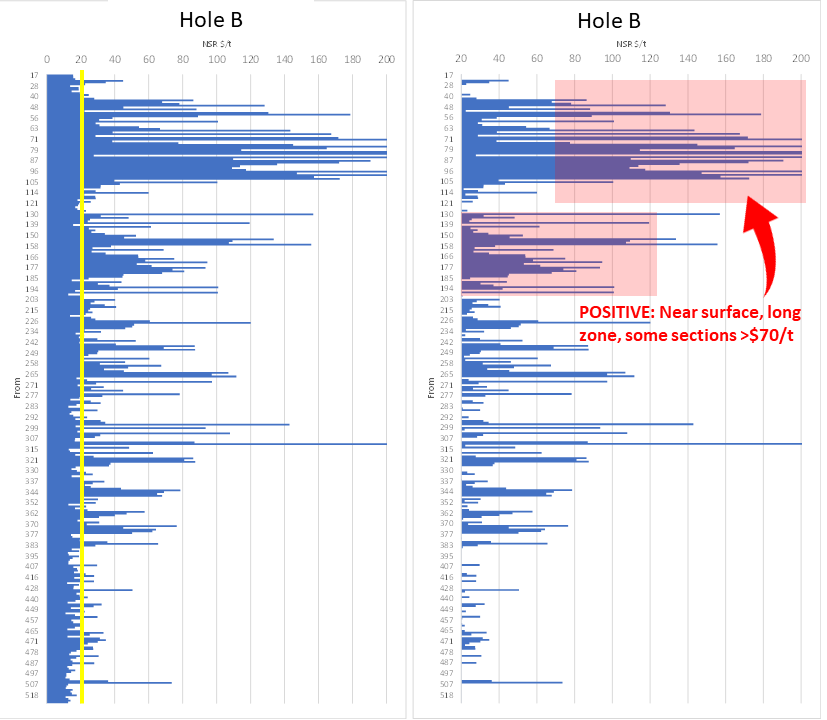
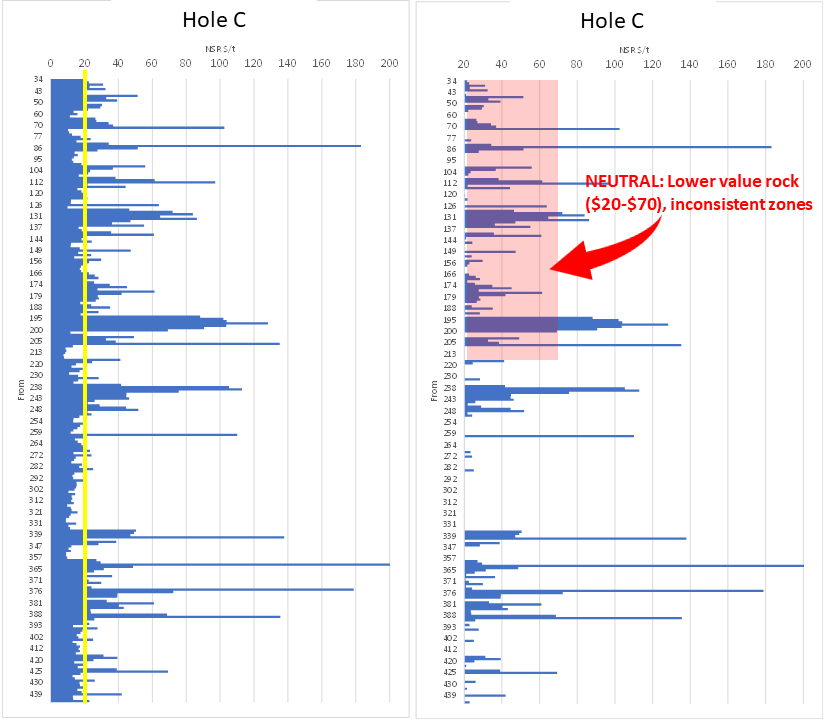
 When disclosing polymetallic drill results, many companies will convert the multiple metal grades into a single equivalent grade. I am not a big proponent of that approach.
 The three aspects that interest me the most when looking at early-stage drill results are:
 The “NSR factor” would now be 85% x 85% or 75%. Therefore, if the breakeven cost is $14/t, then one should target to mine rock with an insitu value greater than $20/tonne (i.e. $14 / 0.75). This would be the approximate ore vs waste cutoff. It is still only ballpark estimate at this early stage, but good enough for this type of review.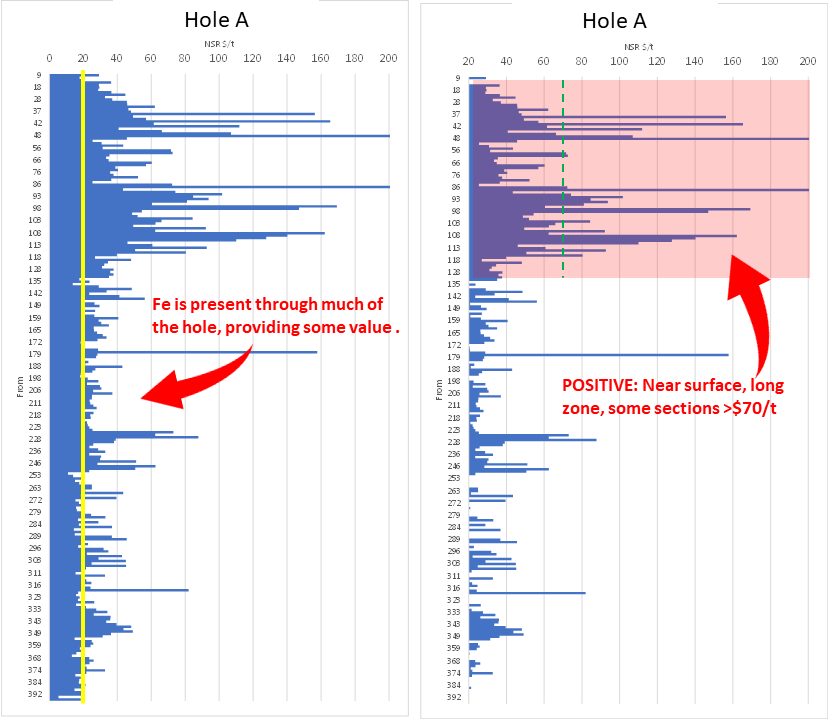


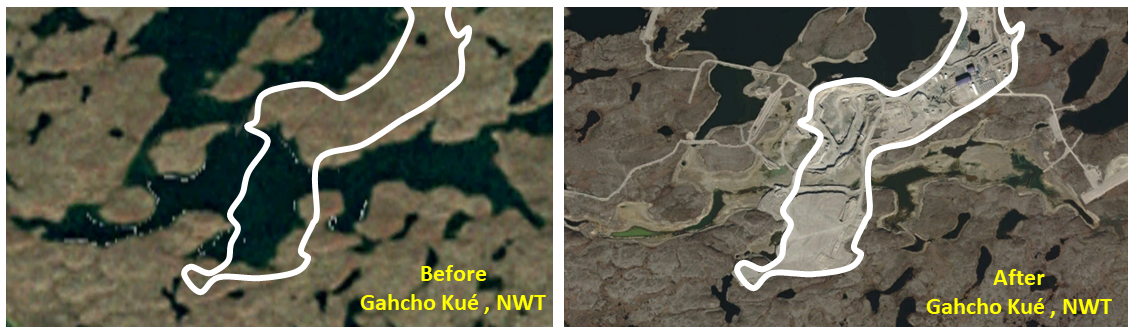
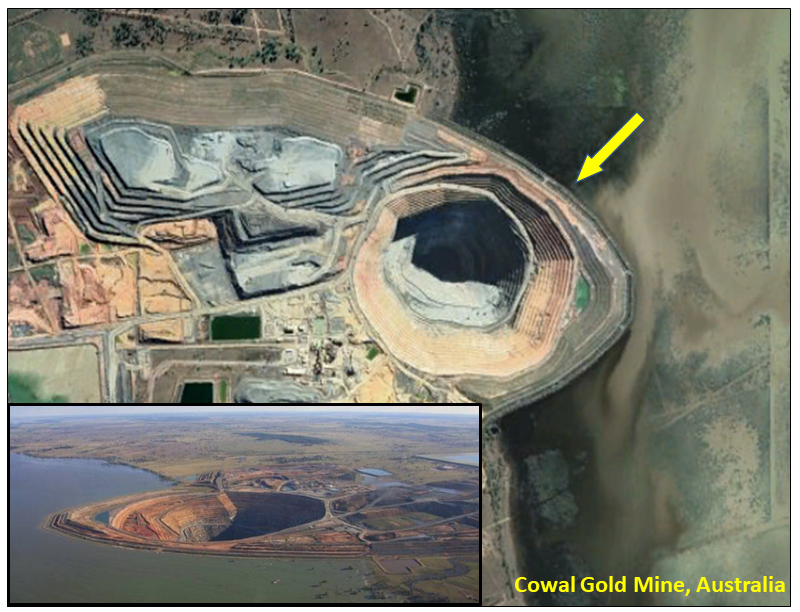
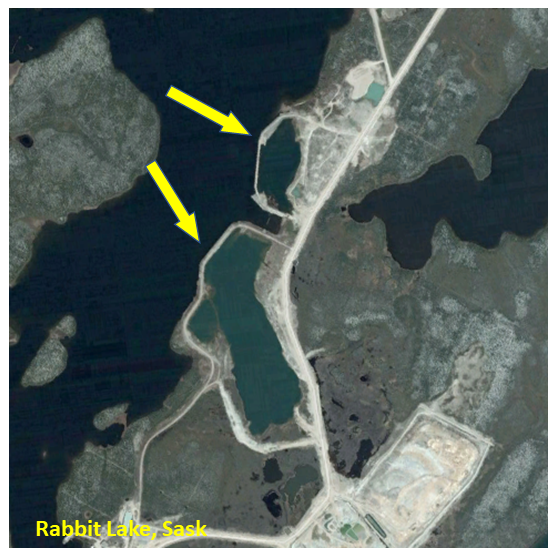
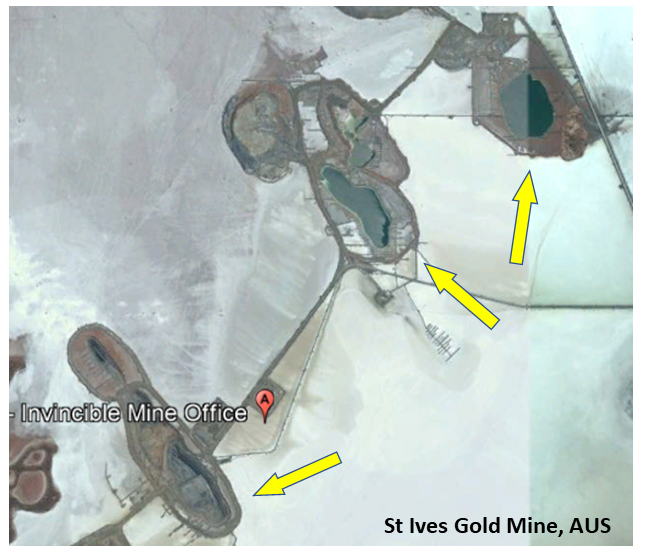
 This is Part 2 of a blog post related to open pit mining within bodies of water. Part 1 can be found at this link “
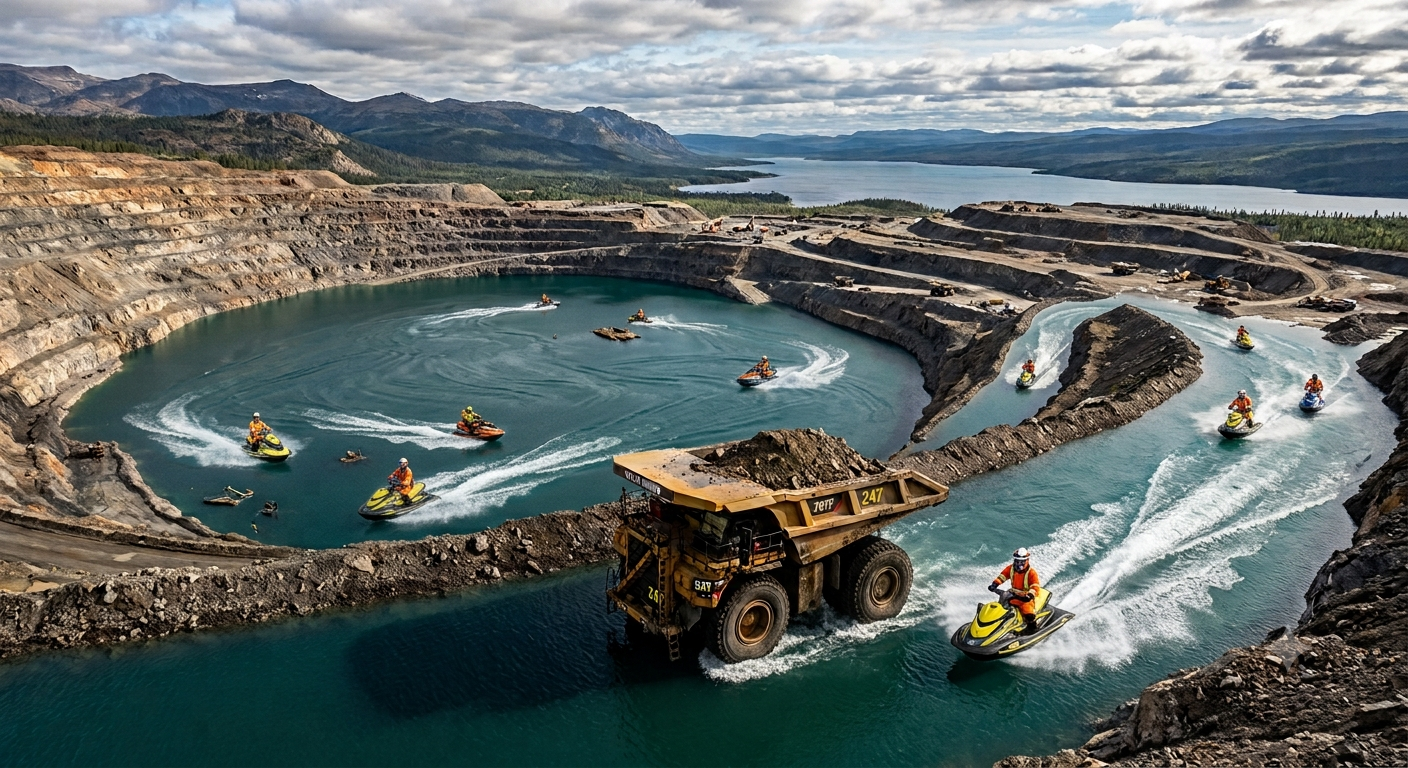
 The primary question to be answered is whether one can mine safely and economically without creating significant impacts on the environment.
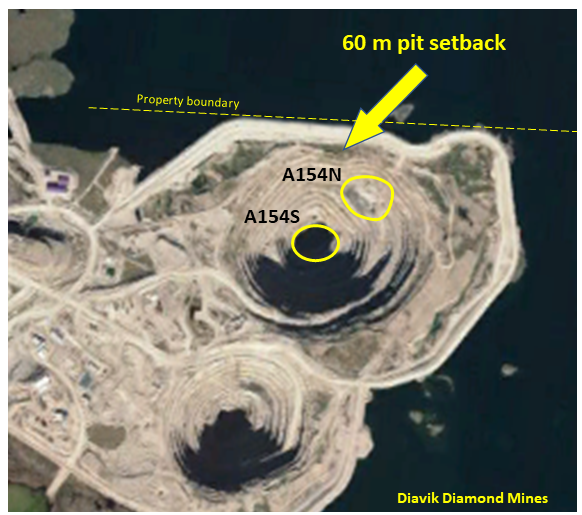
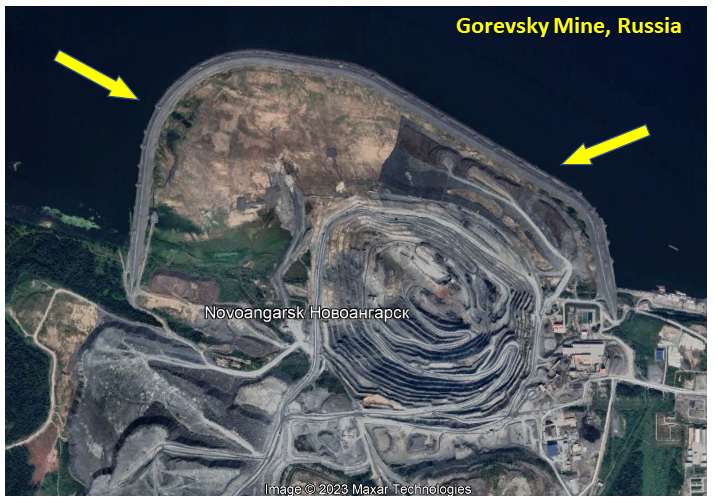
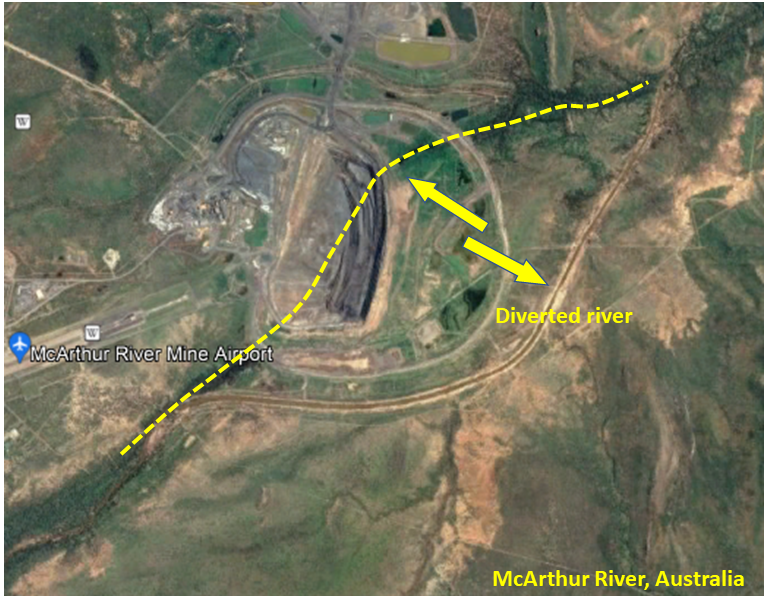
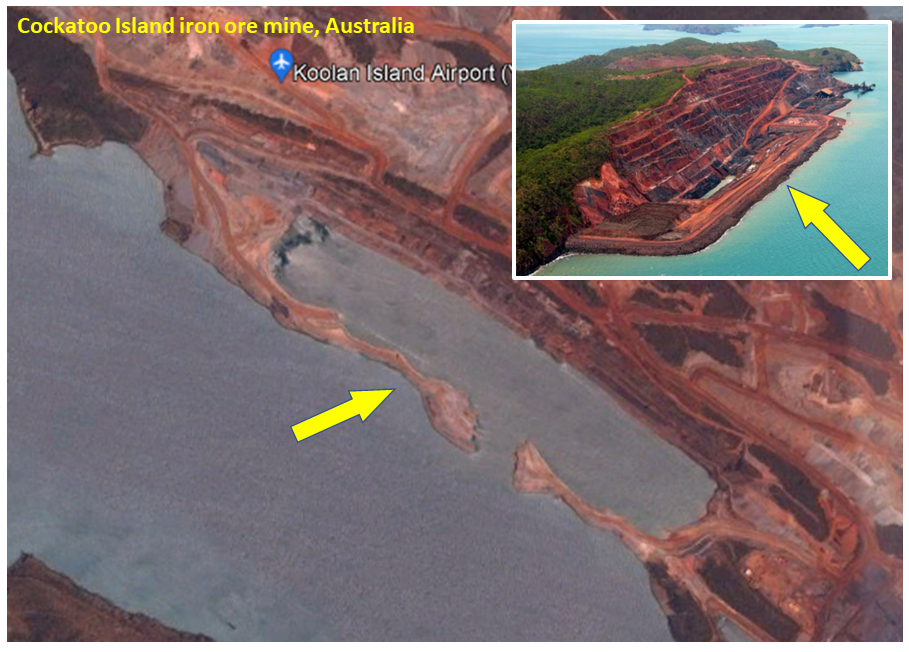
 Once the approximate location of the dike has been identified, the next step is to examine the design of the dike itself. Most of the issues to be considered relate to the geotechnical site conditions.
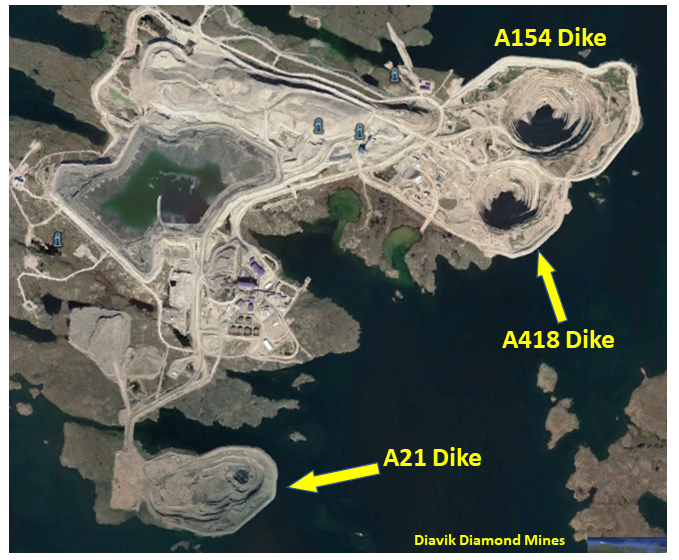
 Each mine site is different, and that is what makes mining into water bodies a unique challenge. However many mine operators have done this successfully using various approaches to tackle the challenge.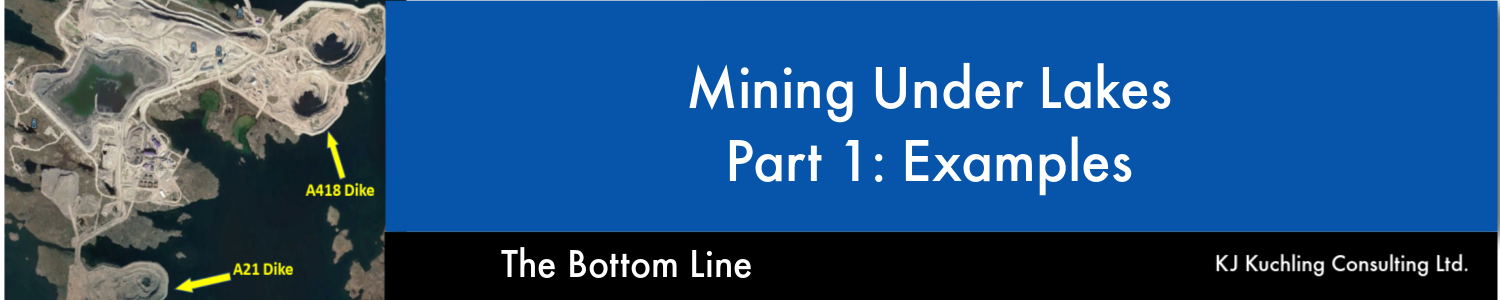


 NPV One is targeting to replace the typical Excel based cashflow model with an online cloud model. It reminds me of personal income tax software, where one simply inputs the income and expense information, and then the software takes over doing all the calculations and outputting the result.
 Pros
Pros Like anything, nothing is perfect and NPV may have a few issues for me.
 The NPV One software is an option for those wishing to standardize or simplify their financial modelling.
 We likely have all heard the statement that increasing pit wall angles will result in significant cost savings to the mining operation.
 The results of applying the increased inter-ramp angle to each of the four pits is shown in the Bar Chart. Note that the waste reduction is not necessarily the same for each pit. It depends on the specific topography around each pit.
 In general one can typically see four positive outcomes from adopting steeper pit walls. They are as follows:
 4. Pit Crest Location: The steeper wall angles result in a shift in the final pit crest location. The Image shows the impact that the 5 degree steepening had on the crest location for one of the pits in this scenario.
 It is relatively easy to justify spending additional time and money on proper geotechnical investigations and geotechnical monitoring given the potential slope steepening benefits.

 I remember in the late fall of that year, the company had a chance to bid on a larger project in Gros Morne National Park, Newfoundland. So our President, Frank Nolan (he was a brother to Fred Nolan, the infamous land-owner at Oak Island, by the way), decided he wanted to see the site and he chartered a Bell 106 helicopter to fly us there from Deer Lake. It was December (they say “December month” in that province) and when we got close to the Park, we ran into a sudden snow squall.
 The QMM field office In Port Dauphin, Madagascar was located near the edge of town, and I typically walked from my lodging to the office each morning when I was there, about the time when school started for the children. Typically I passed dozens and dozens of tiny bamboo huts with corrugated metal roofs, and dirt floors each about 2 meters square.
 It is one thing to briefly visit a remote project as part of a review team. It is another thing to be there as part of a design team trying to solve a problem and engineer a solution. I know of many engineers and geologists that would have similar work life experiences as part of their careers. However John has taken the initiative to write it all down.
 Overburden is a generalized termed used to describe unconsolidated material encountered at a mine. It can consist of gravels, sands, silts, and clays and combinations of each. Usually overburden is not given much focus in many mining studies. Very often, the overburden as a unit, is not adequately characterized.
 These are the clays most people are familiar with, i.e. a sedimentary deposit of very fine particles that have settled in a calm body of water. Normally consolidated clays are generally not a problem, other than having a high moisture content. As such, they can be very sticky in loader buckets, truck boxes, and when feeding crushers.
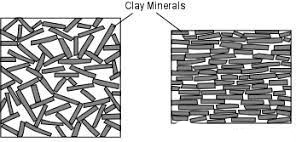 Clays in general consist of very fine plate like particles, as shown in this sketch. In over-consolidated clays, these particles have been flattened and tightly compressed as in the right image. The result is that the clay may be dense, have a good cross bedding shear strength, but very low shear strength along the plates. This characteristic is analogous to the lubricating properties of graphite, which is facilitated by sliding along graphite plates.
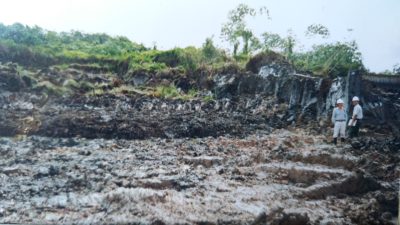 My experience with sensitive clays was at the former BHP bauxite mining operations along the northern coast of Suriname. There were Demerara clay channels up to 20m thick over top of many of their open pits. The bucketwheel excavators used for waste stripping would trigger the quick clay slope failures, sometimes resulting in the crawler tracks being buried and unfortunately also causing some worker fatalities.
 I recall walking up towards a bucketwheel digging face as the machine quietly churned away. About 70 metres from the machine, we would see cracks quietly opening all around us as the ground mass was starting to initiate its flow towards the machine. Most times the bucketwheel could just sit there and dig. Instead of the machine having to advance toward the face, the face would advance towards the machine.
 The formation of the diamond deposits in northern Canada often involved the explosive eruption of kimberlite pipes under bodies of water. The lakebed muds and expelled kimberlite by the eruption would collapse back into the crater, resulting in a mix of mud and kimberlite (yellow zones in the image). This muddy kimberlite could be soft, weak, and difficult to mine with underground methods.
 At many tropical mining operations (west African gold projects for example) the upper bedrock has undergone weathering, resulting in the fresh rock being decomposed into saprolite. This clay-rich material can exceed 50 metres in thickness, can be fairly soft and diggable without blasting. This is an obvious mining cost benefit.
 Compacted clay fill can also be used as a pond liner material for water retention ponds.