


Access to a fresh water supply and a power supply are issues that must be addressed by many mining projects. Mining operations may be in competition with local water users for the available clean water resources. In addition, the greenhouse gas emissions from mine site power plants are also an industry concern. If your project has both water and power supply issues and it is close to tidewater, then there might be a new solution available.
I recently attended a presentation for an oil & gas related technology that is now being introduced to the mining industry. It is an innovative approach that addresses both water and power issues at the same time.
 The technology consists of a floating LNG (liquefied natural gas) turbine power plant combined with high capacity seawater desalinization capabilities. MODEC is offering the FSRWP® (Floating Storage Regasification Water-Desalination & Power-Generation) system.
MODEC also has associated systems for power only (FSR-Power®) and water only (FSR-Water®)
FSRWP capabilities
The technology is geared towards large capacity operations that have access to tidewater. It provides many tangible and intangible operational and environmental benefits. It can:
-
Generate fresh water supply (10,000 – 600,000 m3 /day)
-
Generate electrical power (80 to 1000 MW) using LNG
-
Can provide power inland (>100 km) from a tidewater based floating power plant
-
Can provide natural gas distribution on land via on-board re-gasification systems
-
Has LNG storage capacity of 135,000 cu.m
-
Has a refueling autonomy of 20 to 150 days
-
Allows low cost marine delivery of bulk LNG supply
Procurement & Application
The equipment can be procured in several ways. For instance it can be contracted as an IPP (Independent Power Producer), purchased as an EPCI (Engineering, Procurement, Construction and Installation), BOO (Build, Own and Operate) or BOOT (Build, Own, Operate and Transfer).
Typically it takes 18-24 months of contract award to deliver to the project site, although temporary power solutions can be provided within 60-90 days.
 From a green mining perspective, the FSRWP produces clean power with the highest thermal efficiency and lowest carbon foot-print.
See the table for a comparison of different power generation efficiencies and carbon emissions per kW.
Gas turbines are not new technology to MODEC. They currently own & operate 42 such generators, which can produce roughly 43 MW (each) in combined-cycle mode.
Mooring options
 Currently there are three mooring options for the floating system that should fit most any tidewater situation.
Jetty or Dolphin mooring is suitable for protected areas or near-shore applications where the water depth is in the range of 7 to 20 meters.
Tower Yoke mooring is ideal for relatively calm waters where the water depth is between 20 to 50 meters.
External Turret mooring is similar to a Tower-Yoke and is ideal for water depths exceeding 50 meters or where the seabed drops off steeply into the ocean.
Power transmission
Twenty years ago it was impractical to transmit AC power long-distances and subsea power cable technology was not as advanced as it is today. Hence an offshore power plant like a FSRWP was not technically viable. Due to R&D efforts over the last 15 years it is now possible to economically transmit AC. For example it is possible to transmit up to 100 MW over 100 miles through a single subsea cable. In addition, it is also viable to transit 200 MW at 145 kV from a vessel to shore.
Water treatment
Modern FSRWP’s use reverse osmosis membrane technology to produce industrial or potable water. This is similar to most conventional onshore desalination plants.
The main benefits of floating offshore desalination are increased overall thermal efficiency if both power and water production are combined on a single vessel. In addition, seawater sourced offshore and rejected brine discharged offshore minimizes risk to coastal marine life.
Conclusion
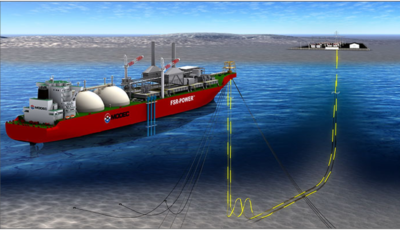 The bottom line is that if your mining project is near shore, and has both water supply and power issues, take a look at the FSRWP technology. One might say it is greener technology by using LNG (rather than coal, heavy fuel oil, or diesel) to generate power. At the same time it avoids competition with locals for access to fresh water.

 Each year business leaders are queried about what they view as their major risks. The survey results are summarized in the Global Risk Report.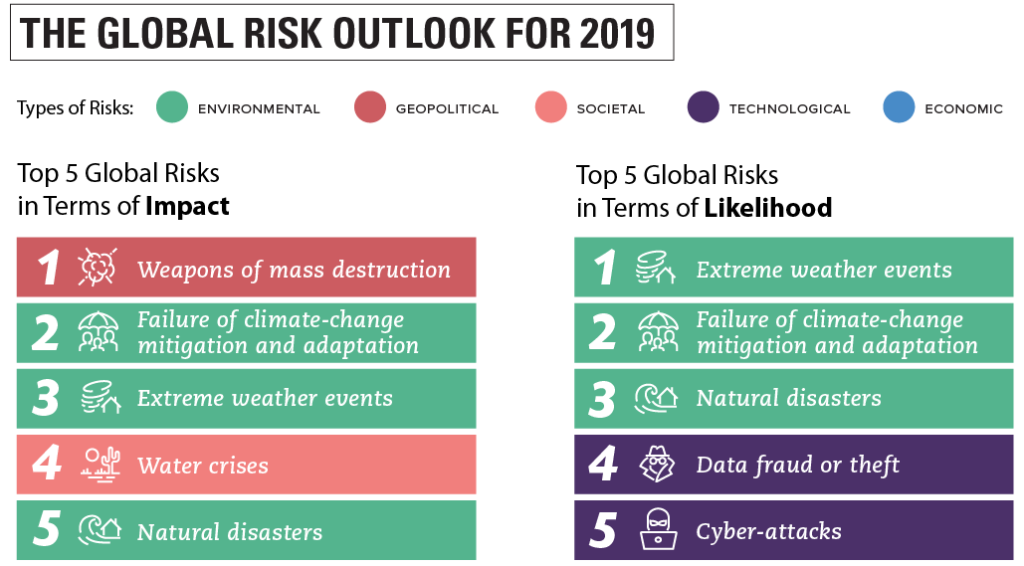
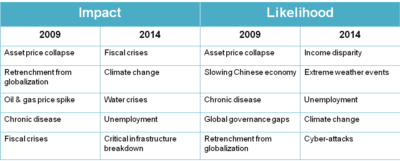 It is also interesting to look at the detailed 10 year table in the report to see how the risk perceptions have changed over the last decade.
 Mining companies are always on the hunt for new projects to grow their cashflows. They would all like to find the “perfect” project; one with ideal conditions and great attributes.
 Now take an honest look at some recent (or past) projects that you have been involved with. How many of the perfect attributes listed above would be represented? It would be surprising to see them all checked off. Unfortunately that means certain flaws (risks) must be accepted when developing a project.
 The bottom line is that management understandably have a difficult task in making go/no-go decisions. Financial institutions have similar dilemmas when deciding on whether or not to finance a project.
 You a create your own checklist but if you would like a copy of mine just email me at KJKLTD@rogers.com and let me know a bit about how you plan to use it (for my own curiosity). Specify if you would prefer the Excel or PDF versions.
 Mining due diligence exercises can be interesting and great learning experiences, even for senior people that have seen it all. However they can also be mentally taxing due to the volumes of information that one must find, review, and comprehend, all in a short period of time.


 His topic is interesting and relevant to today’s mining industry. Paul raised many thoughtful points supported by data. He gave me permission to share his information.
 I agree with many of the points raised by Paul in his study. The mining industry has some credibility issues based on recent performance and therefore understanding the causes and then repairing that credibility will be important for the future.


 The accepted tailings risk therefore becomes a subjective factor.
 Environmental groups continually discuss ways of forcing regulators and mining companies to take action against the risk of tailings failure. This is commendable.
 Recently we have seen a trend of higher cash costs at operating mines when commodity prices are high. Why is this?
 Do the opposite
 Different companies have different corporate objectives and each mining project will be unique with regards to the impacts of cutoff grade changes on the orebody.