How long does it take to turn a mineral discovery into a producing mine. Also how long does permitting really take? These are questions that I see asked frequently in mining circles. The answer often thrown around is “18 years.” Is that really true or is it just a much-repeated industry myth?
Answering these questions is one reason we created a new online App called Timeline Viewer, hosted on the Drilling Down website (https://sites.google.com/view/drillingdown).
What Is the Timeline Viewer
The Timeline Viewer is a online application where anyone can take a look at the milestone history of selected mining projects. Key milestones are laid out chronologically from initial exploration, through studies, permitting, and sometimes even up to production.
The Viewer puts it all in one place: a visual, browsable record of what happened and when. This information is derived from corporate press releases, and weblinks are provided.
This App was vibe coded using the Zite platform (https://www.zite.com/). Just explain to the AI what you want to create, and it then writes all the code for you. Very simple to use and fast.
Let’s look at some Viewer output. The example below is the standard timeline view for the Brucejack Project in BC. One can see the sequence of activities that occurred over time as the mine moved into production. A details table (not shown) provides a brief description of each event. Hover over a point to see the details.
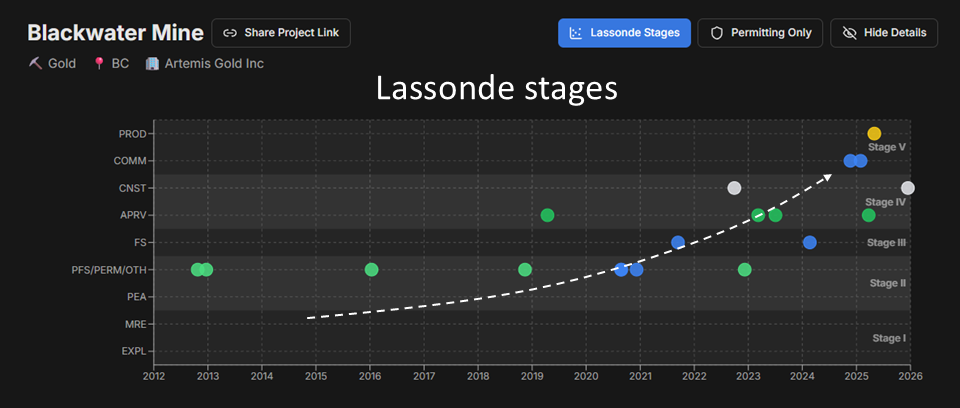
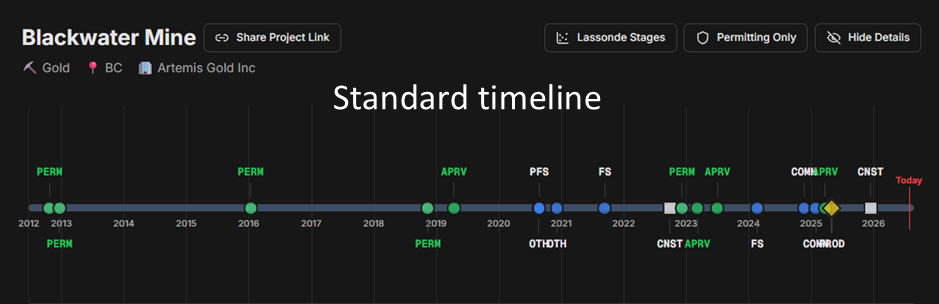 An alternate way to examine the same timeline is to view the development progress in stages. In the Viewer app, we loosely use the term the “Lassonde Stages”, related to the Lassonde Curve (for more info). The Timeline Viewer lets you toggle on a view of the stages over time. Is it advancing towards production or flat lining at the same Stage.
For example, the image below shows the same Brucejack project with the Stages on the right side and milestones on the left axis. One can see the rapid rise as the project accelerates from exploration & studies (Stage II) to construction, commissioning, and production (Stage V). For comparison, the next image after Brucejack is the chart for the KSM Project. Do you notice any difference in the profile of the Stages?
 The Viewer also allows one to see only the “permitting” events to focus on those. When was permitting initiated and when were approvals received? As an example, the timeline below is for the Generation Mining Marathon project, permitting activities only. They started the process in 2021 and received their federal final permit in 2025. The ball is in their court now.
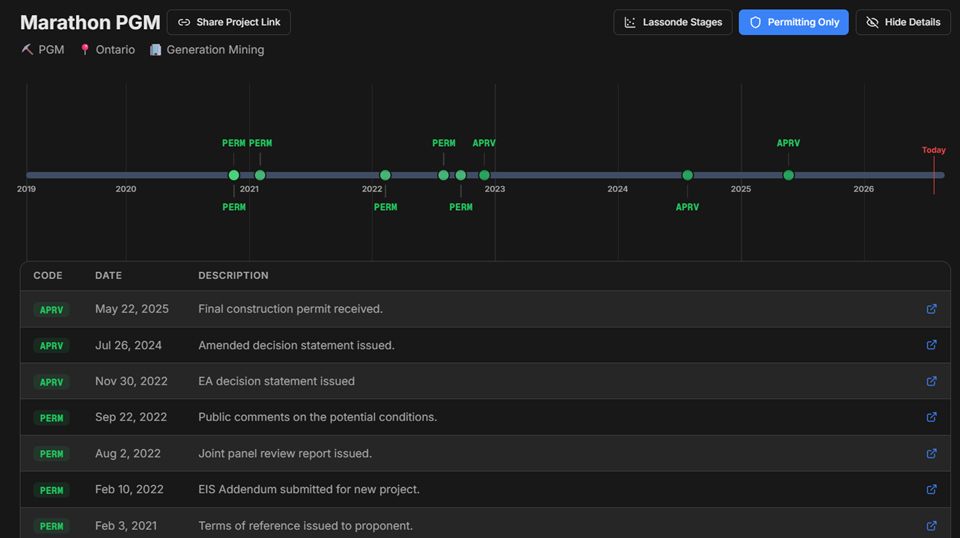
Getting Started: The List of Projects
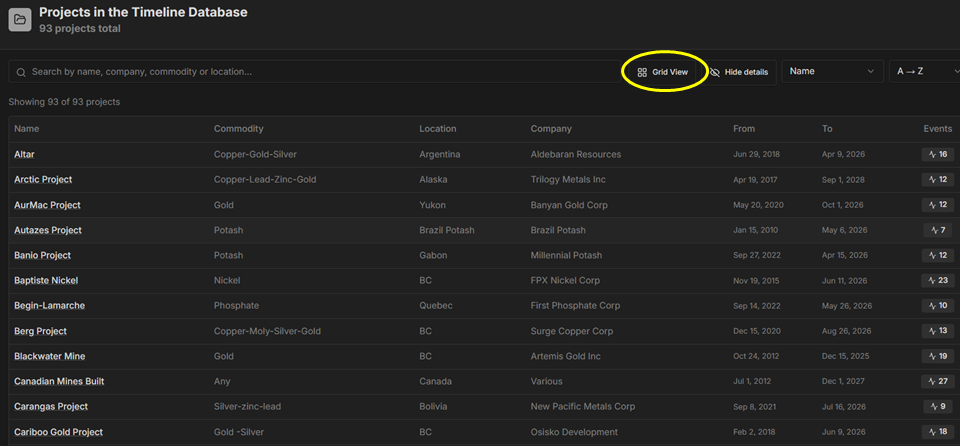
Before diving into an individual timelines, the obvious starting point is the List of Projects (https://jcrkyl7eju.zite.so/). This list gives you an overview of every project currently logged in the database (over 90 as of today).
You can browse the list in either Grid view or List view. Once you find a project of interest, clicking on it takes you to its timeline in the Viewer.
In the Viewer, (https://sites.google.com/view/drillingdown/timeline-viewer) you can trace the entire arc of a project’s development: when exploration drilling began, when a resource estimate was published, when studies (Preliminary Economic Assessment, Prefeasibility, Feasibility) were completed, when permits were approved, and when construction and commissioning eventually led to production. It’s a straightforward way to answer that “18 years” question for yourself, project by project.
Every milestone is categorized. The available categories cover the full lifecycle of a mining project: Exploration, Mineral Resource Estimate, Preliminary Economic Assessment, Prefeasibility Study, Feasibility Study, Permitting Activity, Permit Approval, Construction Start, Commissioning, Production, and a catch-all “Other” category for things like metallurgical testing, mergers, or partnerships that don’t fit neatly into the technical stages but are still significant to a project’s storyline.
All of the companies currently in the database (as of July 2026) are TSX listed. Many of their projects are in Canada, since government websites provide additional permitting timeline information as a backup. I noticed that some companies are much better at disclosing permitting steps than others. Its not often that I saw a company announce when public meetings were being held or when the public review period starts. I wonder why.
Why The Timeline Matters
For anyone following the mining sector, whether as an investor – analyst – geologist -engineer, the value of the Timeline Viewer is that it simplifies a series of press releases into a visual record.
You can look at different projects and start to notice patterns: which companies moved efficiently through permitting, which projects stalled for years at the exploration or pre-feasibility stage, and which ones sailed from discovery to production. Are there lifestyle companies out there in no hurry to get anywhere?
The Viewer is a tool for answering the “how long does it really take” question with actual information.
The Companion Piece: The Timeline Editor
The Timeline Viewer database is fed by a companion tool called the Timeline Editor, which is what allows the database to keep growing and stay current. The Editor is where the content gets compiled and maintained
If you’ve been following a specific project that isn’t in the database yet, you can add it yourself. Just send a message to KJKLTD@gmail.com to get access to the Editor. There is even a blank template available in Excel CSV format, so you can organize the project milestones on your own time and then upload them in the Editor.
One important thing to understand about this system is that it’s intended to be open source. Anyone who is given Editor access can modify a project’s timeline, which means there’s no absolute guarantee of accuracy on every entry. The information should be treated as crowdsourced rather than officially verified. Do not make investment decisions based on what you see here – this is for entertainment purposes only.
If you encounter a bug, issue or inaccuracy, please flag it by email (KJKLTD@gmail.com). We’re open to hearing comments, since nobody expects AI-written code to be 100% perfect.
Conclusion
 The Timeline Viewer is a simple tool for seeing how mining projects actually move (or don’t move) from discovery through to production. Over time as more projects get logged, the database becomes a richer resource for answering that original question honestly: does it really take 18 years to build a mine or how long does it take to permit? With enough timelines in the database, you can decide for yourself.
Note: You can sign up for the KJK mailing list to get notified when new blogs are posted. Follow me on Twitter at @KJKLtd for updates and other mining posts. The entire blog post library can be found at https://kuchling.com/library/
For some free mining calculator apps, including project timelines and a simplified cashflow modeller, check out this website https://sites.google.com/view/drillingdown
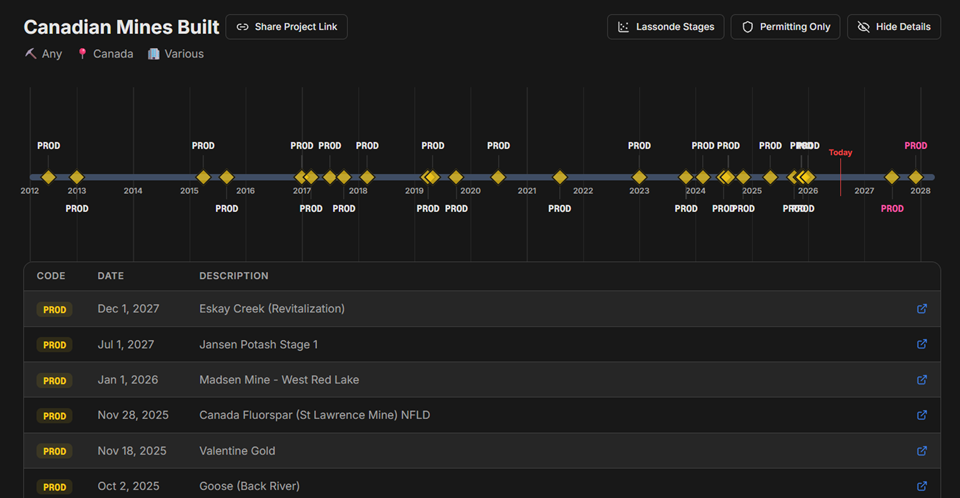
In closing, here is a summary timeline of all the mines coming into production in Canada over the last decade (from what I could find). The link to the timeline is https://neeovjtd7t.zite.so/project/3cd8bd8a-148f-4bc9-9bc3-fa56617f12d8


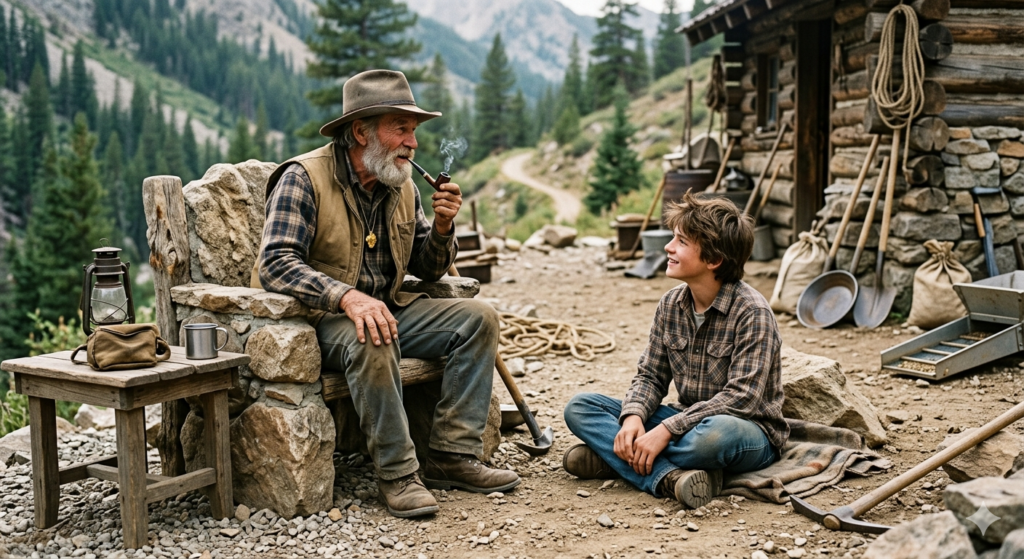 Junior mining companies and Tech Startups share numerous similarities, although they operate in very different worlds. The following comments should recognize that junior mining ecosystem has been around for generations, long before the birth of tech ecosystems.
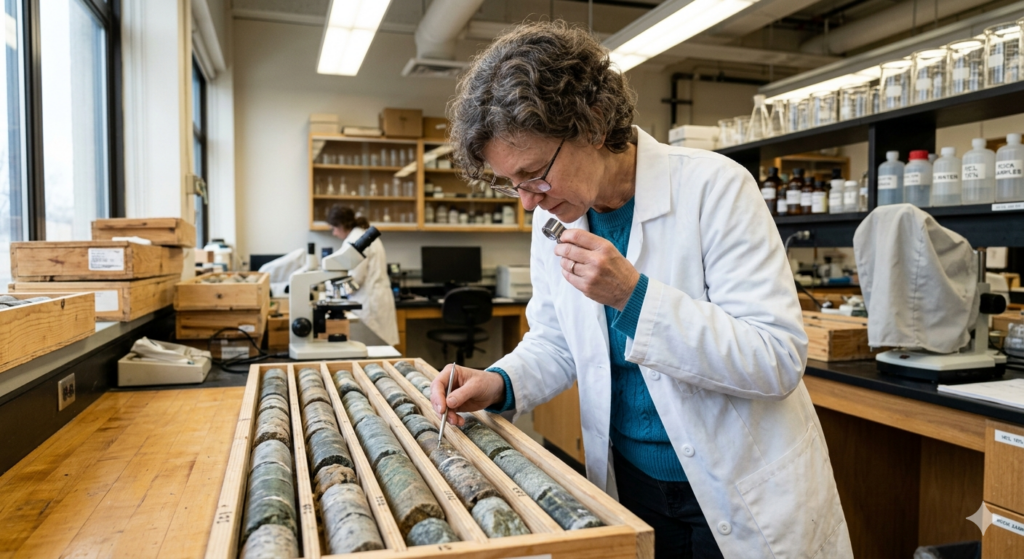 Exploration spending shares some of the same characteristics of more commonly R&D.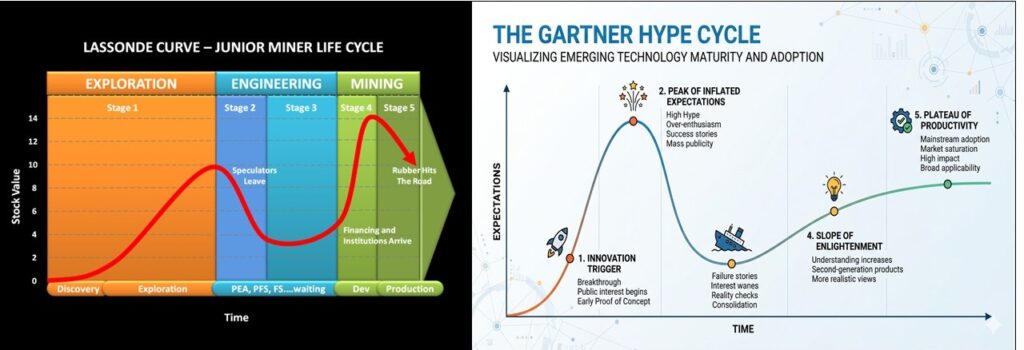
 Another similarity between junior mining and tech world is in the way early-stage viability is assessed. This is required to decide whether millions of dollars of further investment is warranted. Miners will complete a PEA. Startups will complete Product-Market Fit research.
 I recently noticed a few new mining studies that relied on toll milling as their base case operation. This made me wonder if this is a trend and if there are more examples of where this is happening.
 USER PROMPT: What are the risks of toll milling plan.
 RESPONSE: The Qualified Person (QP) signing off on a technical study that uses toll milling as the base case carries significant professional and regulatory responsibility, particularly under NI 43-101 in Canada or JORC in Australia.
 The results given by Claude are quite thorough and insightful. It’s hard to argue with its observations and conclusions. This research took all of 30 seconds, so I can see it is no longer difficult to become a blog writer. Writing isn’t the challenge; finding interesting topics is.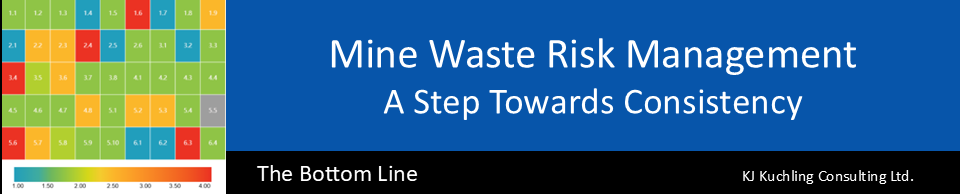
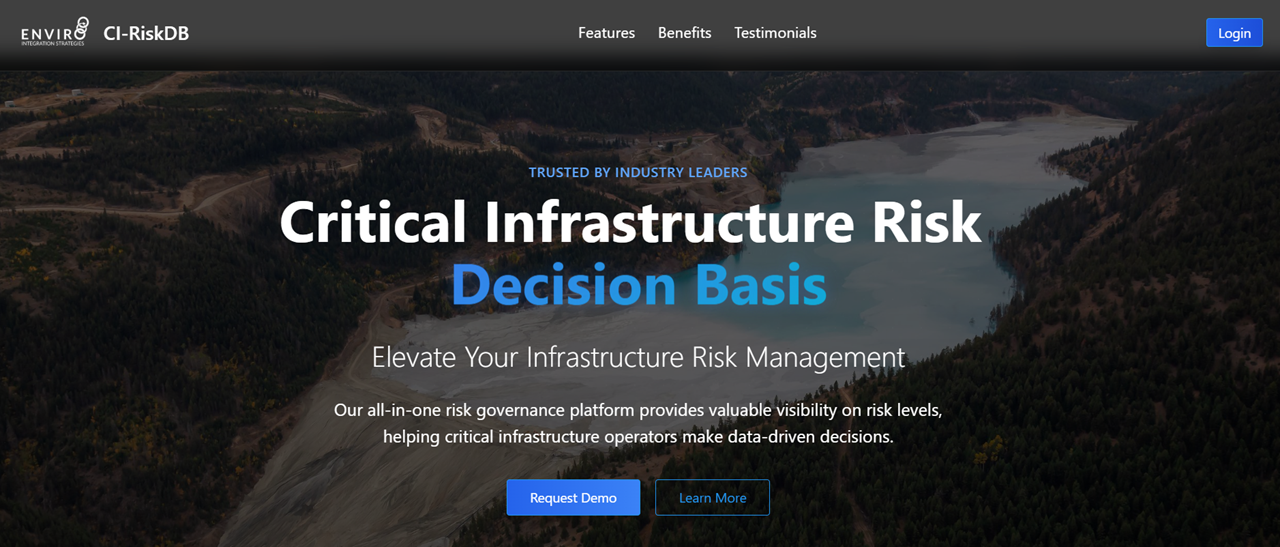
 In my view, having a single industry platform for critical infrastructure risk management provides several benefits. These are:
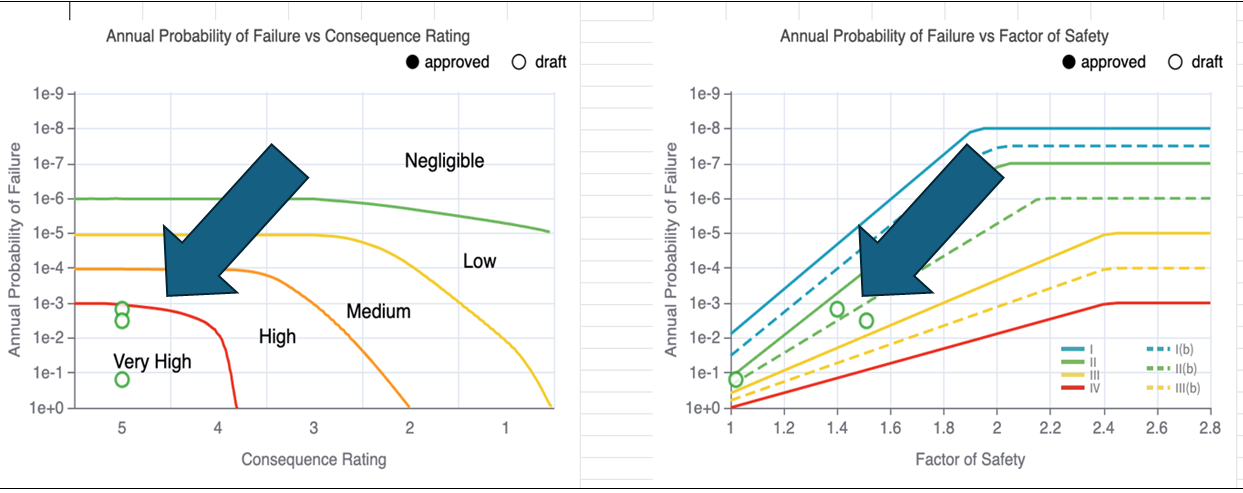 Each mine site is unique with its own set of “Facilities”. For example, the individual Facilities could include Tailing Management Area #1, TMA #2, the Heap Leach Pad, Waste Dump #1, Waste Dump #2, etc.
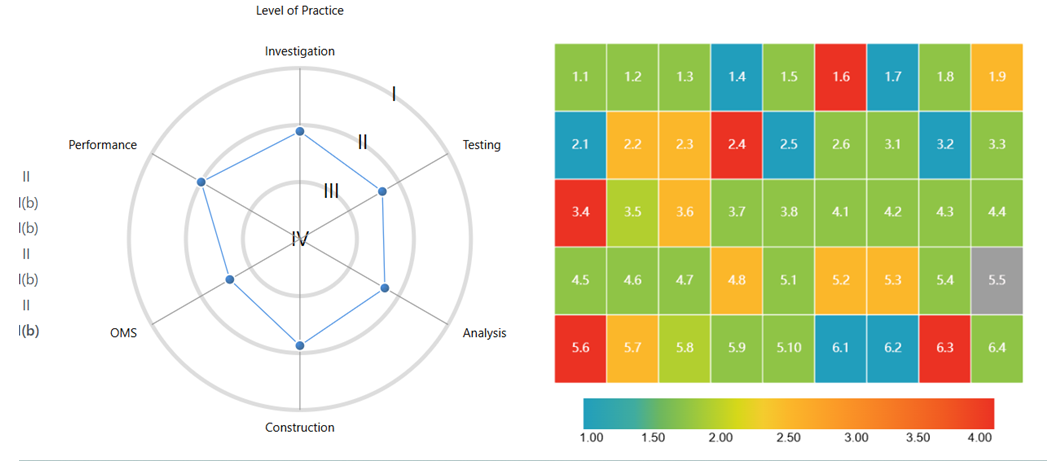
 The Level of Practice (LOP) is a measure of the integrity and quality of data used to design and manage a mine facility. The CI-RiskDB platform currently uses 45 criteria to evaluate the LOP associated with a facility. For example, these quality criteria include items such as: current understanding of soil profile; testing & verification between lab and field investigations; stability analysis detail; construction QA/QC undertaken, monitoring programs, etc.
 Over confidence of personnel is something that can unfortunately play a role in risk management. However, the more eyes involved with reviews and signoffs, as well as occasional third party audits, the less likely that this occurs (hopefully).
 In closing, as of this month December 2025, I understand the Critical Infrastructure Risk Decision Basis platform is currently being piloted and implemented at a number of mine sites in Canada, including Agnico Eagle at a corporate level. Additional pilots may be forthcoming in 2026.
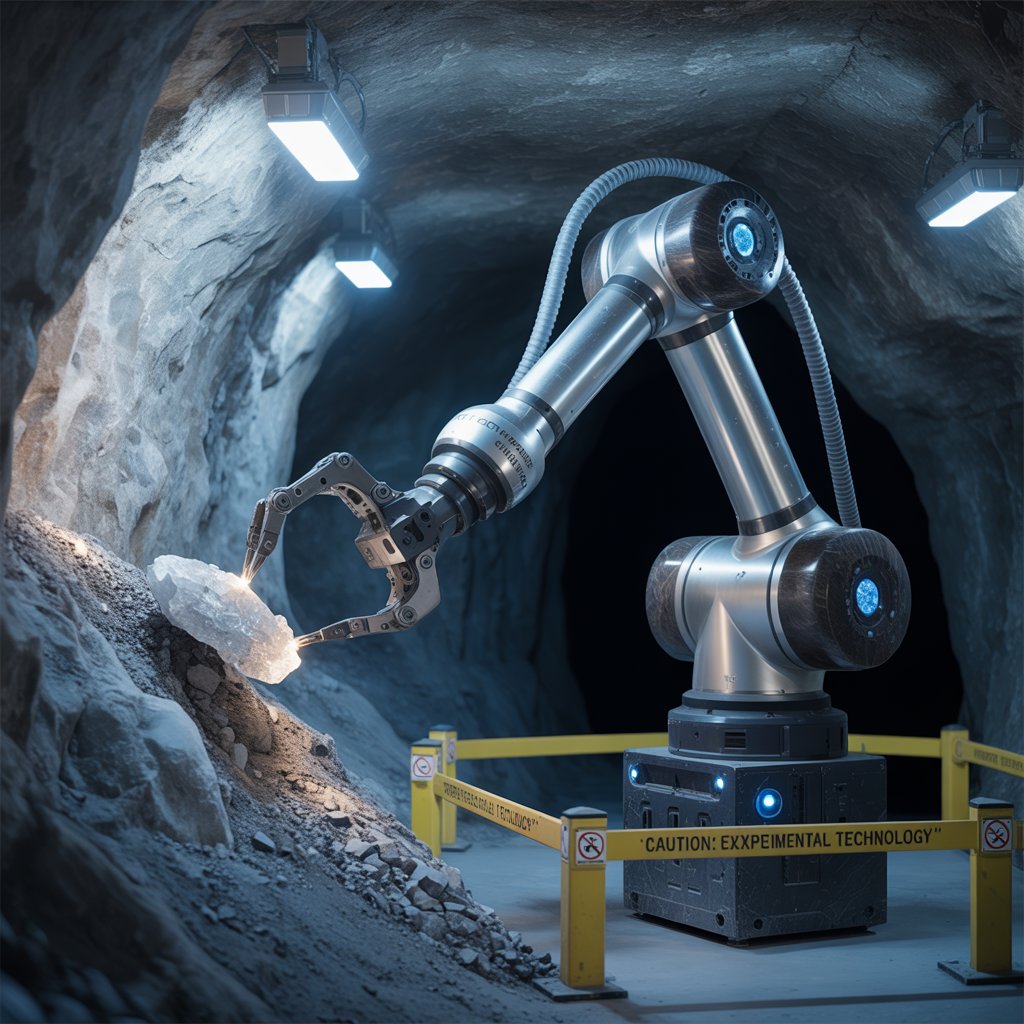 The mining industry is implementing more and more technology in the mining cycle.
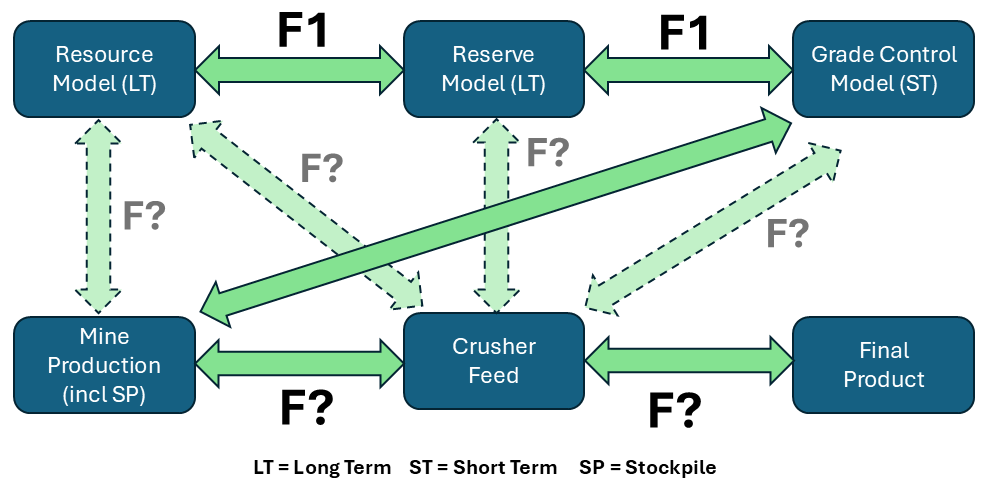 Mine reconciliation requires information such as initial predictions from exploration data and geological models, actual measurement: data from mining sources, such as blast holes, stockpile samples, or mill feed. As well it will need data on the final product being shipped off site. Do the metal quantities balance out throughout the mining operation?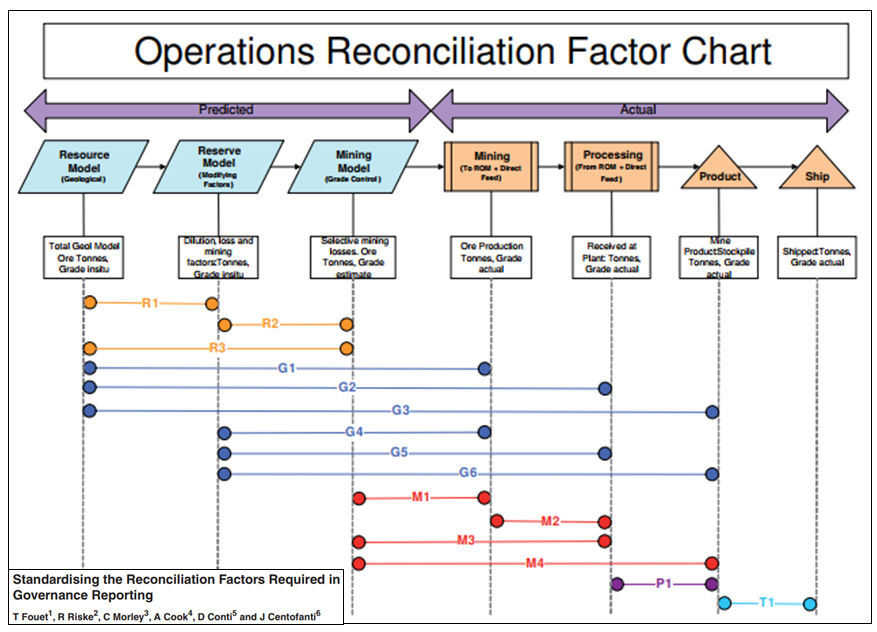
 Each mine site may be unique with respect to; ore sources; terminology; ore types; mining methods; stockpiling philosophy; processing methods; technology availability; and personnel capability. So often the easiest approach for mine reconciliation is based on the Excel spreadsheet. (Reconciliation is generally not an easy undertaking).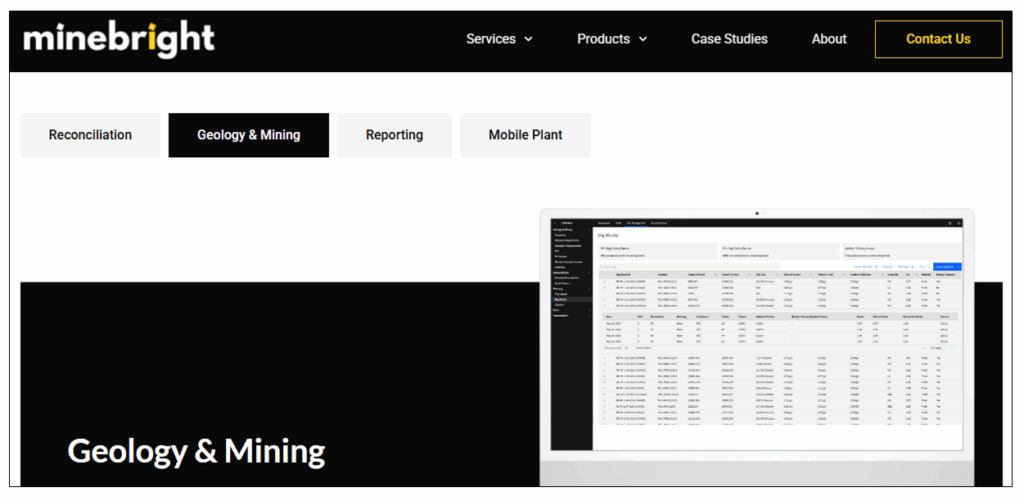

 Podcasts. There are thousands of them out there, free for anyone to access. This blog post is about the top mining podcasts that I find entertaining and educational. There are probably some missing from this list that I have not heard about. One only has so much free time in a day.
 Pick and choose wisely. One can’t listen to all the episodes available or else you wouldn’t have time to do anything else in life. You would also likely be bored because many can be similar and repetitive.
 Fresh Thinking by Optiro-Snowden
  There is no shortage of material in the podcast world about the mining industry. It all depends on what grabs your attention.
 NPV One is targeting to replace the typical Excel based cashflow model with an online cloud model. It reminds me of personal income tax software, where one simply inputs the income and expense information, and then the software takes over doing all the calculations and outputting the result.
 Pros
Pros Like anything, nothing is perfect and NPV may have a few issues for me.
 The NPV One software is an option for those wishing to standardize or simplify their financial modelling.
 This game is part of a coal-mining game trilogy created by Thomas Spitzer in Germany. The players take the role of farmers with opportunities to exploit the presence of coal in the Ruhr region of Germany. During the game, players acquire knowledge about coal, extend their farms, and dig deeper in the ground to extract more coal.
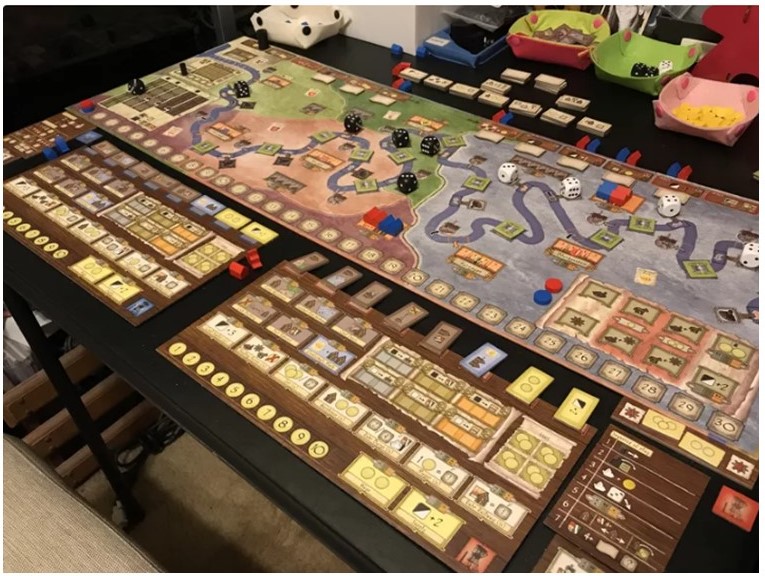 In the second game of Spitzer’s trilogy, you are still in the Ruhr region in the 18th century, at the beginning of the industrial revolution. The Ruhr river presented a transportation route from the coal mines. However, the Ruhr was filled with obstacles and large dams, making it incredibly difficult to navigate.
 This game may still be in German text only. Players are the administrator of a coal mine, and experience competition while living through a piece of Ruhr Valley history.
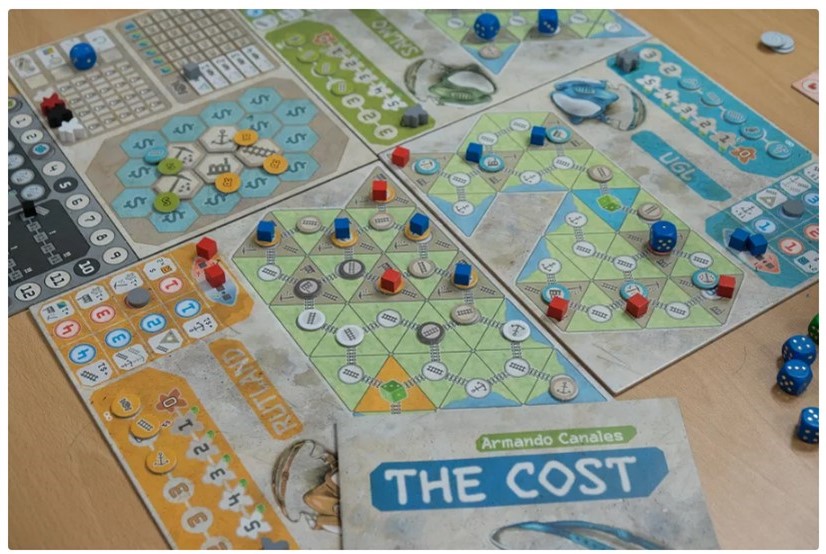 This game takes on a more negative view of the mining industry. It is described as “A bold take on the economics in the brutal industry that is asbestos.” The game players assume the role of a global asbestos company.
 In 1983 my brother, at the age of 10, got his Commodore 64 computer and was eagerly learning to program in BASIC. He was always looking for ideas on what he could write programs about. I had graduated from McGill in Mining Engineering a few years earlier, so I suggested he write a simple computer game about mining as his project.
 Over the last few months I decided to learn VBA (Visual Basic for Applications). VBA is a programming language the works with Microsoft Office products, mainly Excel.

 Mining has been a part of my life for as long as I can remember. Being born in Sudbury, many of my family members have been, or are currently involved, in mining through a variety of occupations, including my father who I idolized. However, I never knew my true interest in the industry until my 11th-grade technology class. I had a teacher who was passionate about the mining industry, and he created a project that involved developing a very basic mine design.
 Before my first year of university, I had a summer job tramming at Macassa Mine in Kirkland Lake Ontario, which has been in production since 1933. My mentality was to get the boots on the ground and get the job done, whatever it took (with proper safety precautions of course). Using rail systems, dumping ore cars manually, jackleg drilling, etc. gave me the perspective that mining was archaic, mining was rough, and mining was only about the ounces.
 To change the negative view around mining, I believe the main focal point should be electric equipment and the ability for remote operation/work. With all this newly developed technology at our fingertips, I know that future operations will be safer and more sustainable, which should be better portrayed.
 Even creating a mining simulation video game where you can run through a story of being a manager, excavator/scoop operator, truck driver, etc. would get the thought of mining brought into the coming generations at a younger age. This would increase the talent pool from the more typical operator because more and more youth are getting skilled at remote operation through video games due to their increased screen time.
 People get comfortable and people are afraid to leave home, so selling a career that allows for boundless flexibility in job tasks and constant stimulation while living wherever you desire could allow a shrinkage in the current technical gap.
 So do I think the mining industry is archaic…. not anymore.
 Firstly, I would like to thank this engineer for taking time to write out his well formed thoughts, and for allowing me to share them.